

PHYSICS - REFLECTION AND REFRACTION

Reflection Worksheet

  • 10 questions
  • Define and use the terms normal, angle of incidence and angle of reflection
  • Difficulty: Medium
  • Board: CAIE
  • Attempt online on the examination portal
Start the 10-question quiz Free, no sign-up needed. Your score shows instantly.

Here are the first 3 questions. Click “View all questions” to see the complete assessment.

Q1.

A plane mirror is tilted so that its reflecting surface is not horizontal. Which description correctly identifies the normal at the point where a light ray strikes the mirror?

  1. A) A line along the reflecting surface through the point where the ray strikes.
  2. B) A line perpendicular to the reflecting surface at the point where the ray strikes.
  3. C) A line parallel to the incoming light ray through the point where the ray strikes.
  4. D) A line that is vertical, regardless of the mirror's position.

Q2.

A student says, “The angle of incidence is the angle between the incoming light ray and the mirror surface.” Which change makes this statement correct?

  1. A) Replace “angle of incidence” with “angle of reflection”.
  2. B) Replace “mirror surface” with “normal at the point where the ray strikes”.
  3. C) Replace “mirror surface” with “reflected light ray”.
  4. D) Replace “incoming light ray” with “reflected light ray”.

Q3.

After striking a plane mirror, a light ray travels away from the mirror. Which angle is the angle of reflection?

  1. A) The angle between the incoming ray and the outgoing ray.
  2. B) The angle between the incoming ray and the normal.
  3. C) The angle between the outgoing ray and the normal on the side from which the light arrived.
  4. D) The angle between the outgoing ray and the mirror surface.

Q4.

A student has traced an incident ray and a normal on paper. To read the angle of incidence directly with a protractor, how should the student position it?

  1. A) Place its centre at the point of incidence, align its zero line with the normal, and read the incident ray.
  2. B) Place its centre anywhere on the normal, align its zero line with the normal, and read the incident ray.
  3. C) Place its centre at the point of incidence, align its zero line with the incident ray, and read the reflected ray.
  4. D) Place its centre at the point of incidence, align its zero line with the mirror surface, and read the incident ray.

Q5.

A ray strikes a plane mirror at point P. A student draws a line perpendicular to the mirror at a different point, Q, and calls it the normal for this ray. Why is the student's label incorrect?

  1. A) The normal must pass through the point where this ray strikes the mirror.
  2. B) The normal must be drawn on the opposite side of the mirror from the incident ray.
  3. C) The normal must point in the direction of the incident ray.
  4. D) The normal must lie along the mirror surface.

Q6.

In a ray diagram, the angle of incidence and the angle of reflection are both labelled 40^(\)circ. A student says they are therefore two names for the same angle. Which explanation is correct?

  1. A) They are the same angle because both are measured from the mirror surface.
  2. B) They are different angles: one lies between the incident ray and the normal, and the other lies between the reflected ray and the normal.
  3. C) They are the same angle because each lies between the incident ray and the reflected ray.
  4. D) They are different angles because the angle of incidence is measured from the surface, but the angle of reflection is measured from the normal.

Q7.

A light ray approaches a plane mirror along the normal. Which statement correctly describes its angle of incidence?

  1. A) It cannot be defined because the ray lies along the normal.
  2. B) It is 0^(\)circ because there is no angular separation between the incident ray and the normal.
  3. C) It is 90^(\)circ because the ray is perpendicular to the mirror.
  4. D) It is 45^(\)circ because the normal divides a right angle equally.

Q8.

The diagram shows a light ray striking a plane mirror at O. Which labelled line is the normal used to define the angles of incidence and reflection?
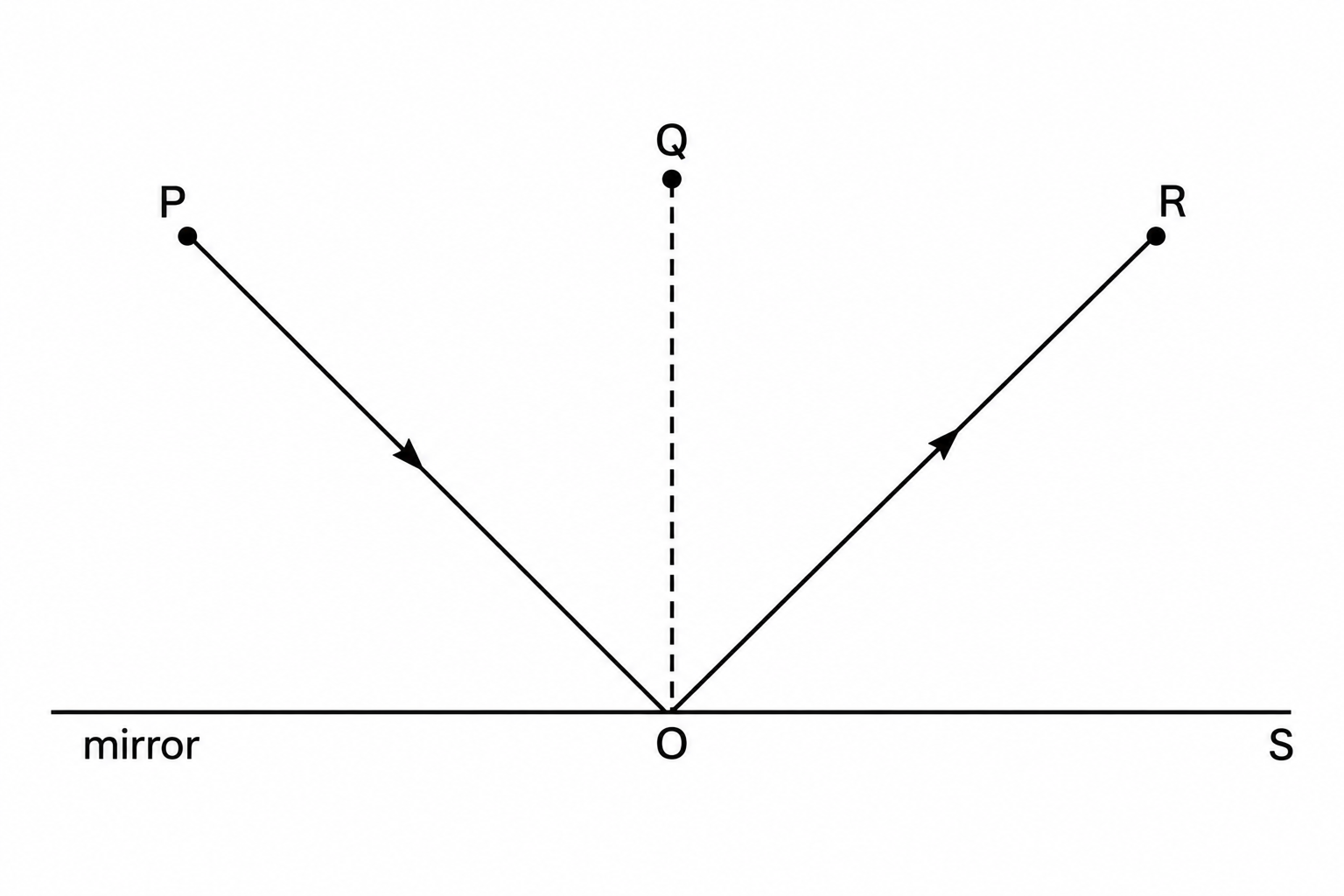
Diagram for question 8: The diagram shows a light ray striking a plane mirror at O. Which labelled line is the normal used to define…
  1. A) OQ
  2. B) OS
  3. C) OR
  4. D) OP

Q9.

Four angles are labelled in the diagram. Which labelled angle is the angle of reflection?
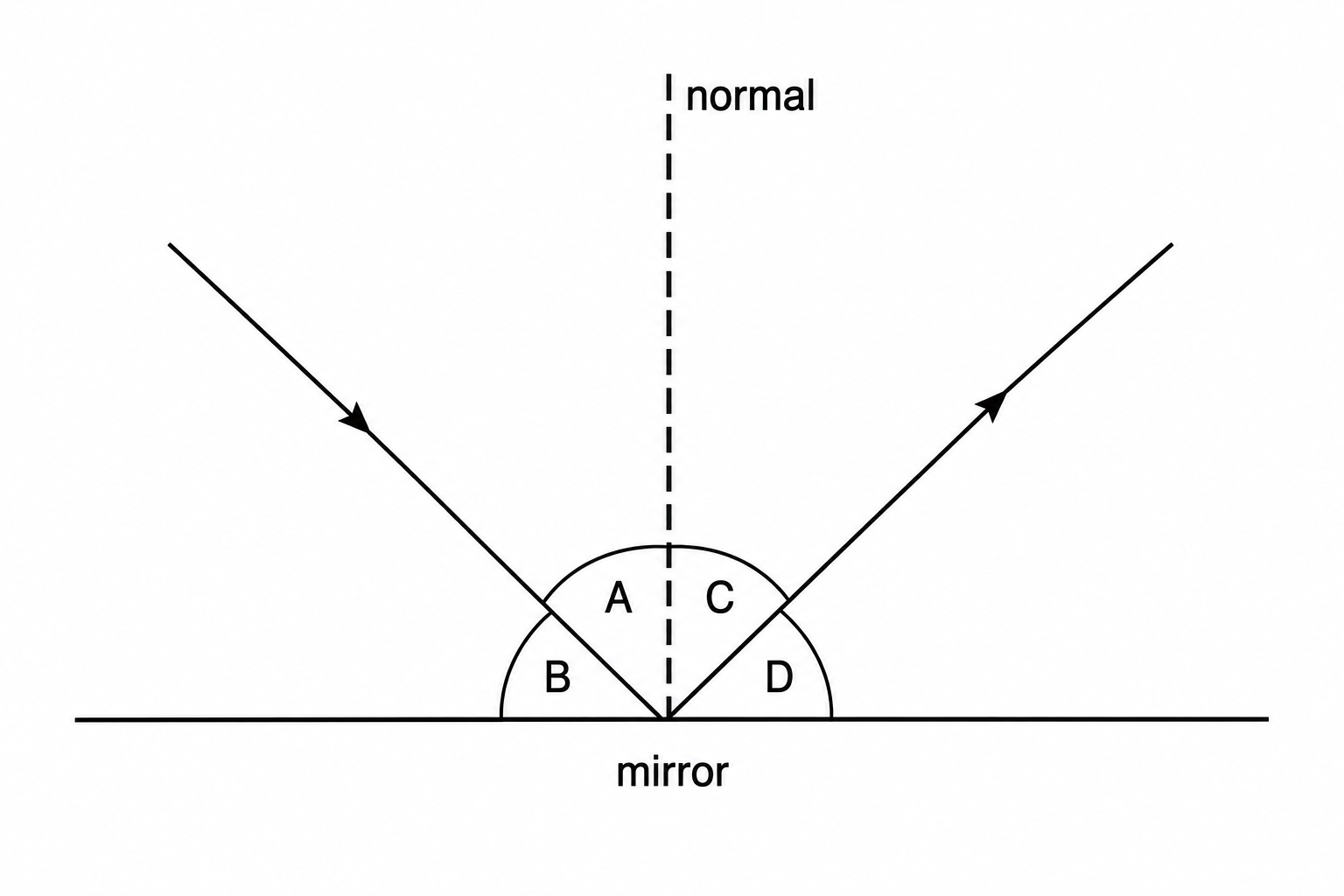
Diagram for question 9: Four angles are labelled in the diagram. Which labelled angle is the angle of reflection?
  1. A) A
  2. B) C
  3. C) D
  4. D) B

Q10.

The diagram shows two measured angles for a light ray reflecting from a plane mirror. Which pair gives the angle of incidence and the angle of reflection, in that order?
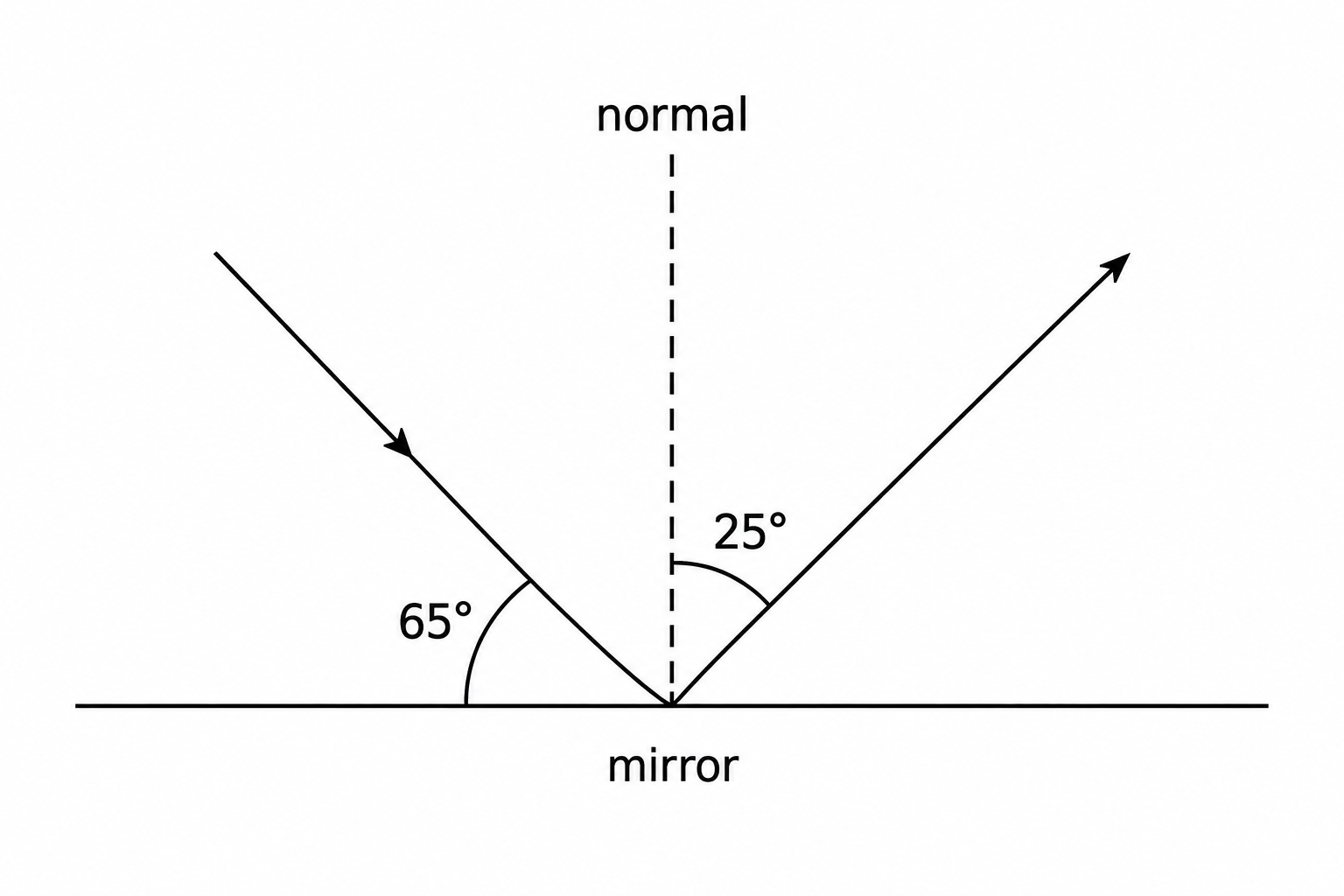
Diagram for question 10: The diagram shows two measured angles for a light ray reflecting from a plane mirror. Which pair gives the…
  1. A) 25^(\)circ and 25^(\)circ
  2. B) 65^(\)circ and 65^(\)circ
  3. C) 25^(\)circ and 65^(\)circ
  4. D) 65^(\)circ and 25^(\)circ

What this assessment covers

Concepts Tested

  • Reflection and Refraction
  • Define and use the terms normal, angle of incidence and angle of reflection

Question Mix

  • Medium questions included

Skills you build

  • Understand