

PHYSICS - FORCES

Friction Worksheet

  • 10 questions
  • Describe solid friction as the force between two surfaces that may impede motion and produce heating
  • Difficulty: Hard
  • Board: CAIE
  • Attempt online on the examination portal
Start the 10-question quiz Free, no sign-up needed. Your score shows instantly.

Here are the first 3 questions. Click “View all questions” to see the complete assessment.

Q1.

A worker pulls a wooden crate across a stationary floor at constant speed. The bottom of the crate and the part of the floor it passes over become warmer. Which explanation accounts for both the steady motion and the warming?

  1. A) Friction acts forwards to maintain the motion, and heating occurs only inside the crate.
  2. B) There is no friction because the speed is constant; the warming is caused by the crate pressing on the floor.
  3. C) Friction opposes the sliding and is balanced by the pull; rubbing transfers energy to the crate and floor by heating.
  4. D) Friction opposes the sliding but is smaller than the pull; the remaining force produces the warming.

Q2.

A drawer initially remains stationary when it is pulled gently. A stronger pull makes it slide, and repeated opening and closing warms its wooden runners. Which statement correctly describes friction in these observations?

  1. A) Friction begins only when the drawer slides, so a different force must resist the gentle pull.
  2. B) Friction can prevent the drawer from starting to move, and rubbing against the runners can produce heating once it slides.
  3. C) Friction produces heating while the drawer is stationary, but sliding prevents further heating.
  4. D) Friction resists the gentle pull, but it stops acting once the drawer starts sliding.

Q3.

A box rests on a horizontal conveyor belt. The belt gradually speeds up towards the right, and the box speeds up with it without slipping. There is no other horizontal contact with the box. Which statement correctly applies the idea of solid friction?

  1. A) Friction acts towards the right to prevent slipping, and heating from surfaces sliding against each other is not required.
  2. B) Friction acts towards the left because the box is moving towards the right, and the contact must become warmer.
  3. C) Friction acts towards the right, but it can do so only if the box continuously slides over the belt.
  4. D) There is no friction because the box does not slip, so the belt cannot exert a horizontal force on it.

Q4.

A rope is pulled towards the right through a fixed clamp whose jaws press against it. After a long length has passed through, the jaws and rope near the clamp are warmer. Which statement identifies the action of solid friction?

  1. A) Friction on the rope acts towards the left, and the stationary jaws can also be heated by the rubbing.
  2. B) Friction on the rope acts towards the left, but the jaws cannot be heated because they do not move.
  3. C) Friction acts only between the two jaws, and the rope warms because it moves through air.
  4. D) Friction on the rope acts towards the right, and only the moving rope can be heated.

Q5.

A plate is initially at rest on a tablecloth. The cloth is pulled quickly towards the right and slides beneath the plate. During the short interval when the cloth is moving right faster than the plate, which statement is correct?

  1. A) Friction on the plate is zero until it reaches the speed of the cloth; heating begins only after their speeds become equal.
  2. B) Friction on the plate acts left because friction must oppose any motion of the plate; rubbing can produce heating.
  3. C) Friction on the plate acts right because it opposes slipping between the surfaces; rubbing can also produce heating.
  4. D) Friction on the plate acts right, but heating is impossible unless the plate and cloth move in opposite directions.

Q6.

A student rubs a sanding block repeatedly backwards and forwards over a fixed piece of wood. The block returns to its starting position after each complete stroke. Which prediction correctly describes friction and heating?

  1. A) Friction on the block keeps the same direction throughout, so only one part of each stroke produces heating.
  2. B) Friction on the block reverses direction when its sliding direction reverses, but both parts of the stroke can produce heating.
  3. C) Friction produces no heating over a complete stroke because the block returns to its starting position.
  4. D) Friction on the block reverses direction, so heating on one part of the stroke is cancelled by cooling on the return.

Q7.

A sledge slides downhill over hard, dry snow at a steady speed. Air resistance is negligible. A student claims that friction cannot be acting because the sledge does not slow down. Which response is correct?

  1. A) The student is correct: solid friction acts only while an object is slowing down.
  2. B) The student is incorrect: friction acts downhill and maintains the motion while heating the snow.
  3. C) The student is correct: any heating must be caused by gravity rubbing against the sledge.
  4. D) The student is incorrect: friction acts uphill and can produce heating even when the speed remains steady.

Q8.

Two identical pairs of wooden blocks begin at the same temperature. In one trial, a student presses a pair together without rubbing. In the other, the student presses equally hard and repeatedly slides one block over the other for the same time. Only the rubbed contact surfaces show a noticeable temperature rise. Which explanation best accounts for this difference?

  1. A) Pressing and rubbing must produce equal heating, so the temperature difference cannot be related to friction.
  2. B) Pressing removes friction from the stationary pair, whereas motion creates a new force unrelated to contact.
  3. C) In the rubbed pair, friction acts in the direction of sliding and changes the blocks' motion into a permanent forward force.
  4. D) In the rubbed pair, solid friction resists the sliding and transfers energy by heating; pressing alone does not provide the same rubbing process.

Q9.

The diagram shows a wheel rotating clockwise while a fixed brake pad presses against its top edge. The wheel continues rotating as the pad rubs against it. Which statement correctly describes the friction forces at the contact and the possible heating?
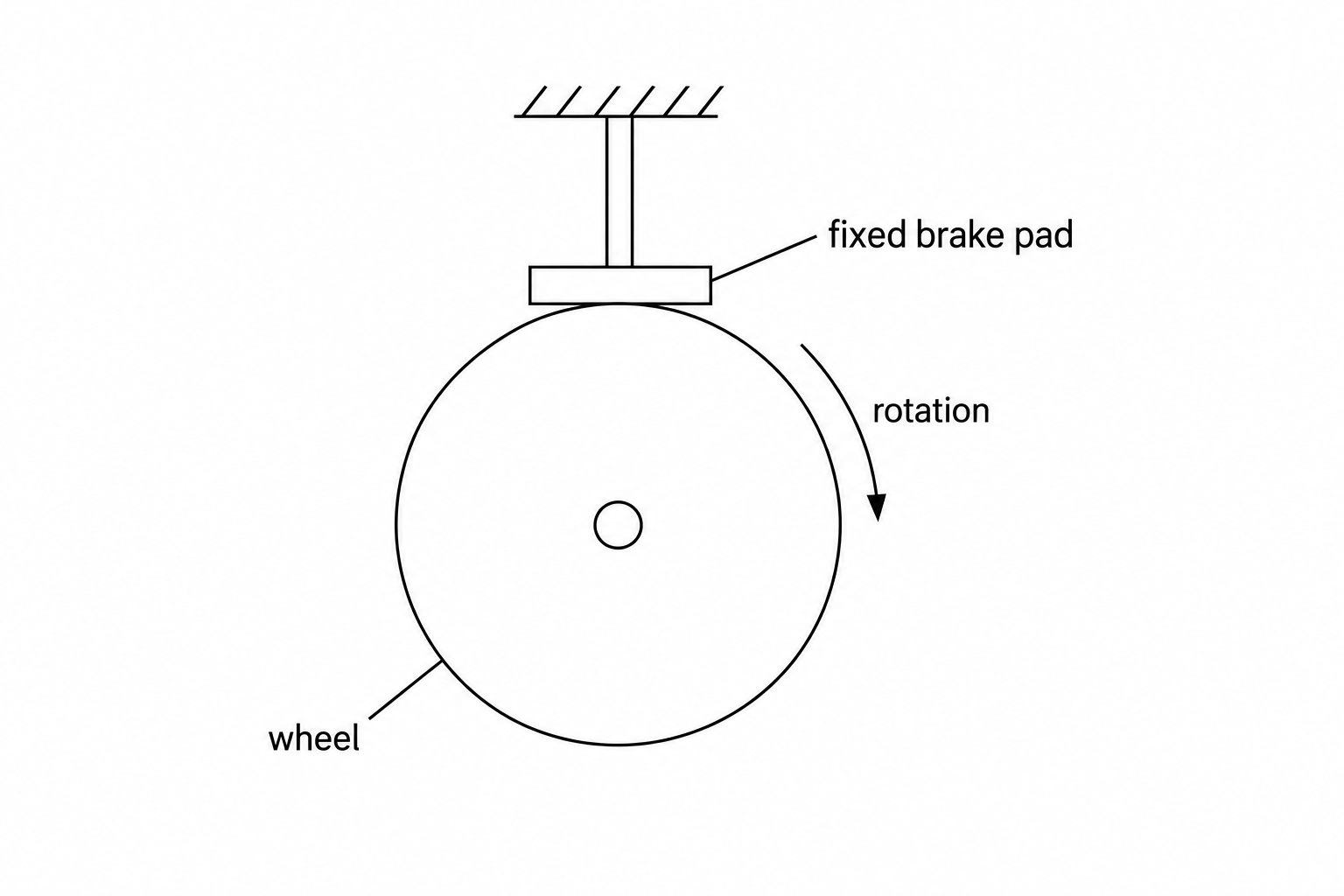
Diagram for question 9: The diagram shows a wheel rotating clockwise while a fixed brake pad presses against its top edge. The wheel…
  1. A) Friction acts left on the wheel and right on the pad; both contact surfaces can become warmer.
  2. B) Friction acts left on both the wheel and the pad; only the rotating wheel can become warmer.
  3. C) Friction acts left on the wheel and right on the pad; the fixed pad cannot become warmer.
  4. D) Friction acts right on the wheel and left on the pad; both contact surfaces can become warmer.

Q10.

The two solid strips shown are pressed together and driven towards the right at the speeds indicated. They slide against each other. Which statement correctly describes friction at their shared contact surface?
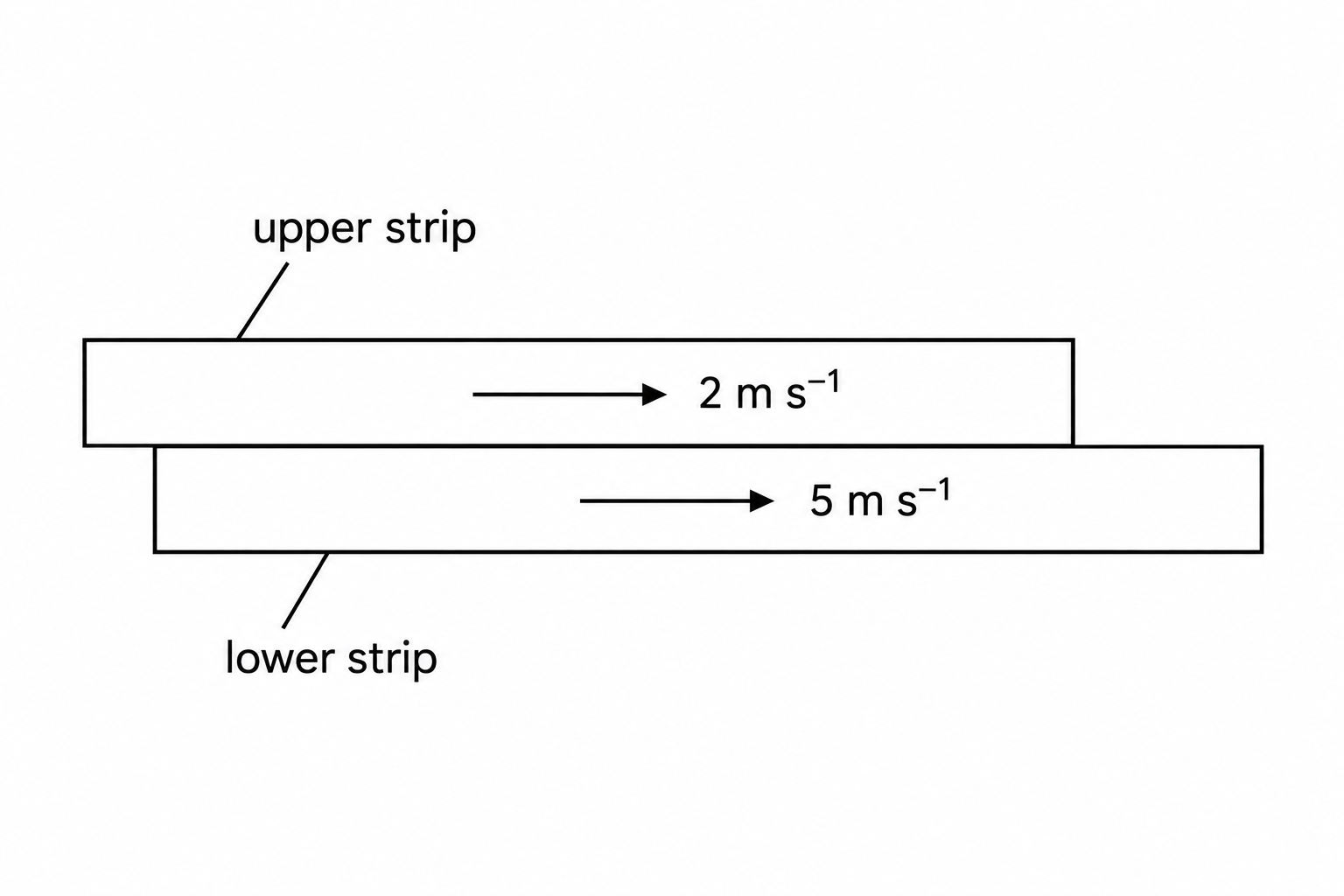
Diagram for question 10: The two solid strips shown are pressed together and driven towards the right at the speeds indicated. They…
  1. A) Friction acts right on the upper strip and left on the lower strip, but moving in the same direction prevents frictional heating.
  2. B) Friction acts left on both strips because both move right, and the sliding can heat both strips.
  3. C) Friction acts left on the upper strip and right on the lower strip, and only the faster strip can be heated.
  4. D) Friction acts right on the upper strip and left on the lower strip, and the sliding can heat both strips.

What this assessment covers

Concepts Tested

  • Forces
  • Describe solid friction as the force between two surfaces that may impede motion and produce heating

Question Mix

  • Hard questions included

Skills you build

  • Apply