

PHYSICS - RADIOACTIVE DECAY
Half Life Calculations Worksheet
- 10 questions
- Define the half-life of a particular isotope as the time taken for half the nuclei of that isotope in any sample to decay; recall and use this definition in simple calculations, which might involve information in tables or decay curves (calculations will not include background radiation)
- Difficulty: Hard
- Board: CAIE
- Attempt online on the examination portal
Start the 10-question quiz
Free, no sign-up needed. Your score shows instantly.
Here are the first 3 questions. Click “View all questions” to see the complete assessment.
Q1.
Q2.
The activity of a radioactive sample falls from 960 Bq to 120 Bq in 15 h. Activity is proportional to the number of undecayed nuclei. Starting from the initial measurement, the activity is checked at the end of every half-life. At which check time is the activity first below 40 Bq?
Q3.
A mixture initially contains 96 mg of material, including 32 mg of a stable substance. The rest is a radioactive isotope. After 12 h, the combined mass of the stable substance and the undecayed isotope is 40 mg. Decay products are not included in this combined mass. At what time after preparation will this combined mass first be 36 mg?
Q4.
Two radioactive samples initially have activities of 800 Bq and 100 Bq. Their half-lives are 3 h and 6 h, respectively. For each sample, activity is proportional to its number of undecayed nuclei. After what time will the two activities be equal?
Q5.
A sample initially contains 96 mg of a radioactive isotope with a half-life of 4 h. After 4 h, a technician removes one-third of the undecayed isotope and discards it. How much undecayed isotope remains in the retained sample 12 h after the original start?
Q6.
In a radioactive sample, 2400 nuclei decay during the first 6 h, and 600 nuclei decay during the next 6 h. Treat these numbers as following the half-life model exactly. How many undecayed nuclei remain 18 h after the start?
Q7.
A container initially holds 6400 nuclei of a radioactive isotope with a half-life of 2 h. At 4 h after the start, another 3200 undecayed nuclei of the same isotope are added. What is the total number of undecayed nuclei in the container at 8 h after the start?
Q8.
A reference sample containing 2.0 mg of a particular radioactive isotope has an activity of 480 Bq. A different sample initially contained 10 mg of the same isotope and now has an activity of 300 Bq. Activity is proportional to the mass of undecayed isotope. If the half-life is 6.0 h, how old is the different sample?
Q9.
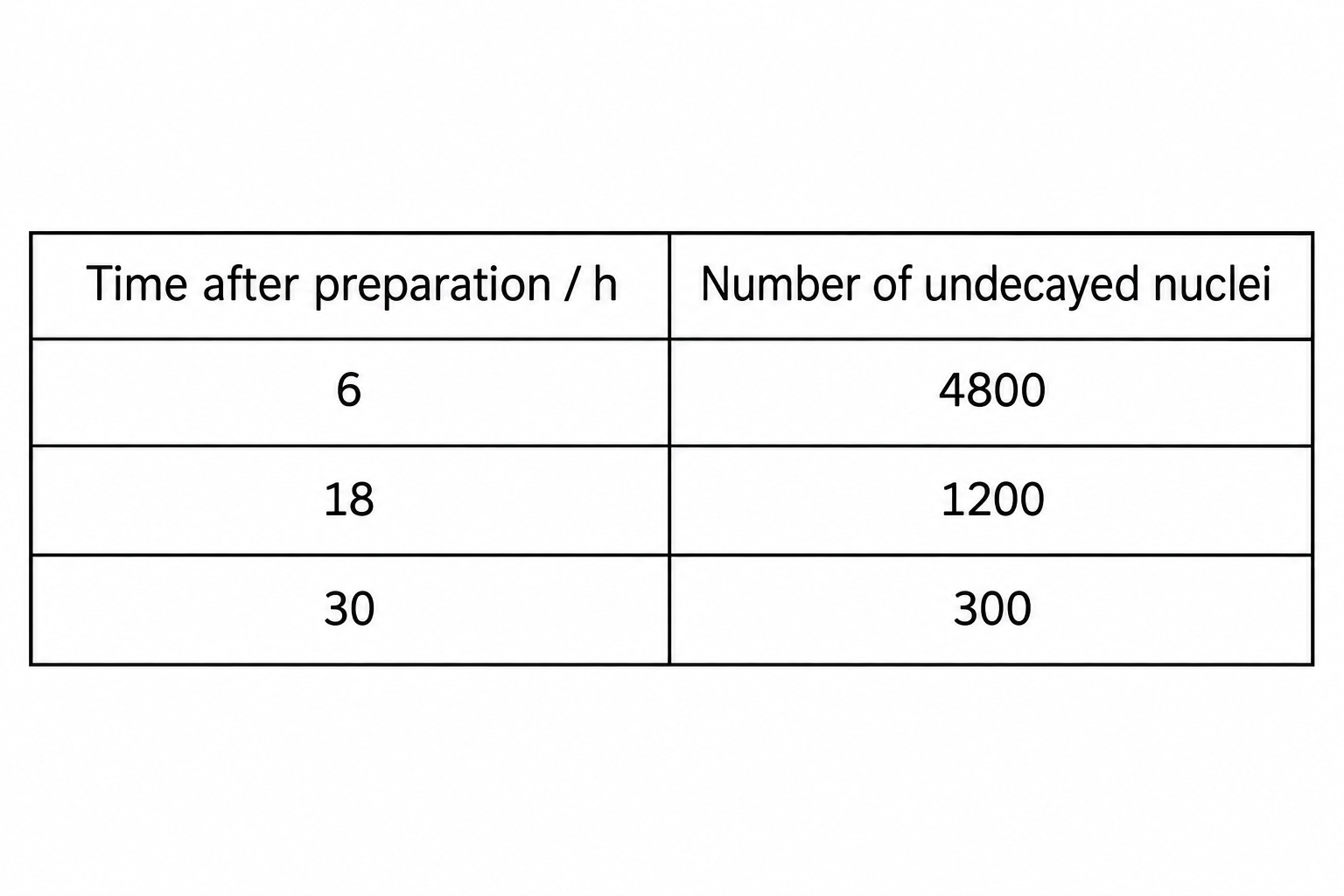
The table shows the number of undecayed nuclei in a sample at different times after preparation. Treat the values as following the half-life model exactly. How many nuclei decay between preparation and 24 h after preparation?
Q10.
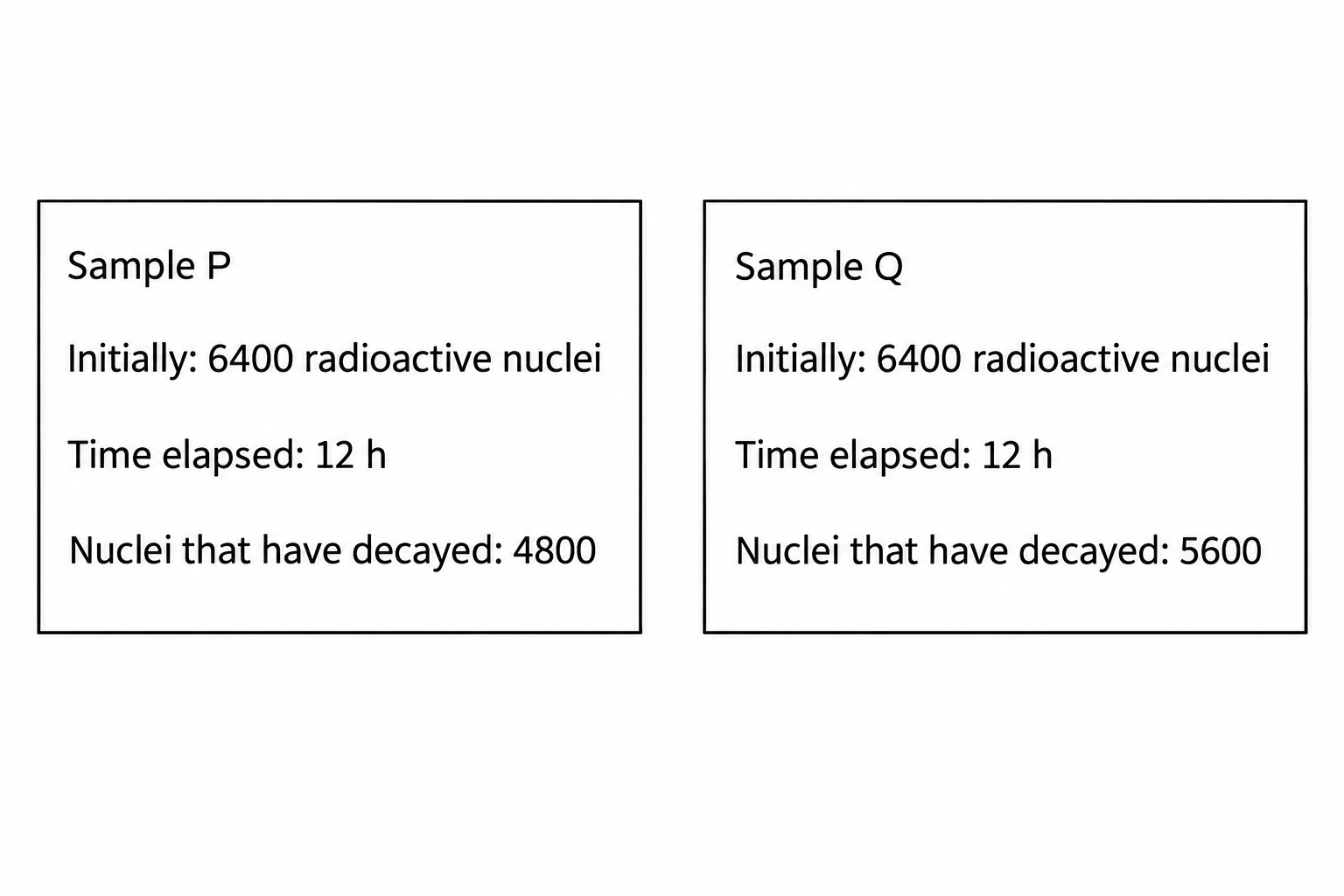
The diagram gives information about two separate radioactive samples. Both samples were prepared at the same time, and neither sample has had any material added or removed. Treat the numbers as following the half-life model exactly. What is the combined number of undecayed radioactive nuclei in the two samples 24 h after preparation?
What this assessment covers
Concepts Tested
- Radioactive Decay
- Define the half-life of a particular isotope as the time taken for half the nuclei of that isotope in any sample to decay; recall and use this definition in simple calculations, which might involve information in tables or decay curves (calculations will not include background radiation)
Question Mix
- Hard questions included
Skills you build
- Apply
Related assessments
More practice
Other assessments in this subject
