

PHYSICS - CONSERVATION OF ENERGY
Conservation of Energy Practice Problems
- 10 questions
- Know the principle of the conservation of energy and apply this principle to simple examples including the interpretation of simple flow diagrams
- Difficulty: Hard
- Board: CAIE
- Attempt online on the examination portal
Start the 10-question quiz
Free, no sign-up needed. Your score shows instantly.
Here are the first 3 questions. Click “View all questions” to see the complete assessment.
Q1.
Q2.
During each complete operating cycle, a machine receives 260 J electrically, transfers 210 J usefully and transfers 70 J to the surroundings. The difference is supplied by a separate energy store inside the machine. This store initially contains 100 J of available energy and cannot be recharged during operation. What is the maximum number of complete cycles possible?
Q3.
Two trolleys collide on a horizontal track. Immediately before the collision, their kinetic energies are 140 J and 40 J. Immediately afterwards, their total kinetic energy is 110 J. During the collision, 15 J is carried away by sound. All the remaining decrease in kinetic energy increases the internal energy of the trolleys. Which statement correctly accounts for the energy?
Q4.
A battery supplies a heater immersed in water inside a container. The battery's chemical energy decreases from 64 kJ to 19 kJ. The water's internal energy increases by 32 kJ, and the combined internal energy of the heater and container increases by 5 kJ. There are no other changes in stored energy. How much energy is transferred to the surroundings?
Q5.
A pendulum is released from rest with gravitational potential energy of 1.8 J, measured relative to its lowest position. On its first passage through the lowest position, its kinetic energy is 1.5 J. A further 0.3 J is dissipated as it rises to rest on the other side, and 0.2 J is dissipated during its next descent. What is its kinetic energy on its second passage through the lowest position?
Q6.
A pumped-storage system receives 80 MJ of electrical energy while pumping water uphill. During pumping, 20 MJ is dissipated, and the remaining energy increases the water's gravitational potential energy. Later, some water flows back through a generator. After this discharge, 12 MJ of the added gravitational potential energy remains stored. During discharge, 9 MJ is dissipated. How much electrical energy is generated?
Q7.
An electric vehicle slows on a level road using regenerative braking. Its kinetic energy decreases from 96 kJ to 24 kJ. Air resistance and tyre friction transfer 18 kJ to thermal stores. The remaining energy is transferred electrically to the battery, whose chemical energy increases by 48 kJ. If there are no other energy transfers, how much does the battery's internal energy increase through heating?
Q8.
A winch raises a load while a counterweight descends. During one interval, the motor receives 900 J electrically and the counterweight loses 160 J of gravitational potential energy. The load gains 720 J of gravitational potential energy, the total kinetic energy of the moving parts increases by 80 J, and 40 J is transferred by sound. All remaining energy is transferred to thermal stores. What is this thermal energy transfer?
Q9.
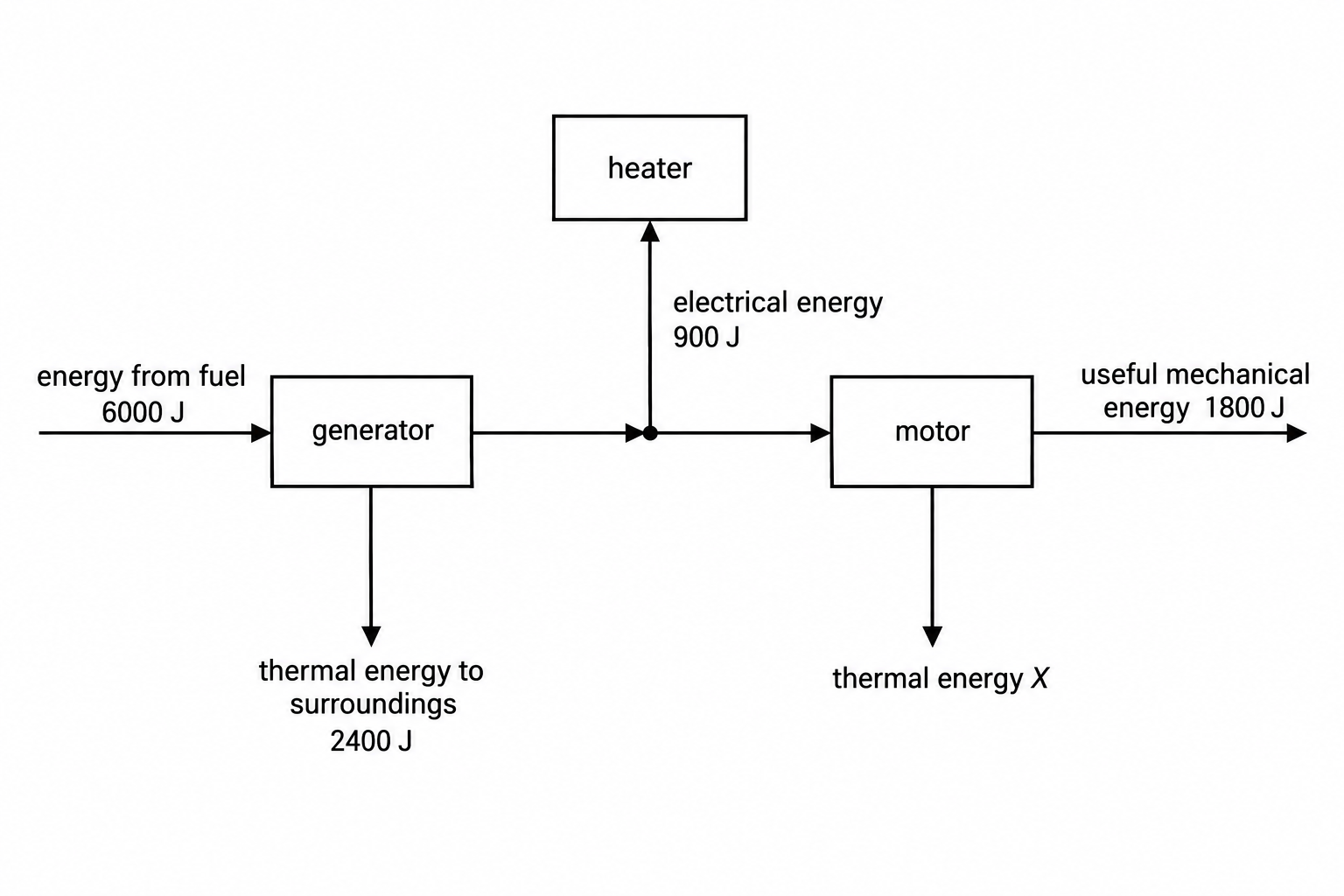
The flow diagram shows all energy transfers in a generator and the devices it supplies during one interval. No energy remains stored in the generator or motor at the end of the interval. What is the thermal energy transfer labelled X?
Q10.
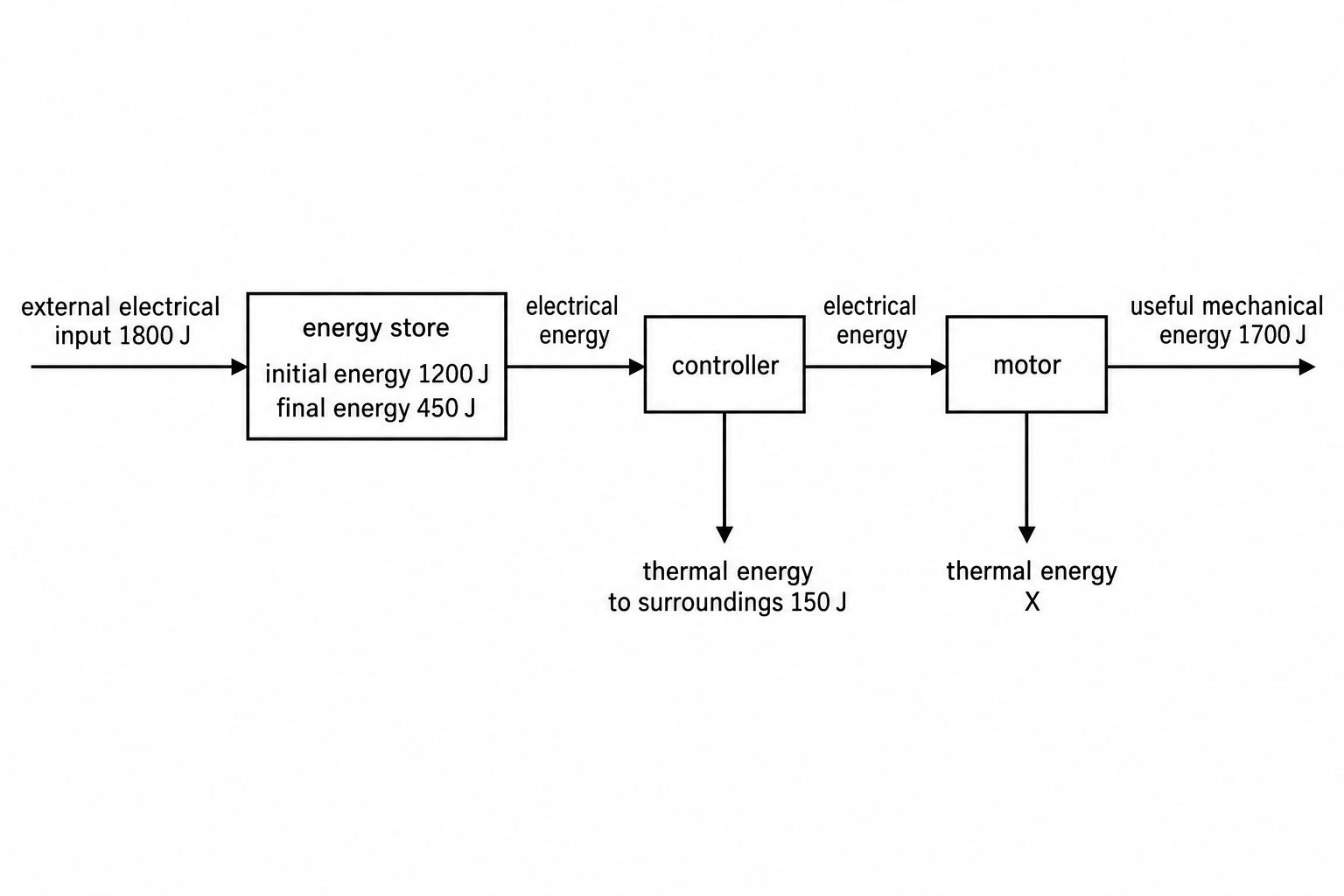
The diagram shows all energy transfers in a storage-and-motor system during one interval. It also gives the energy in the store at the start and end. No other part of the system changes its stored energy. How much energy is transferred thermally from the motor, as indicated by X?
What this assessment covers
Concepts Tested
- Conservation of Energy
- Know the principle of the conservation of energy and apply this principle to simple examples including the interpretation of simple flow diagrams
Question Mix
- Hard questions included
Skills you build
- Apply
Related assessments
More practice
Other assessments in this subject
