

PHYSICS - NEWTON'S LAWS OF MOTION

Newtons Second Law Worksheet

  • 10 questions
  • Recall and use the equation F = ma and know that the force and the acceleration are in the same direction
  • Difficulty: Easy
  • Board: CAIE
  • Attempt online on the examination portal
Start the 10-question quiz Free, no sign-up needed. Your score shows instantly.

Here are the first 3 questions. Click “View all questions” to see the complete assessment.

Q1.

Which equation correctly relates resultant force F, mass m and acceleration a?

  1. A) F = \m/a
  2. B) F = m + a
  3. C) F = \a/m
  4. D) F = ma

Q2.

Several forces act on an object. What does F represent in F = ma?

  1. A) The resultant force acting on the object
  2. B) Only the largest force acting on the object
  3. C) Only the force opposing the motion
  4. D) The sum of the force magnitudes, ignoring their directions

Q3.

To use F = ma, a student needs the object's mass. Which measurement provides this quantity?

  1. A) Its volume measured in cubic metres
  2. B) Its density measured in kilograms per cubic metre
  3. C) Its weight measured in newtons
  4. D) Its mass measured in kilograms

Q4.

Which quantity is represented by a in Newton's second-law equation?

  1. A) The time for which the force acts
  2. B) The acceleration of the object
  3. C) The distance travelled by the object
  4. D) The speed of the object

Q5.

Which statement about a non-zero resultant force and the acceleration it produces is always correct?

  1. A) They are in opposite directions.
  2. B) They are perpendicular to each other.
  3. C) Their directions are unrelated.
  4. D) They are in the same direction.

Q6.

According to F = ma, what is the acceleration of an object when the resultant force on it is zero?

  1. A) It must be increasing.
  2. B) It depends on the object's speed.
  3. C) It is zero.
  4. D) It must be directed upwards.

Q7.

Which relationship follows from F = ma when mass is constant?

  1. A) Acceleration is directly proportional to the square of resultant force.
  2. B) Acceleration is independent of resultant force.
  3. C) Acceleration is inversely proportional to resultant force.
  4. D) Acceleration is directly proportional to resultant force.

Q8.

For a fixed non-zero resultant force, how does acceleration depend on mass?

  1. A) Acceleration is independent of mass.
  2. B) Acceleration is inversely proportional to mass.
  3. C) Acceleration is directly proportional to the square of mass.
  4. D) Acceleration is directly proportional to mass.

Q9.

The table shows possible units for the quantities in F = ma. Which row gives the standard SI units to use directly in this equation?
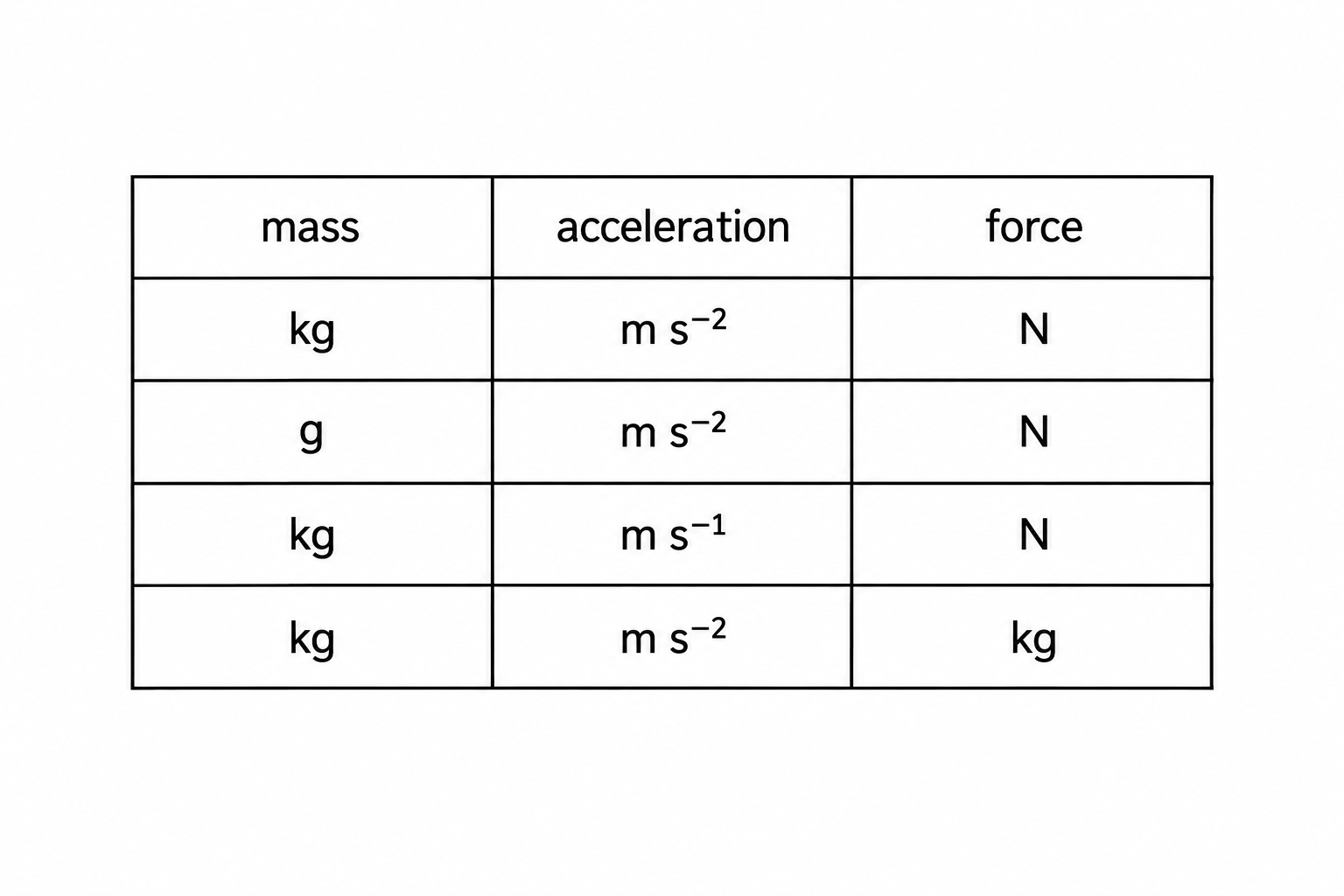
Diagram for question 9: The table shows possible units for the quantities in F = ma. Which row gives the standard SI units to use…
  1. A) The first row
  2. B) The third row
  3. C) The fourth row
  4. D) The second row

Q10.

The arrow shows the acceleration of an object. In which direction must the resultant force on the object act?
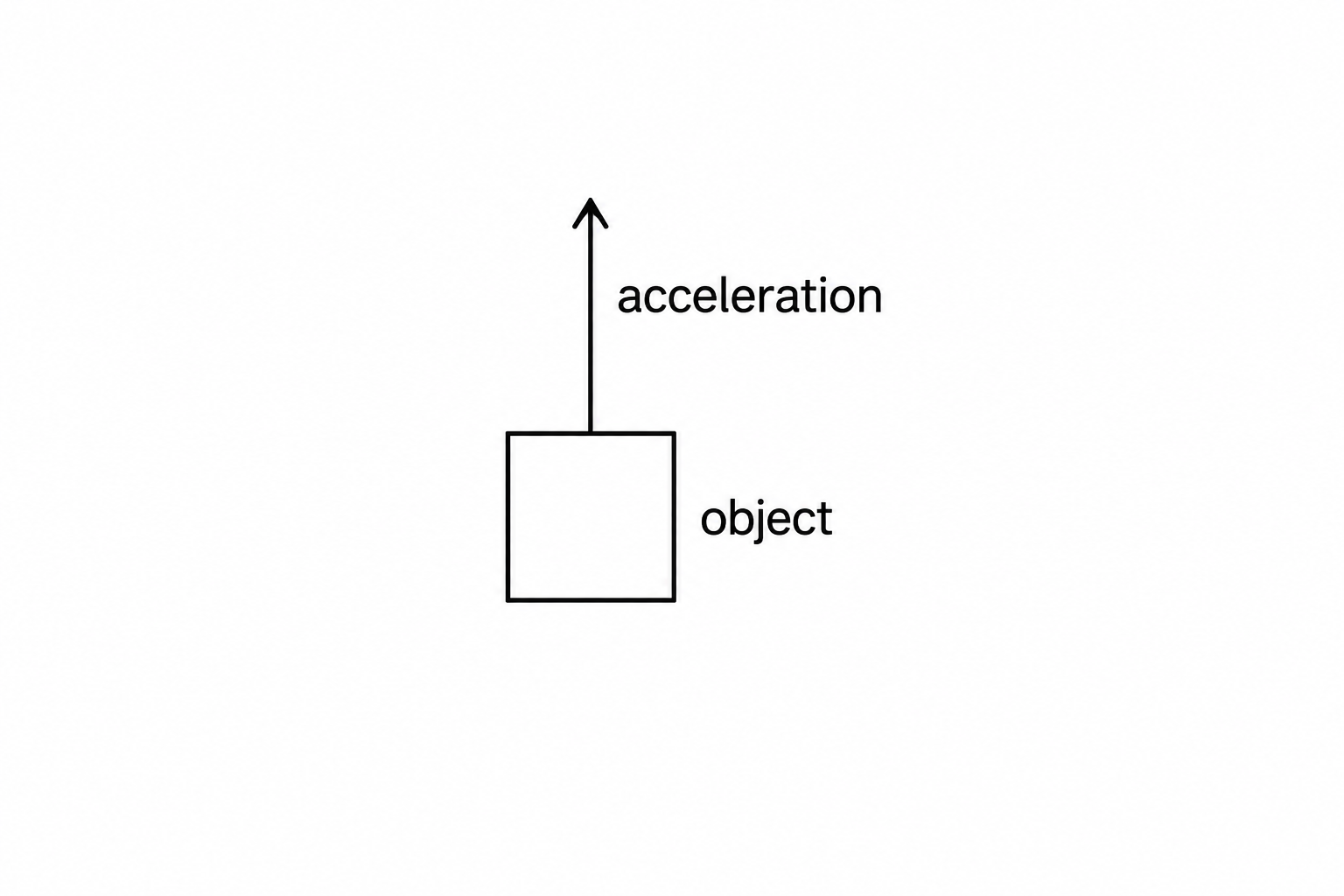
Diagram for question 10: The arrow shows the acceleration of an object. In which direction must the resultant force on the object act?
  1. A) Upwards
  2. B) Downwards
  3. C) To the left
  4. D) To the right

What this assessment covers

Concepts Tested

  • Newton's Laws of Motion
  • Recall and use the equation F = ma and know that the force and the acceleration are in the same direction

Question Mix

  • Easy questions included

Skills you build

  • Remember