

BIOLOGY - MUSCULAR SYSTEM

Muscular System Quiz

  • 10 questions
  • Difficulty: Medium
  • Board: US
  • Attempt online on the examination portal
Start the 10-question quiz Free, no sign-up needed. Your score shows instantly.

Here are the first 3 questions. Click “View all questions” to see the complete assessment.

Q1.

A skeletal muscle contains muscle tissue, connective tissue, nerves, and blood vessels. Why is the entire muscle considered an organ rather than a single tissue?

  1. A) It functions independently of the other parts of the body.
  2. B) Each of its tissues belongs to a separate organism.
  3. C) All of its cells have the same structure and carry out the same task.
  4. D) Several types of tissue work together to carry out its functions.

Q2.

After an injury, the motor nerve leading to a person's hand muscle no longer carries signals. The muscle and its blood supply remain intact. Why might the person be unable to move that muscle voluntarily?

  1. A) The muscle can no longer produce blood cells because motor nerves control their formation.
  2. B) The muscle can no longer receive oxygen because motor nerves transport oxygen.
  3. C) The muscle can no longer receive the nervous system signals that trigger contraction.
  4. D) The muscle can no longer attach to bones because motor nerves form tendons.

Q3.

The diaphragm is a muscle beneath the lungs. When it contracts, the chest cavity becomes larger and air moves into the lungs. Which explanation best connects this muscular action to the needs of other body cells?

  1. A) It allows the lungs to make oxygen that other cells use to release energy.
  2. B) It moves oxygen directly from the lungs into every body cell without blood transport.
  3. C) It helps bring oxygen into the lungs, where oxygen can enter blood for delivery to cells.
  4. D) It replaces the heart's pumping action by pushing blood through the body.

Q4.

The wall of the small intestine contains smooth muscle as well as tissue that absorbs digested nutrients. How do these tissues work together to support the body's other organs?

  1. A) Absorbing tissue contracts to move food, while smooth muscle carries nutrients through the blood.
  2. B) Smooth muscle mixes and moves intestinal contents, helping nutrients reach surfaces where they can be absorbed.
  3. C) Smooth muscle changes directly into nutrients, which the absorbing tissue sends to other organs.
  4. D) Smooth muscle prevents food from contacting the absorbing tissue until digestion has completely stopped.

Q5.

A disease weakens the contraction of cardiac muscle in the heart. Which explanation best describes how this could reduce the performance of otherwise healthy leg muscles during exercise?

  1. A) The weakened heart prevents tendons from connecting the leg muscles to bones.
  2. B) Reduced blood flow causes the leg muscles to change from skeletal muscle into smooth muscle.
  3. C) The weakened heart sends fewer motor nerve signals directly to the leg muscles.
  4. D) Reduced blood flow can limit delivery of oxygen and nutrients needed by the leg muscles.

Q6.

When a person becomes cold, the nervous system can trigger shivering, which consists of repeated skeletal muscle contractions. How does this interaction help the body?

  1. A) The contractions turn skeletal muscle tissue into insulating fat tissue.
  2. B) The contractions make the skin absorb oxygen, replacing the work of the lungs.
  3. C) The contractions release heat, helping maintain conditions needed by cells and organs.
  4. D) The contractions stop blood circulation, keeping all body heat inside the muscles.

Q7.

An athlete tears a tendon connecting a calf muscle to the heel bone. The muscle can still contract, but the athlete has difficulty raising the heel. Which explanation best accounts for this result?

  1. A) The tendon normally produces the nerve signals that cause the calf muscle to contract.
  2. B) The tendon normally allows the heel bone to contract along with the calf muscle.
  3. C) The tendon normally supplies all the oxygen used by the calf muscle.
  4. D) The tendon normally transfers the muscle's pulling force to the bone.

Q8.

The diagram shows two muscles attached across the elbow joint. Why does bending and then straightening the elbow require coordinated activity of both muscles?
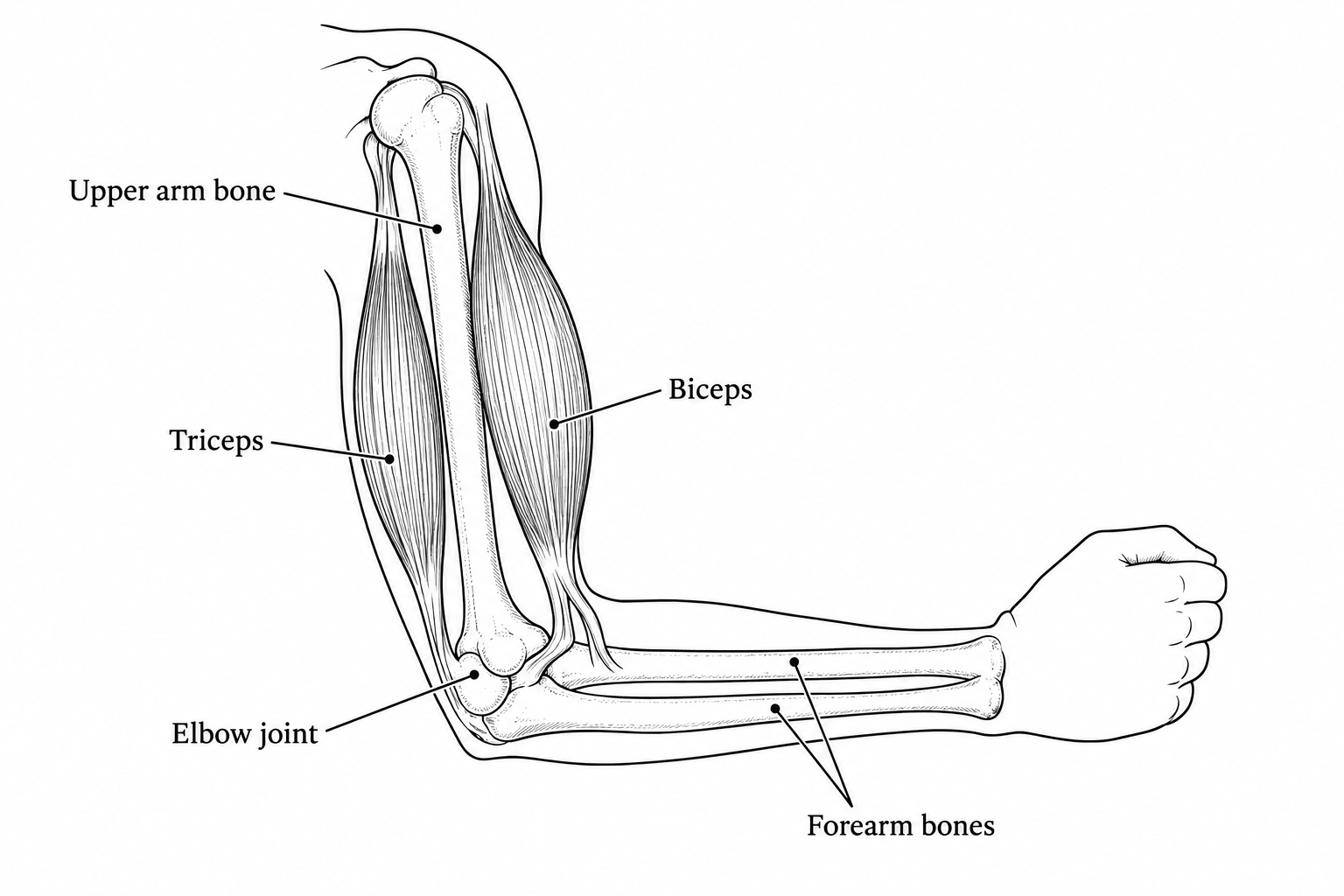
Diagram for question 8: The diagram shows two muscles attached across the elbow joint. Why does bending and then straightening the…
  1. A) The muscles alternate between becoming bone and becoming muscle to change the forearm's position.
  2. B) Each muscle pulls when it contracts, so opposing muscles are needed to move the forearm in opposite directions.
  3. C) One muscle moves the bones, while the other makes the elbow joint rigid during all movement.
  4. D) The muscles contract together to push the forearm in opposite directions.

Q9.

The diagram shows structures within a skeletal muscle at increasing magnification. Which statement best explains how the organization shown supports movement of the whole muscle?
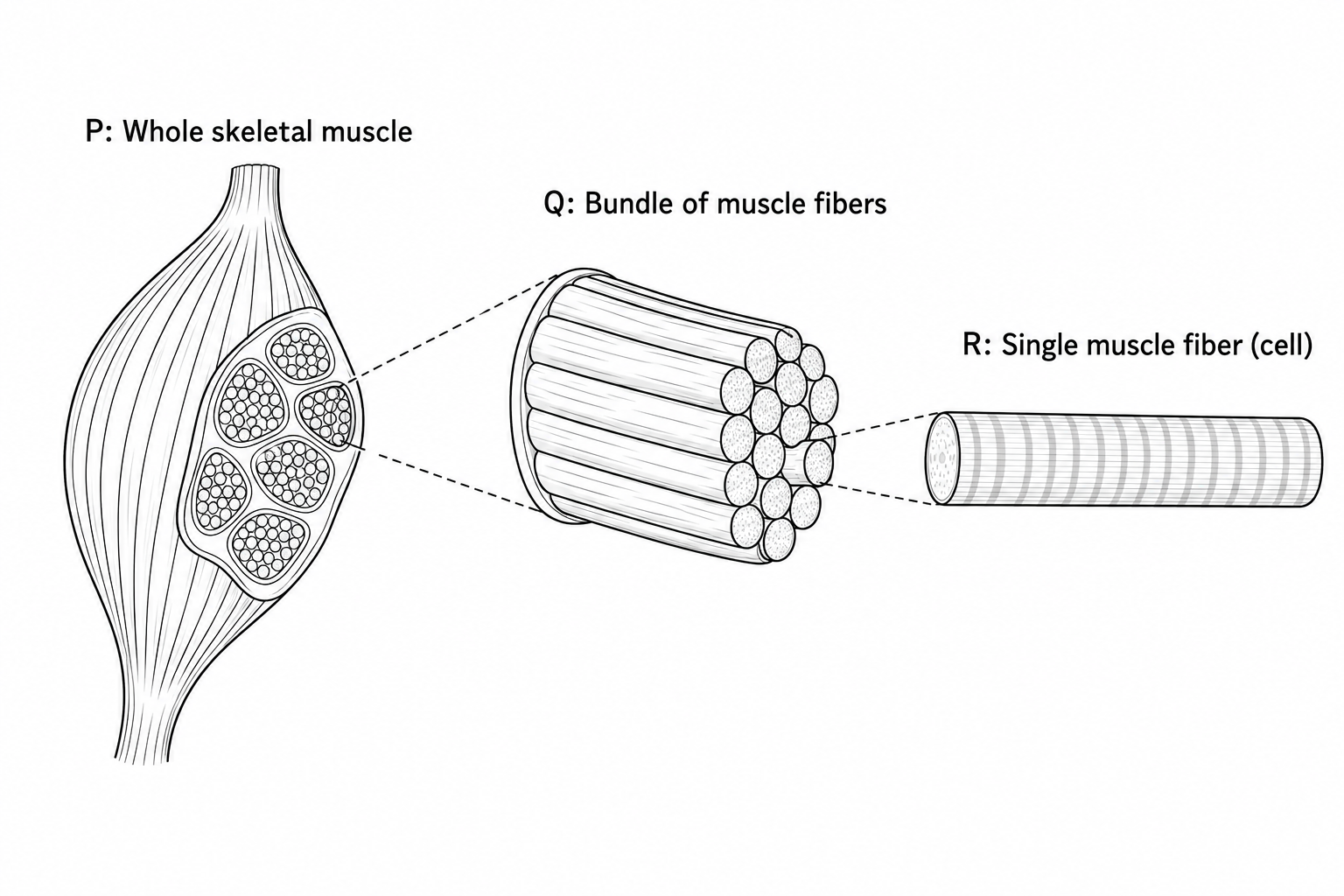
Diagram for question 9: The diagram shows structures within a skeletal muscle at increasing magnification. Which statement best…
  1. A) Structure Q is a separate body system that moves without interacting with structure P.
  2. B) Structures P, Q, and R are unrelated structures that happen to have similar shapes.
  3. C) Structure P is a single cell that contains many complete muscles like structure R.
  4. D) Many cells like structure R are organized into bundles like structure Q, whose combined contractions help structure P produce force.

Q10.

The diagram models exchange between a blood capillary and active skeletal muscle cells. Arrow P shows materials moving toward the muscle cells, and arrow Q shows a material moving toward the blood. Which explanation best matches these exchanges?
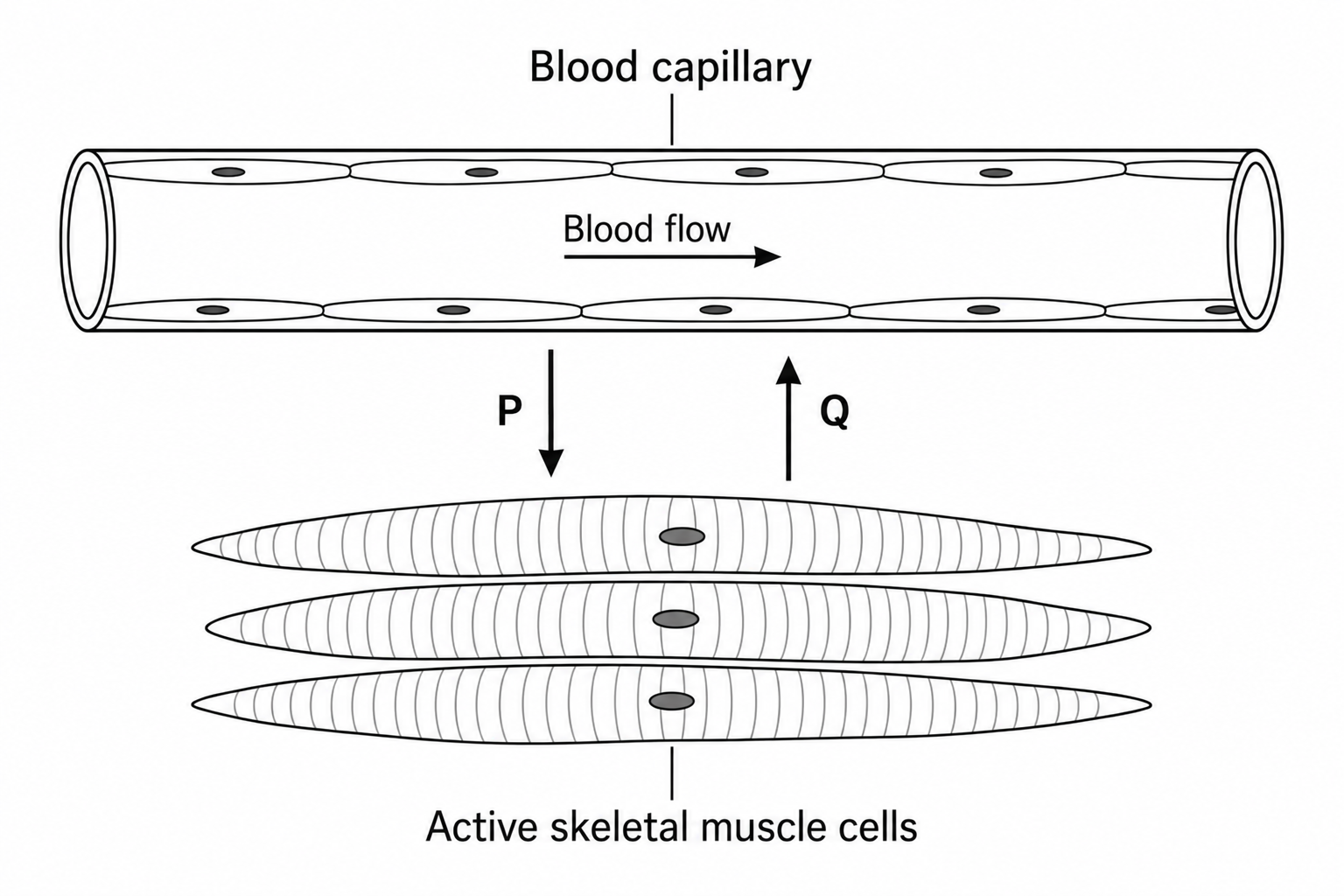
Diagram for question 10: The diagram models exchange between a blood capillary and active skeletal muscle cells. Arrow P shows…
  1. A) P carries oxygen and glucose released as wastes; Q carries carbon dioxide needed for muscle contraction.
  2. B) P carries oxygen and glucose used in cellular respiration; Q carries carbon dioxide produced by the cells.
  3. C) P carries carbon dioxide used to make food; Q carries oxygen produced by the cells.
  4. D) P carries muscle fibers used to repair blood; Q carries nerve signals produced during contraction.

What this assessment covers

Concepts Tested

  • Muscular System

Question Mix

  • Medium questions included

Skills you build

  • Understand