

BIOLOGY - PROTEIN SYNTHESIS
Protein Synthesis Practice Problems
- 10 questions
- Explain how a protein is made, limited to: • the gene coding for the protein remains in the nucleus • messenger RNA (mRNA) is a copy of a gene • mRNA molecules are made in the nucleus and move to the cytoplasm • the mRNA passes through ribosomes • the ribosome assembles amino acids into protein molecules • the specific sequence of amino acids is determined by the sequence of bases in the mRNA (knowledge of the details of transcription or translation is not required)
- Difficulty: Hard
- Board: CAIE
- Attempt online on the examination portal
Start the 10-question quiz
Free, no sign-up needed. Your score shows instantly.
Here are the first 3 questions. Click “View all questions” to see the complete assessment.
Q1.
Q2.
Cells A and B normally make forms of a protein with different amino acid sequences. The nucleus of cell A is replaced with the nucleus of cell B. All mRNA originally present in cell A is removed, but its ribosomes and amino acids remain functional. After new mRNA has reached the cytoplasm, which protein should the reconstructed cell make?
Q3.
A researcher labels a batch of newly made mRNA without labelling DNA or proteins. Immediately afterwards, the label is found only in the nucleus. Later, some of this labelled mRNA is found passing through cytoplasmic ribosomes while a protein is being made. Which explanation correctly links these observations?
Q4.
Three mixtures contain identical functional ribosomes and identical mRNA for a particular protein. Mixture P contains enough of every required amino acid. Mixture Q also contains enough of every required amino acid, but their relative amounts differ from those in P. Mixture R completely lacks one amino acid needed in the protein. Which prediction is correct?
Q5.
A treatment leaves genes unchanged, allows mRNA to be made and exported normally, and leaves amino acids available. However, no new protein molecules are assembled. Adding more mRNA or amino acids does not restore protein production. Which additional result would most strongly support the conclusion that the treatment has disabled ribosomes?
Q6.
A cell initially contains mRNA that directs the production of protein P. Its nuclear gene is then replaced by a version whose mRNA is known to direct the production of protein Q, which has a different amino acid sequence. The old mRNA remains functional for a short time while new mRNA reaches the cytoplasm. Which pattern of new protein production is expected?
Q7.
A scientist supplies an artificial mixture with functional ribosomes, all required amino acids and energy, but no nucleus or DNA. No protein is produced until purified mRNA for a particular protein is added. The expected protein is then made. Why is this result consistent with the normal role of the nucleus in protein production?
Q8.
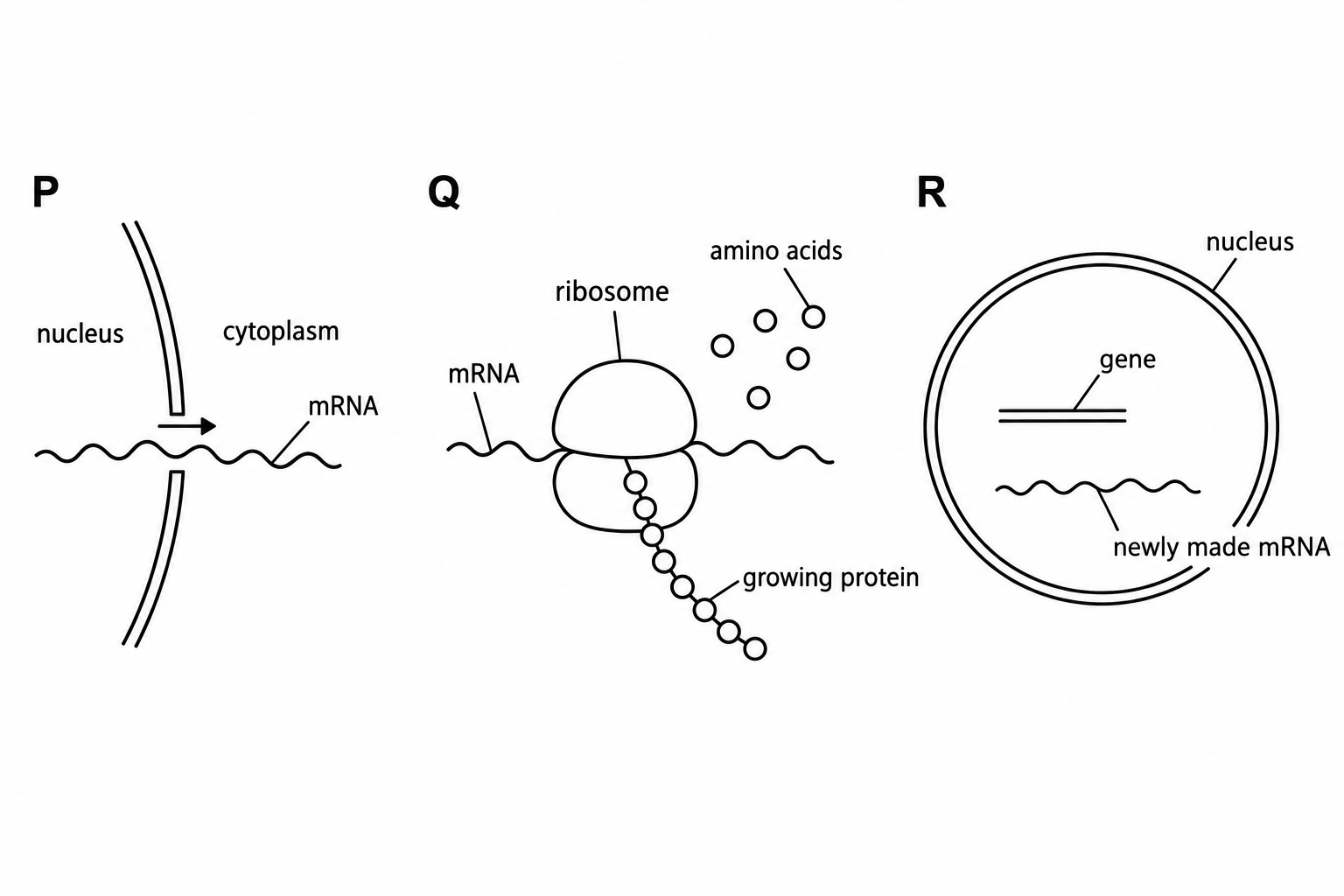
The diagram shows three stages involving the same mRNA molecule. The stages are arranged out of time order. A label is attached to the mRNA immediately after it has been made. Which sequence correctly follows the labelled molecule until a protein is assembled?
Q9.
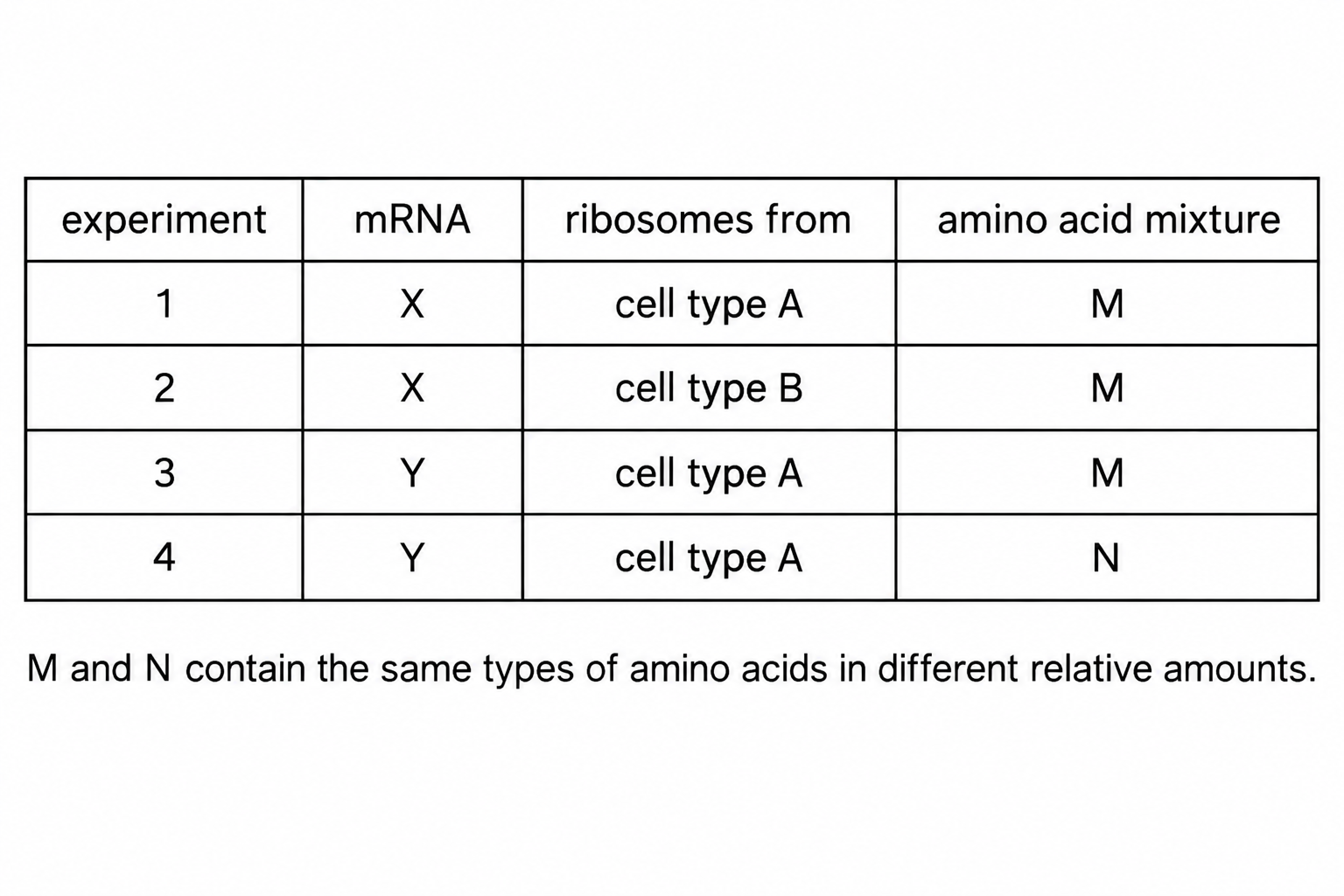
The table shows four experiments investigating the sequence of amino acids in a protein. Each mixture has functional ribosomes and enough of every required amino acid. mRNA X has exactly the same base sequence wherever it appears; mRNA Y has a different base sequence. Which comparison best tests whether changing only the mRNA base sequence can change the protein's amino acid sequence?
Q10.
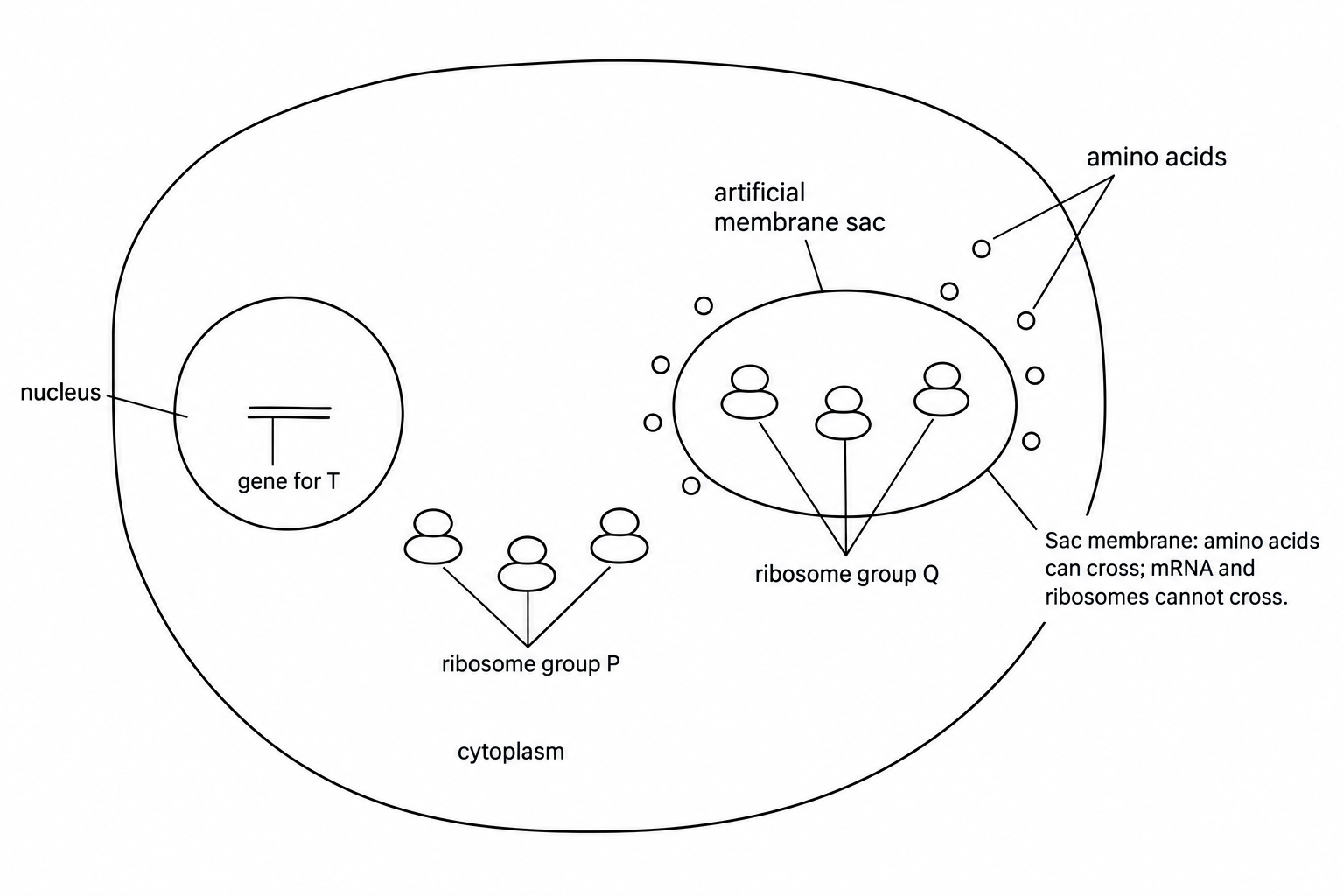
The diagram shows a cell containing an artificial membrane sac. Initially, there is no mRNA for protein T anywhere in the cell. The nuclear gene for T then begins producing mRNA, which can leave the nucleus normally. The sac membrane allows amino acids through but prevents mRNA and ribosomes from crossing. Both ribosome groups are functional, and all other requirements are available. Which prediction is correct?
What this assessment covers
Concepts Tested
- Protein Synthesis
- Explain how a protein is made, limited to: • the gene coding for the protein remains in the nucleus • messenger RNA (mRNA) is a copy of a gene • mRNA molecules are made in the nucleus and move to the cytoplasm • the mRNA passes through ribosomes • the ribosome assembles amino acids into protein molecules • the specific sequence of amino acids is determined by the sequence of bases in the mRNA (knowledge of the details of transcription or translation is not required)
Question Mix
- Hard questions included
Skills you build
- Apply
Related assessments
More practice
Other assessments in this subject
