

BIOLOGY - MUSCULAR SYSTEM

Muscular System Worksheet

  • 10 questions
  • Difficulty: Medium
  • Board: US
  • Attempt online on the examination portal
Start the 10-question quiz Free, no sign-up needed. Your score shows instantly.

Here are the first 3 questions. Click “View all questions” to see the complete assessment.

Q1.

A student models a skeletal muscle as an organ containing muscle tissue, connective tissue, nerves, and blood vessels. Why is this model more complete than one showing only muscle cells?

  1. A) The other tissues produce the force, while muscle cells mainly hold the organ together.
  2. B) The tissues cooperate to produce force, provide support, carry signals, and deliver materials.
  3. C) The muscle cells become separate organ systems when the other tissues are included.
  4. D) Each tissue performs the same task, allowing the muscle to work if any other tissue stops functioning.

Q2.

A model of the elbow includes two muscles attached on opposite sides of the joint. One bends the elbow, and the other straightens it. Why are both muscles needed?

  1. A) One muscle moves the upper arm bone, while the other prevents the forearm bones from moving.
  2. B) Each muscle can push but cannot pull the bones toward itself.
  3. C) Each muscle pulls when it contracts, so an opposing muscle is needed to reverse the movement.
  4. D) Both muscles must contract equally whenever the elbow moves.

Q3.

In a model of inhalation, the diaphragm contracts and moves downward, increasing the space inside the chest. Which explanation correctly connects this muscular action to the respiratory system?

  1. A) The diaphragm carries oxygen directly from the chest into the blood.
  2. B) The larger chest space allows the lungs to expand, lowering air pressure inside them so air flows inward.
  3. C) The downward movement squeezes the lungs, forcing outside air into them.
  4. D) The diaphragm opens the air sacs by pulling directly on each air sac wall.

Q4.

A heart model shows connected cardiac muscle cells contracting together in the wall of a chamber. Which explanation best connects this tissue arrangement to the function of the circulatory system?

  1. A) The connected cells allow the chamber to store blood without changing its volume.
  2. B) The connected cells exchange oxygen with outside air before sending it to the blood.
  3. C) Coordinated contraction of the chamber wall creates the force needed to move blood through vessels.
  4. D) Coordinated contraction causes the heart to pull on bones that push blood through vessels.

Q5.

During sustained running, working muscle cells need an increased supply of oxygen. Which statement best explains why both breathing rate and heart rate usually increase?

  1. A) The heart produces oxygen, while the lungs convert that oxygen into energy for the muscles.
  2. B) The lungs pump oxygen through blood vessels, while the heart moves air into the muscles.
  3. C) The respiratory system brings oxygen into the body, and the circulatory system delivers it to working muscle tissue.
  4. D) The respiratory and circulatory systems take over contraction so that skeletal muscles can rest.

Q6.

When body temperature falls, the nervous system can trigger rapid, repeated contractions of skeletal muscles called shivering. How does this interaction help the body?

  1. A) The contractions increase heat production as muscle cells use energy, helping restore body temperature.
  2. B) The contractions make the skin absorb more heat regardless of the surrounding temperature.
  3. C) The contractions stop blood circulation so that heat cannot leave the muscles.
  4. D) The contractions reduce energy use in muscle cells, preventing further cooling.

Q7.

A tendon connecting a leg muscle to a bone is completely torn. The muscle still receives nerve signals and contracts, but it can no longer move the bone normally. Which explanation best accounts for this result?

  1. A) The tendon normally contracts independently to push the bone away from the muscle.
  2. B) The tendon normally produces the nerve signals that tell the bone when to move.
  3. C) The tendon normally supplies all the oxygen used by the contracting muscle.
  4. D) The tendon normally transfers the muscle's pulling force to the bone, so the tear interrupts that connection.

Q8.

The diagram models a withdrawal response after a person steps on a sharp object. Which explanation best describes how the labeled structures work together to move the foot away?
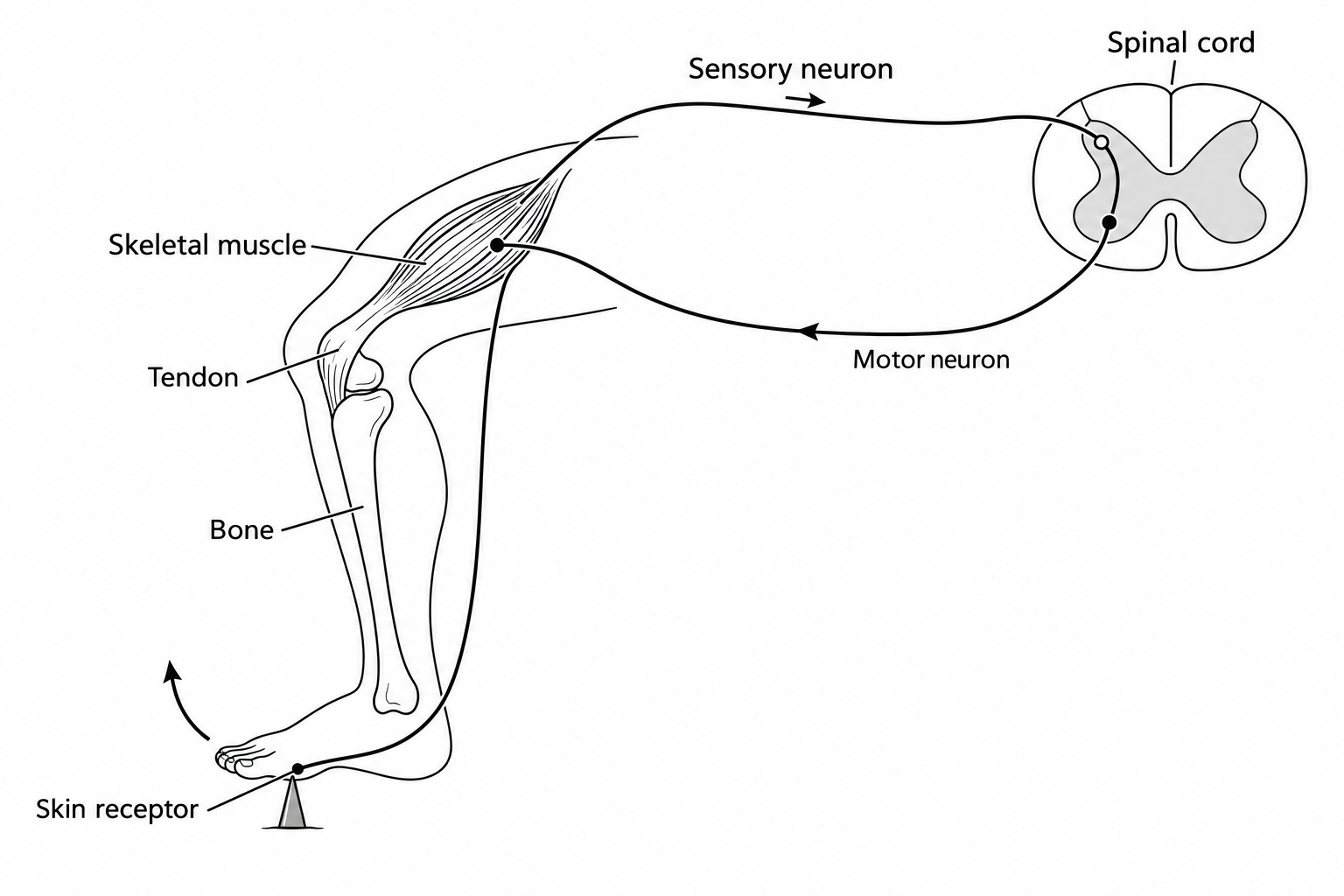
Diagram for question 8: The diagram models a withdrawal response after a person steps on a sharp object. Which explanation best…
  1. A) Signals pass through the nervous system to a skeletal muscle, whose contraction moves the attached bones.
  2. B) The spinal cord contracts the tendon, which sends a signal back to the skin receptor.
  3. C) The skin receptor pulls on the leg bone, and the spinal cord supplies energy for the movement.
  4. D) The leg bone detects the sharp object and sends a signal that makes the skin receptor contract.

Q9.

The diagram shows two stages of movement in a section of the small intestine. Which explanation best connects the muscle tissue in the intestinal wall to the function of the digestive system?
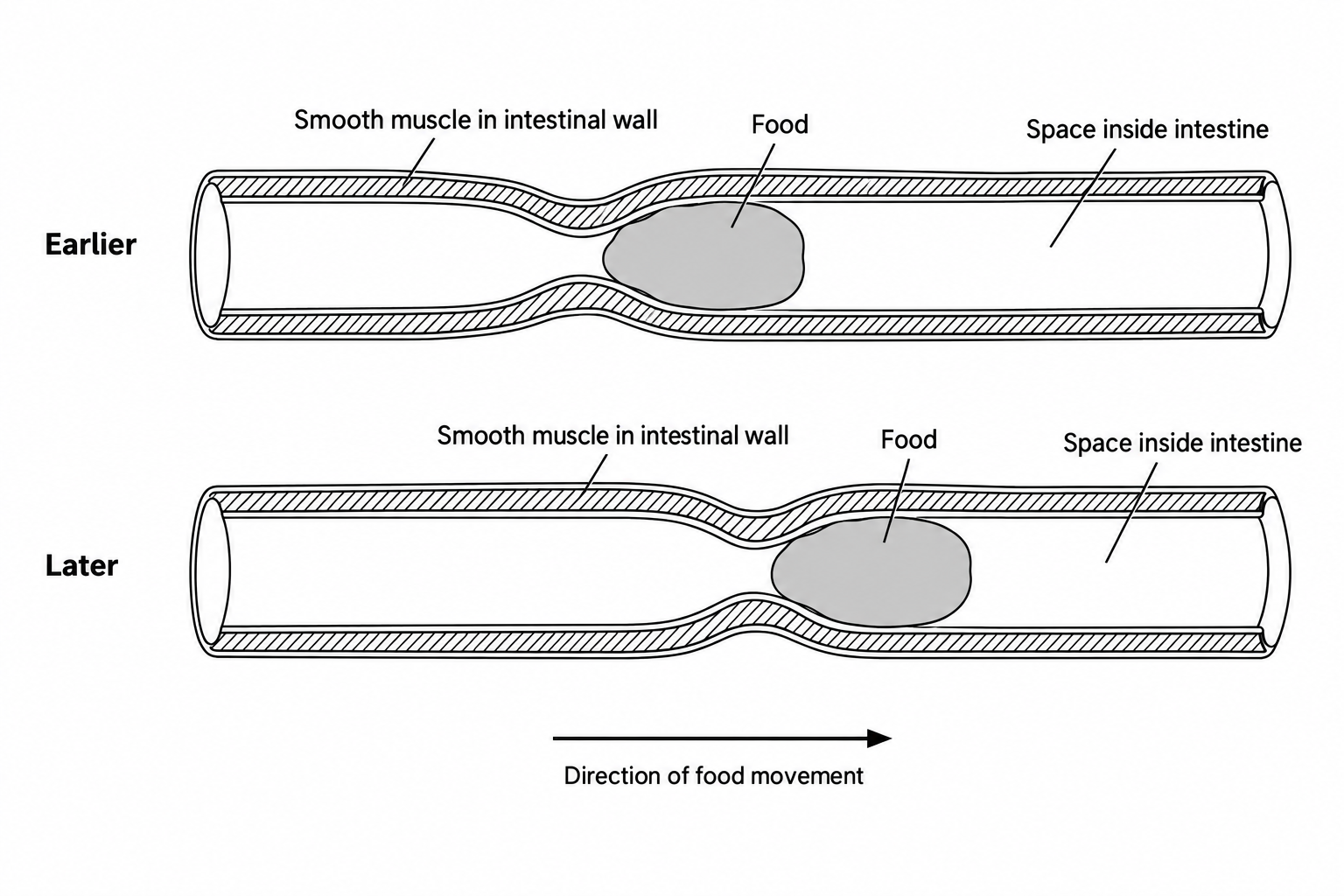
Diagram for question 9: The diagram shows two stages of movement in a section of the small intestine. Which explanation best…
  1. A) The lining pushes food forward by producing new muscle cells behind it.
  2. B) The intestinal muscles move nearby bones, which press food through the intestine.
  3. C) A wave of smooth muscle contraction squeezes behind the food and moves it along the intestine.
  4. D) The food contracts, pulling the intestinal wall forward as digestion occurs.

Q10.

The diagram shows the same small artery before and after its smooth muscle contracts. If the pressure difference driving blood through this artery stays the same, how does this muscular change affect circulation through it?
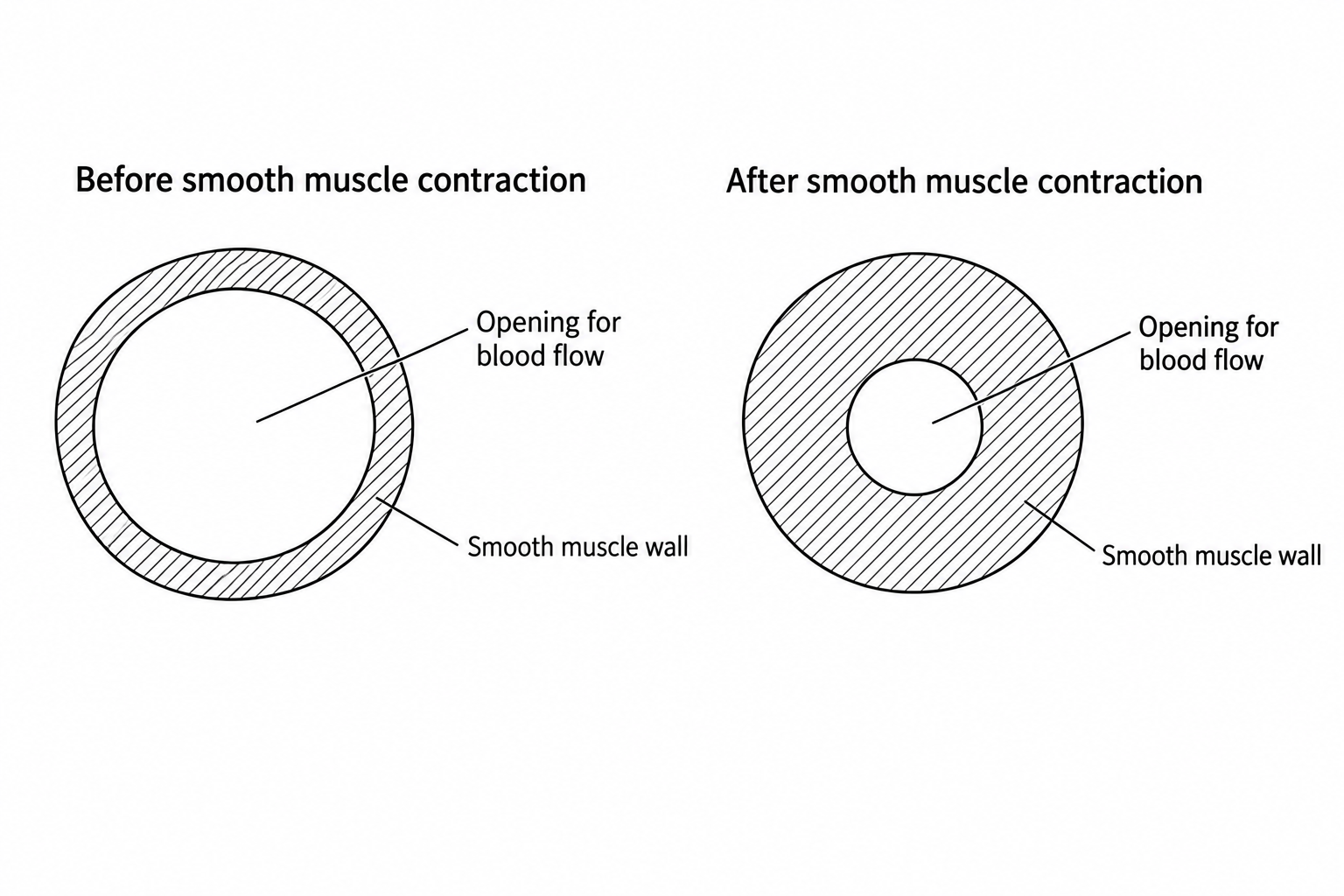
Diagram for question 10: The diagram shows the same small artery before and after its smooth muscle contracts. If the pressure…
  1. A) It increases blood flow because the thicker wall produces additional blood cells.
  2. B) It increases blood flow because the smaller opening provides more space for blood.
  3. C) It leaves blood flow unchanged because only heart muscle can affect circulation.
  4. D) It reduces blood flow because contraction narrows the opening through which blood passes.

What this assessment covers

Concepts Tested

  • Muscular System

Question Mix

  • Medium questions included

Skills you build

  • Understand