

BIOLOGY - PLANT AND ANIMAL CELLS
Plant and Animal Cells Worksheet
- 10 questions
- Describe and compare the structure of a plant cell with an animal cell, limited to: cell wall, cell membrane, nucleus, cytoplasm, chloroplasts, ribosomes, mitochondria, vacuoles
- Difficulty: Hard
- Board: CAIE
- Attempt online on the examination portal
Start the 10-question quiz
Free, no sign-up needed. Your score shows instantly.
Here are the first 3 questions. Click “View all questions” to see the complete assessment.
Q1.
Q2.
A student builds models of a typical leaf cell and an animal cell. In the leaf-cell model, the nucleus is placed inside the large central vacuole. In the animal-cell model, all the ribosomes are placed inside the nucleus and none are in the cytoplasm. All other structures are correctly represented. Which pair of changes corrects both models?
Q3.
Three structures in a leaf cell are coded K, L and M. K consists of very small particles scattered in the cytoplasm. L is an oval organelle with a folded inner membrane. M is an oval organelle containing stacks of internal membranes. A student makes a model of an animal cell using the same codes. Which instruction is correct?
Q4.
A student sorts structure cards when comparing a typical green leaf cell with an animal cell. The 'both cells' group contains cell membrane, nucleus, cytoplasm and ribosomes. The 'leaf cell only' group contains cell wall, chloroplasts, mitochondria and large permanent central vacuole. The 'animal cell only' group contains small temporary vacuoles. Which single move corrects the error in these groups?
Q5.
A reconstruction of a mature plant cell shows a large central vacuole occupying most of the cell's interior. An animal cell of similar overall size has several much smaller vacuoles. Which additional arrangement would make the two reconstructions structurally consistent with these observations?
Q6.
A treatment removes only the cell wall from an intact green leaf cell. The cell membrane and all internal structures remain undamaged. A student claims that the treated cell now has the same set of structures as a typical animal cell. Which comparison best evaluates this claim?
Q7.
A thin section through part of a cell shows a cell wall outside a cell membrane, cytoplasm, mitochondria and part of a large vacuole. No nucleus or chloroplasts are visible. A student concludes that the cell cannot be a plant cell because these two structures are not shown. Which evaluation is most accurate?
Q8.
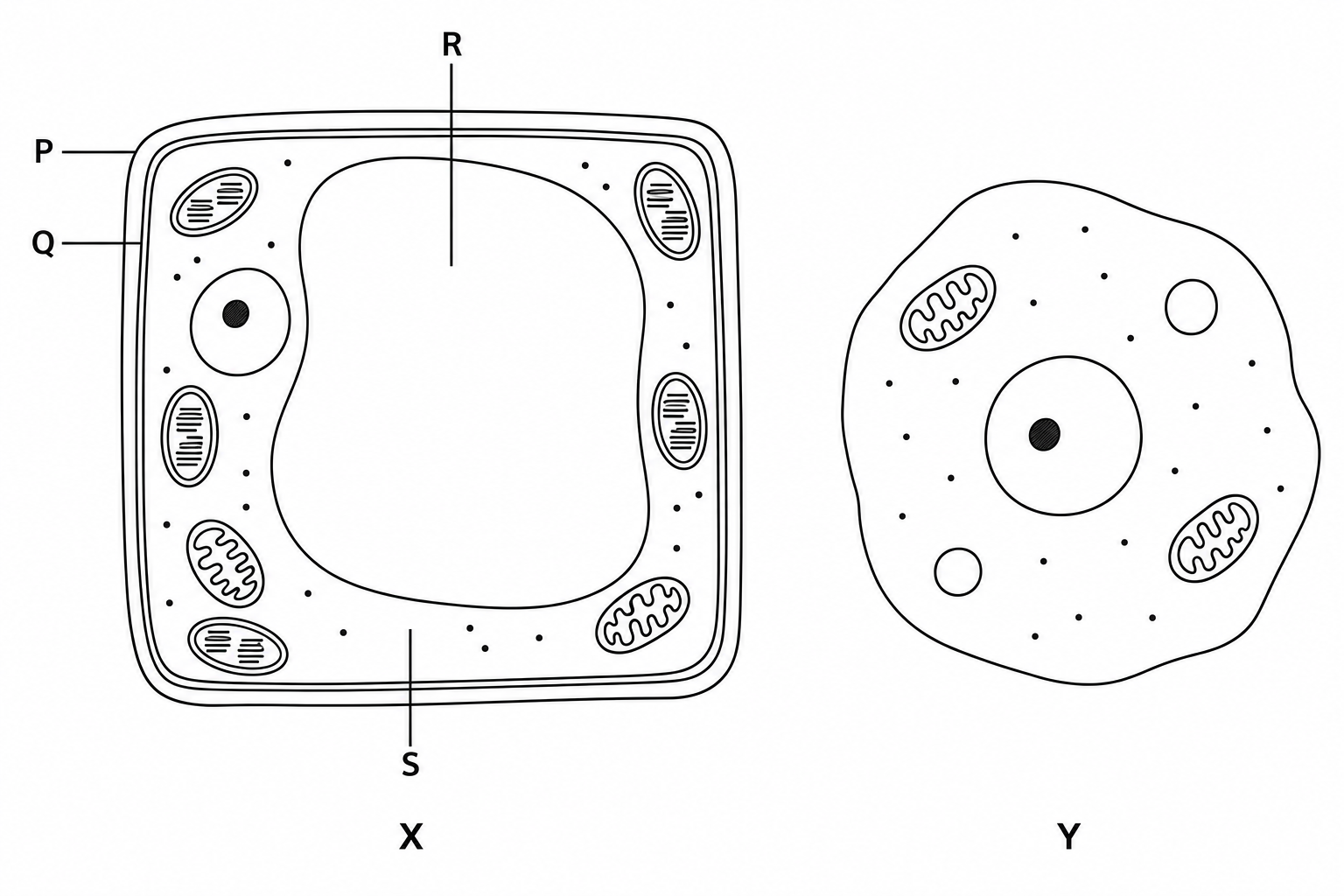
The diagram shows a plant cell X and an animal cell Y. Labels P, Q, R and S identify structures or regions in X. Which pair identifies, respectively, the structure corresponding to the outer boundary of Y and the material surrounding the organelles in Y?
Q9.
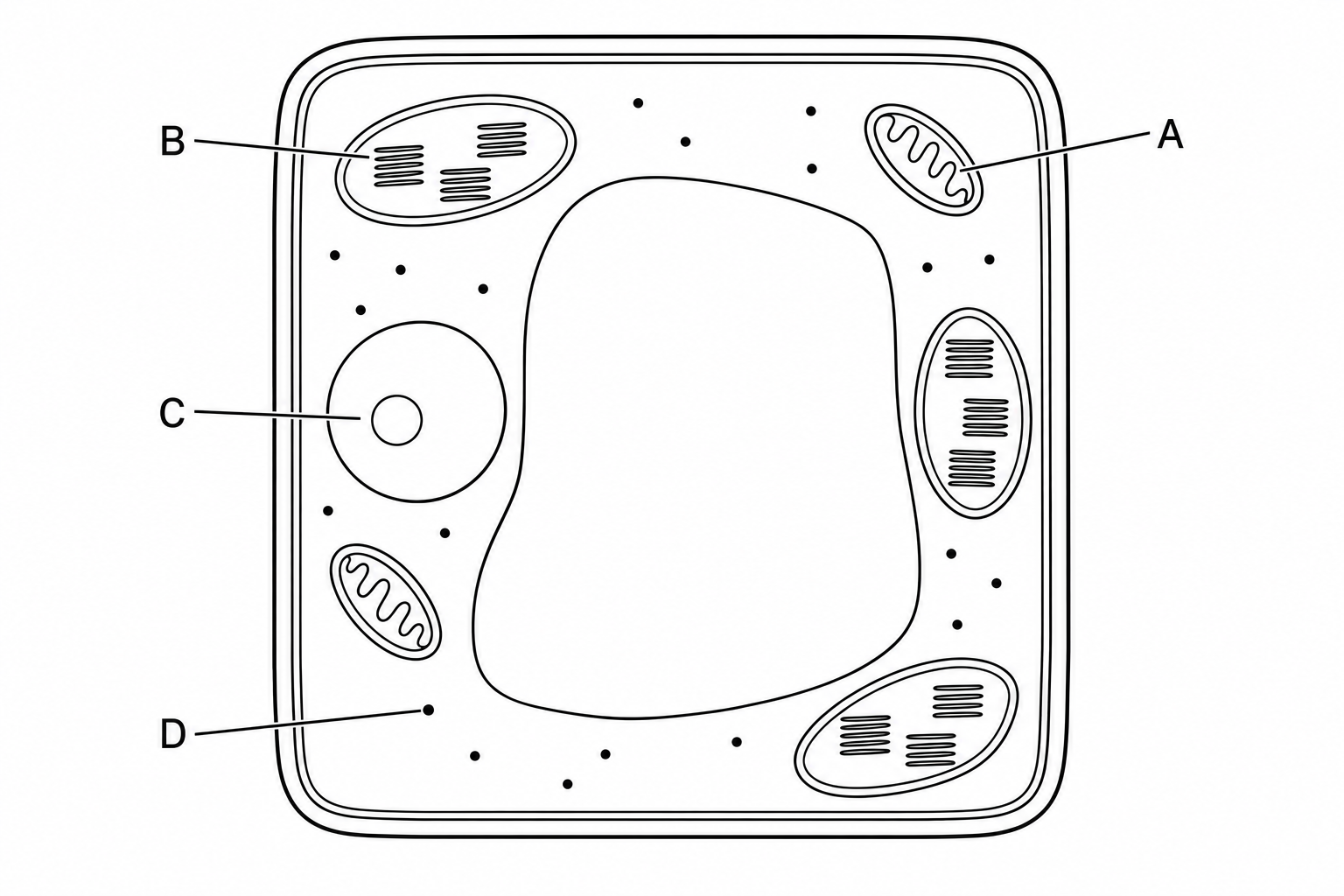
The diagram shows a green leaf cell with four structures labelled A to D. A student is adapting this drawing to represent a plant root cell that has no chloroplasts. Which instruction removes the appropriate structure while correctly identifying two structures that should remain?
Q10.
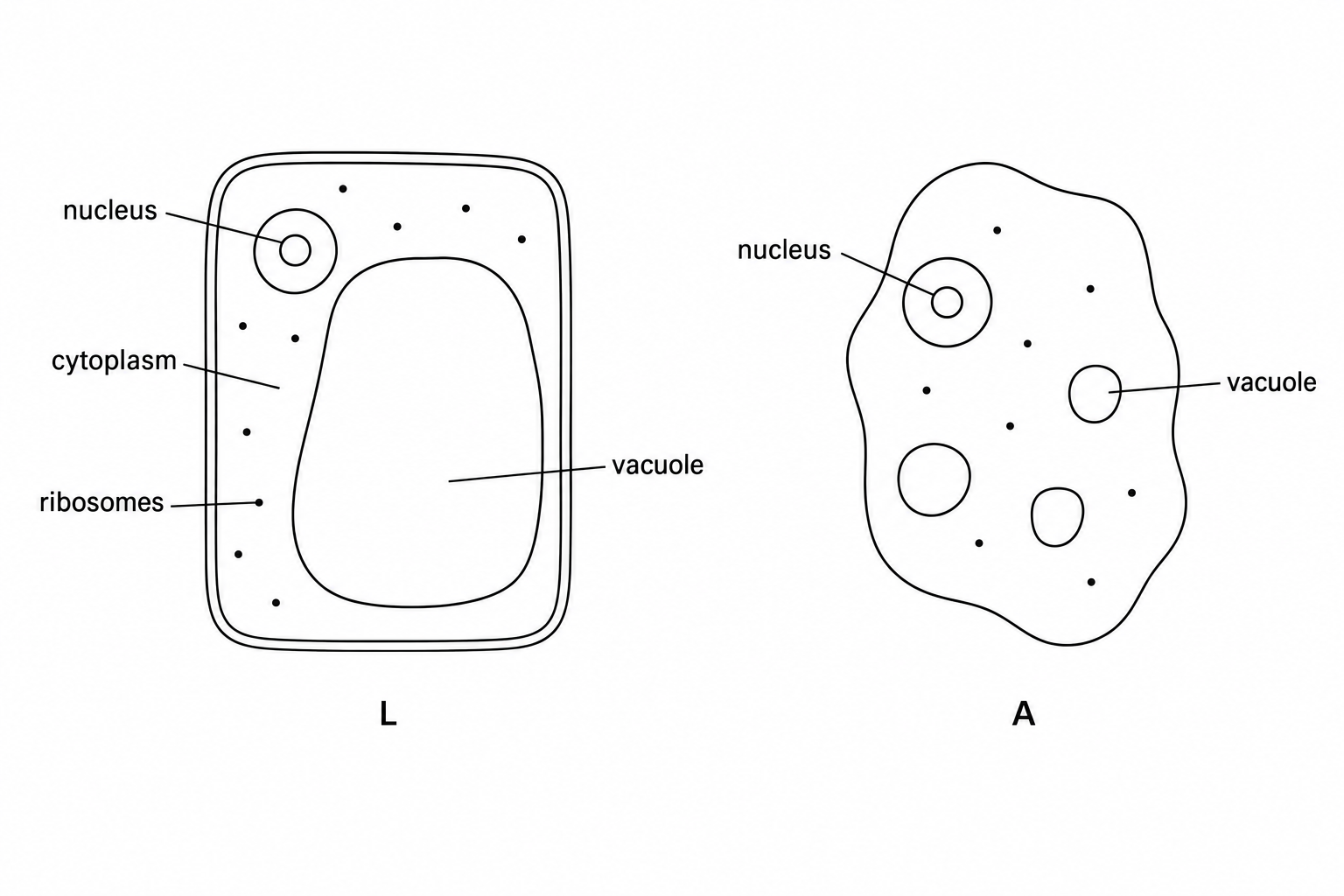
The diagrams are unfinished models of a typical green leaf cell L and an animal cell A. In both models, the outer enclosing line represents the cell membrane. The nucleus, cytoplasm, ribosomes and vacuoles are already represented correctly. Which set of additions completes the models?
What this assessment covers
Concepts Tested
- Plant and Animal Cells
- Describe and compare the structure of a plant cell with an animal cell, limited to: cell wall, cell membrane, nucleus, cytoplasm, chloroplasts, ribosomes, mitochondria, vacuoles
Question Mix
- Hard questions included
Skills you build
- Apply
Related assessments
More practice
Other assessments in this subject
