

BIOLOGY - EVOLUTION

Speciation Worksheet

  • 10 questions
  • explain how speciation may occur as a result of genetic isolation by: • geographical separation (allopatric speciation) • ecological and behavioural separation (sympatric speciation)
  • Difficulty: Hard
  • Board: CAIE
  • Attempt online on the examination portal
Start the 10-question quiz Free, no sign-up needed. Your score shows instantly.

Here are the first 3 questions. Click “View all questions” to see the complete assessment.

Q1.

A river divides a population of flightless beetles. After many generations, beetles on opposite banks differ in their courtship chemicals. The river later changes course, bringing the populations together. Individuals survive equally well in both habitats, but females usually reject males from the other population. Which explanation best accounts for the persistence of two genetically distinct populations after contact?

  1. A) Different habitats continue to eliminate migrants before reproduction, so courtship differences have no role in maintaining isolation.
  2. B) Restricted gene flow allowed courtship differences to evolve independently, and these differences now reduce interbreeding without the river.
  3. C) Geographical isolation must have caused hybrid sterility, and female rejection is evidence that any hybrids would be infertile.
  4. D) The river selected directly for females that rejected males on the opposite bank, because those females encountered fewer unsuitable mates.

Q2.

Two groups of fruit flies occupy the same orchard. One group feeds and mates on an early-fruiting host; the other feeds and mates on a late-fruiting host. Their adult emergence periods overlap very little. Researchers suggest that host use and emergence time are jointly reducing gene flow. Which experimental outcome would most strongly support this explanation rather than an inability of the groups to produce fertile offspring?

  1. A) Flies given the same emergence conditions still choose their original hosts, and mating between groups remains uncommon.
  2. B) Flies kept on their usual hosts retain different emergence periods, and adults collected from the orchard show genetic differences.
  3. C) Flies forced to mate across groups produce fertile offspring, but their descendants continue to emerge at different times on the original hosts.
  4. D) Synchronising emergence and providing a shared mating host greatly increases mating between groups, producing fertile offspring.

Q3.

Two fish forms live and breed together in a lake. Females choose males using differences in colour. Under clear-water conditions, mating between forms is rare, although their hybrids are viable and fertile. Suspended sediment then makes the male colours difficult to distinguish, without changing survival or breeding locations. If this condition persists, which outcome is most likely?

  1. A) Mating between forms will increase, increasing gene flow and weakening the behavioural barrier that could lead to sympatric speciation.
  2. B) Mating between forms will decrease, because loss of a recognisable signal necessarily produces stronger preferences for the original form.
  3. C) Mating between forms will increase, strengthening reproductive isolation because fertile hybrids prevent alleles passing between the forms.
  4. D) Mating between forms will remain rare, because behavioural isolation cannot be reversed once genetically different forms have developed.

Q4.

A grass population extends across adjacent metal-contaminated and uncontaminated soils. Wind carries pollen freely across the boundary. Metal-tolerant plants survive best on contaminated soil, while non-tolerant plants produce more seeds on uncontaminated soil. A heritable change that advances flowering appears among the metal-tolerant plants. Which condition would allow this change to promote speciation despite continued pollen dispersal?

  1. A) Earlier flowering removes the survival disadvantage of all migrants, while random mating continues across the soil boundary.
  2. B) Earlier flowering increases seed production, but both groups continue releasing pollen and having receptive stigmas throughout the same period.
  3. C) Earlier flowering increases the distance travelled by pollen, so more pollen reaches plants on the other soil type.
  4. D) Earlier flowering reduces overlap in pollen release and stigma receptivity between groups, while soil-dependent selection maintains their ecological differences.

Q5.

A small number of lizards colonise an island from a mainland population. Sea conditions prevent further movement between them. Many generations later, researchers find that island and mainland lizards produce fertile offspring when paired without a choice, but almost always choose partners from their own population when given a choice. Which conclusion best applies these findings to speciation?

  1. A) Geographical isolation allowed divergence, and evolved mate preferences could maintain reduced gene flow if the populations meet again.
  2. B) Mate preferences show that behavioural separation caused the original colonisation, so the process must have begun sympatrically.
  3. C) The sea barrier alone guarantees that the populations will remain reproductively isolated if they are placed together.
  4. D) Fertile offspring show that gene flow continued across the sea, so geographical separation did not contribute to divergence.

Q6.

In a freely interbreeding moth population, a heritable variant causes some females to release a different mating pheromone. All moths use the same habitat and breeding season. Initially, few males respond to the new pheromone. Which additional heritable change would most directly allow the variant group to persist and develop behavioural isolation?

  1. A) Males become equally responsive to both pheromones, and mating occurs randomly between the female types.
  2. B) Males attracted to the new pheromone disperse away before mating, while only males attracted to the original pheromone remain.
  3. C) Some males preferentially respond to the new pheromone, and sons of females releasing it commonly inherit this preference.
  4. D) Females releasing the new pheromone begin mating with males attracted to the original pheromone at the same frequency as other females.

Q7.

A road has separated two woodland rodent populations for many generations. Their allele frequencies now differ, but experimental encounters show random mating between populations and fully fertile offspring. A wildlife bridge is built, and many rodents cross and reproduce on either side. Assuming no strong differences in selection between the woodlands, what is the most likely effect on the speciation process?

  1. A) Speciation will accelerate because movement increases the number of individuals exposed to mutations in both woodlands.
  2. B) Speciation will continue at the same rate because allele-frequency differences become irreversible after several generations.
  3. C) Speciation will become less likely because renewed gene flow will tend to reduce genetic differences before reproductive isolation develops.
  4. D) Speciation will change from allopatric to sympatric because occupying connected habitats necessarily prevents interbreeding.

Q8.

Two flower-scent forms of a plant grow intermixed and flower at the same time. Bees usually visit one scent form repeatedly before returning to their nests. Pollen transferred by hand between forms produces as many fertile offspring as pollen transferred within forms. A new bee species that switches frequently between scent forms becomes abundant. Which prediction best follows?

  1. A) Gene flow will increase, but this will strengthen the scent differences by preventing alleles from passing between forms.
  2. B) Gene flow between forms will increase, weakening an ecological route to sympatric speciation based on pollinator fidelity.
  3. C) Gene flow between forms will decrease, because visits by an additional pollinator necessarily increase reproductive isolation.
  4. D) Gene flow will remain unchanged, because fertile hand-produced offspring show that pollinator behaviour never restricted interbreeding.

Q9.

The maps show three stages in the history of a freshwater fish population. Fish cannot cross dry land. At the present stage, fish descended from population P breed only in shallow gravel areas, while fish descended from population Q breed only in deep muddy areas. Adults of both groups feed throughout the connected lake. Which explanation best accounts for the origin and present maintenance of their genetic separation?
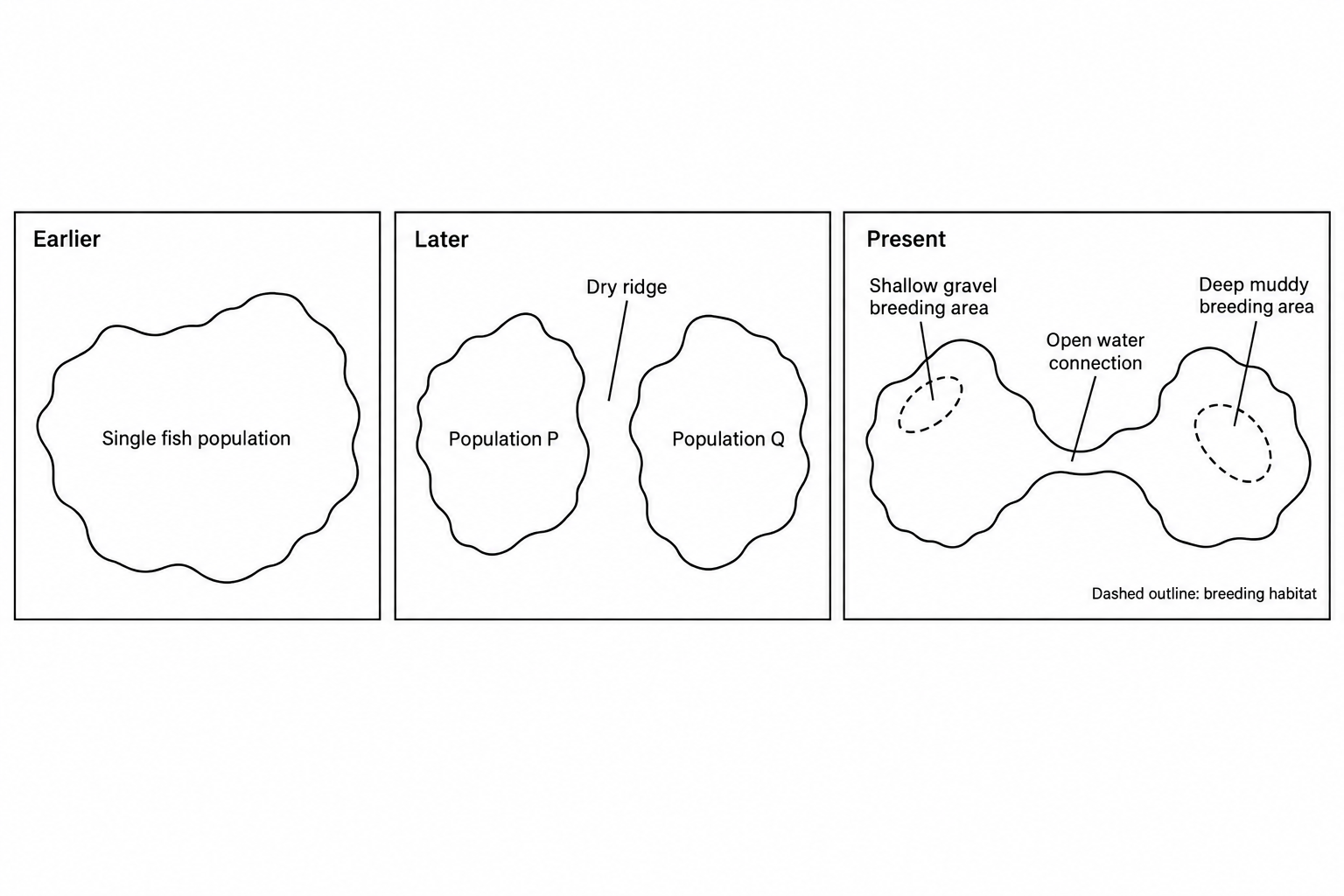
Diagram for question 9: The maps show three stages in the history of a freshwater fish population. Fish cannot cross dry land. At…
  1. A) The original lake contained a geographical barrier, and adult feeding movements now maintain that barrier.
  2. B) Ecological separation began only when the lakes rejoined, so the earlier dry ridge could not have contributed to genetic divergence.
  3. C) Reconnection must have restored unrestricted gene flow, because adults from both groups can reach the entire lake.
  4. D) The dry ridge initially restricted gene flow, and different breeding habitats can now maintain reduced gene flow after reconnection.

Q10.

Two cricket groups occupy the same grassland and breed during the same weeks. They have been reared for several generations under identical conditions, but males retain different songs. The table shows results from separate trials in which females were offered two loudspeakers playing different songs. Loudspeaker positions were exchanged between trials. Direct observations show that females normally mate only after approaching a singing male. Which field manipulation would most directly test whether the behavioural difference shown could maintain genetic isolation without geographical separation?
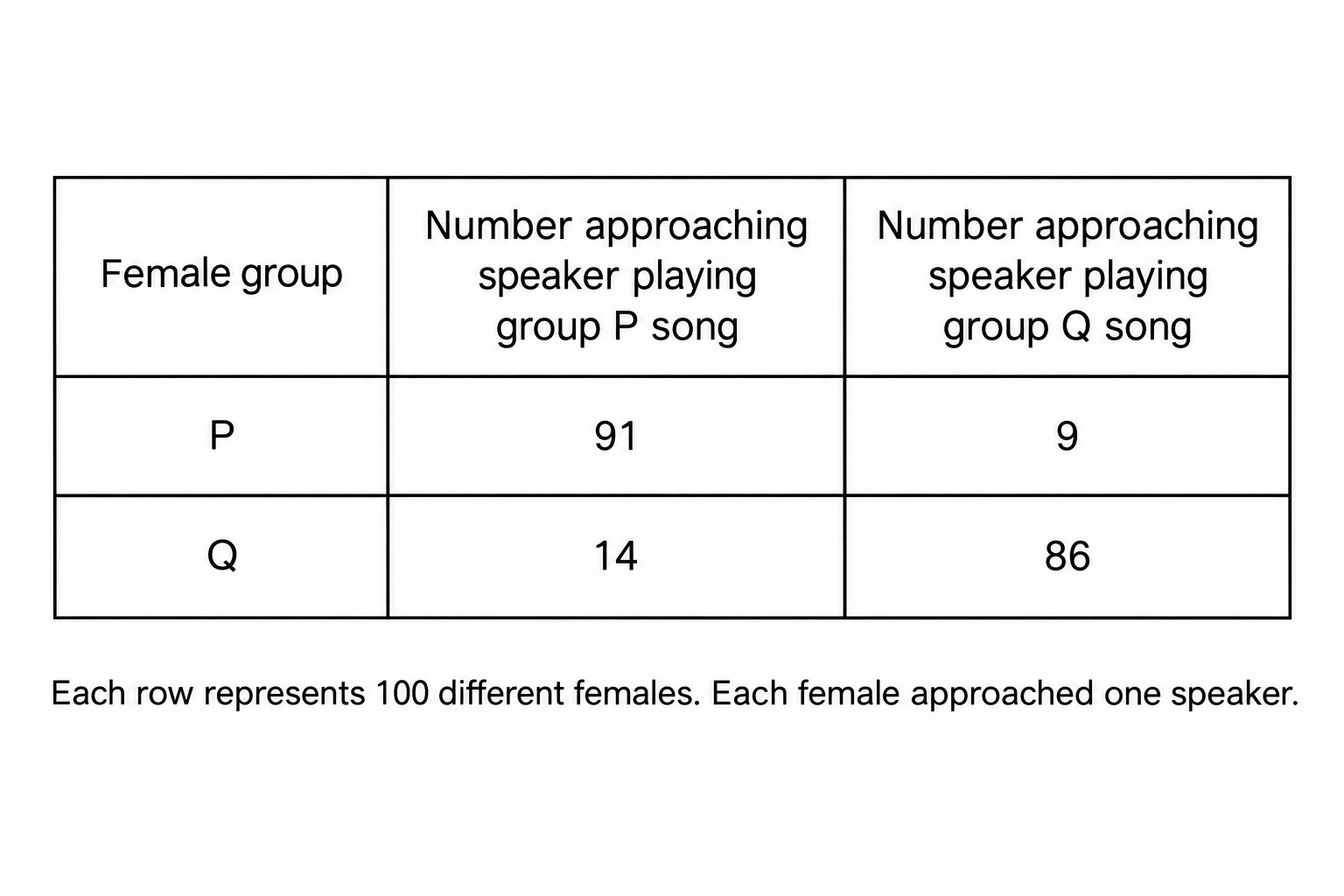
Diagram for question 10: Two cricket groups occupy the same grassland and breed during the same weeks. They have been reared for…
  1. A) Move the groups into separate enclosures and measure whether their allele frequencies become more different over several generations.
  2. B) Keep each female group with males of its own group and measure whether successful offspring are produced.
  3. C) Silence males and give males of both groups the same artificial song, then measure whether mating between groups increases relative to unaltered controls.
  4. D) Give both groups identical food while leaving songs unchanged, then measure whether males retain their original song patterns.

What this assessment covers

Concepts Tested

  • Evolution
  • explain how speciation may occur as a result of genetic isolation by: • geographical separation (allopatric speciation) • ecological and behavioural separation (sympatric speciation)

Question Mix

  • Hard questions included

Skills you build

  • Apply