

BIOLOGY - EVOLUTION

Evidence for Evolution Worksheet

  • 10 questions
  • Difficulty: Medium
  • Board: US
  • Attempt online on the examination portal
Start the 10-question quiz Free, no sign-up needed. Your score shows instantly.

Here are the first 3 questions. Click “View all questions” to see the complete assessment.

Q1.

Scientists compare the DNA sequence of the same inherited gene in three mammal species. The sequences in species P and Q are much more similar to each other than either is to the sequence in species R. Why is this evidence that P and Q share a more recent common ancestor?

  1. A) Every mammal species has a completely different set of genes.
  2. B) An individual mammal changes its inherited DNA sequence to match nearby species.
  3. C) Species living in similar habitats always develop identical DNA sequences.
  4. D) DNA sequences generally accumulate differences after populations separate from a common ancestor.

Q2.

A fossil animal has scales and fins like those of fish, but its fins contain sturdy bones resembling the limb bones of early land vertebrates. How does this fossil support an evolutionary relationship between these groups?

  1. A) It shows that fish and land vertebrates appeared at exactly the same time.
  2. B) It shows that every fish species eventually developed into a land vertebrate.
  3. C) It proves that the fossil animal was the direct ancestor of every living land vertebrate.
  4. D) It preserves a combination of features expected in a lineage connecting the two groups.

Q3.

Some whales have small pelvic bones that do not support walking legs, although these bones can help anchor muscles. Why are these bones considered evidence of evolution?

  1. A) They are reduced inherited structures consistent with descent from ancestors that had hind limbs.
  2. B) They formed because individual whales needed to store extra minerals.
  3. C) They demonstrate that structures must lose every function before evolution can occur.
  4. D) They show that present-day whales regularly walk on land.

Q4.

Early embryos of fish, chickens, and humans develop a tail extending beyond the anus and a series of pharyngeal arches near the head. These structures develop differently in the adults. What does their presence in the embryos help explain?

  1. A) The three groups inherited some developmental features from a common ancestor.
  2. B) Embryonic structures are unrelated to inherited genetic information.
  3. C) The three species will develop the same adult body structures.
  4. D) Each embryo passes through the adult forms of the other species.

Q5.

Several lizard species found only on a volcanic island group are most closely related to lizards on the nearest mainland, rather than to lizards on distant islands with similar climates. Which explanation best connects this distribution to common ancestry?

  1. A) Each island species arose independently without inheriting traits from earlier populations.
  2. B) The mainland lizards acquired their traits by copying the island lizards.
  3. C) Similar climates always produce species with the same ancestry.
  4. D) An ancestral mainland population reached the islands, and its descendants diversified there.

Q6.

Bacteria, oak trees, and humans use nearly the same genetic code to translate genetic information into proteins. Why does this similarity support common ancestry?

  1. A) It means these organisms make exactly the same proteins.
  2. B) It is consistent with inheritance of a shared information-processing system from ancient ancestors.
  3. C) It shows that these organisms occupy the same ecological role.
  4. D) It means these organisms contain identical DNA sequences.

Q7.

Bird wings are supported by bones inside the body, while butterfly wings are extensions of the external body covering. Why is the ability of both animals to fly weak evidence, by itself, that birds and butterflies share a recent common ancestor?

  1. A) Animals that fly cannot share any ancestors with animals that do not fly.
  2. B) Structures used for the same function must have identical internal anatomy.
  3. C) A similar function can evolve independently in structures with different evolutionary origins.
  4. D) Differences in wing structure show that neither group has changed over time.

Q8.

A proposed evolutionary relationship between two animal groups is supported by their DNA sequences, shared skeletal features, and fossils with relevant combinations of traits. Why is this conclusion stronger than one based only on a shared body shape?

  1. A) DNA evidence guarantees that similar body shapes could not evolve independently.
  2. B) Different kinds of evidence independently support the same explanation.
  3. C) Any conclusion supported by several observations is impossible to revise.
  4. D) Fossil evidence removes the need to compare living organisms.

Q9.

The figure compares the forelimb skeletons of a human, a cat, and a whale. Although these limbs perform different functions, their bones follow the same basic arrangement. Which explanation best accounts for this pattern?
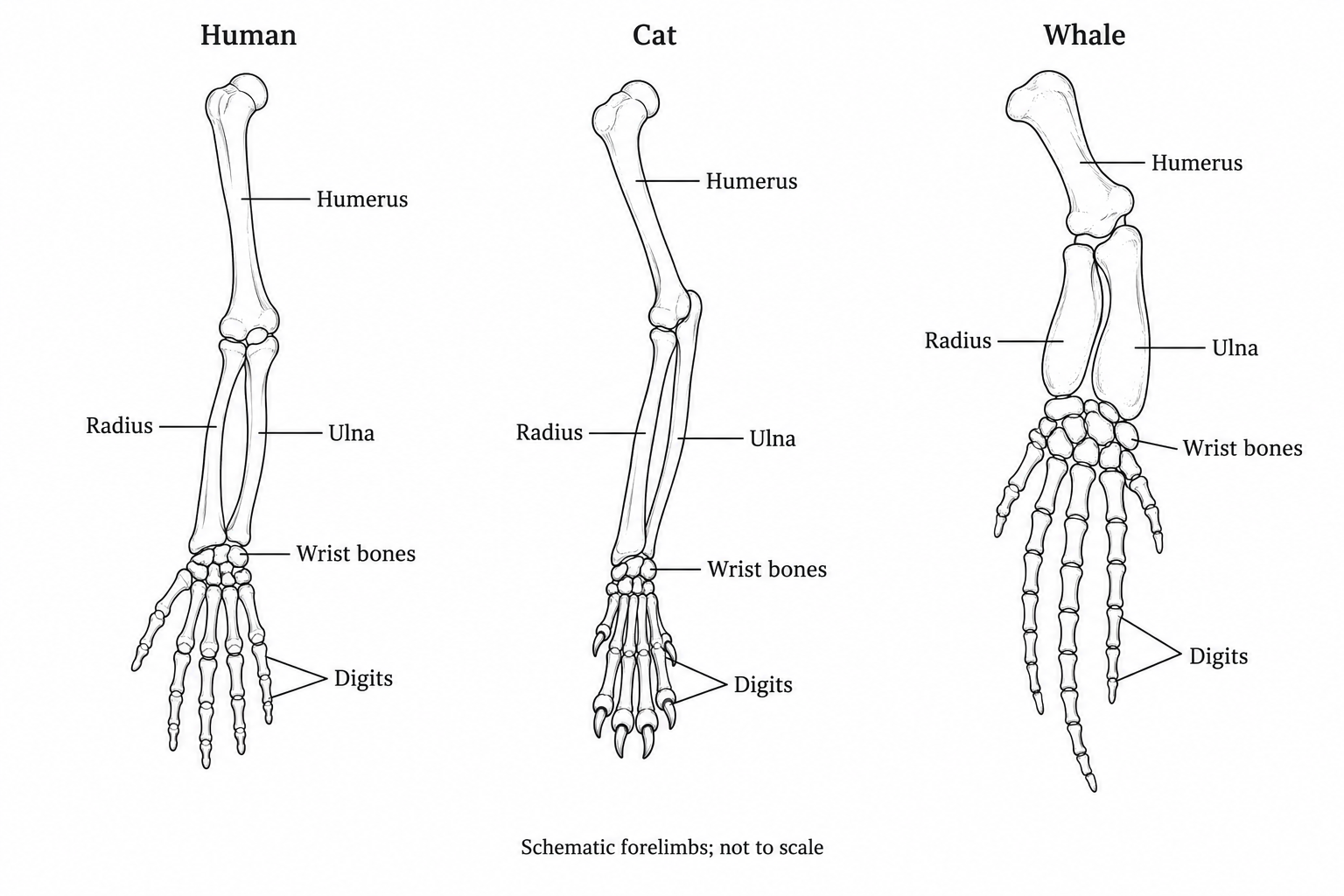
Diagram for question 9: The figure compares the forelimb skeletons of a human, a cat, and a whale. Although these limbs perform…
  1. A) The three animals have identical limb shapes because they live in the same habitat.
  2. B) The matching bone arrangement shows that the three animals belong to one species.
  3. C) The limbs are modified versions of a skeletal pattern inherited from a common ancestor.
  4. D) The three animals acquired matching bones by using their limbs in the same way.

Q10.

The figure shows representative shell fossils from three undisturbed rock layers at one site. Which statement best explains how this fossil record provides evidence relevant to evolution?
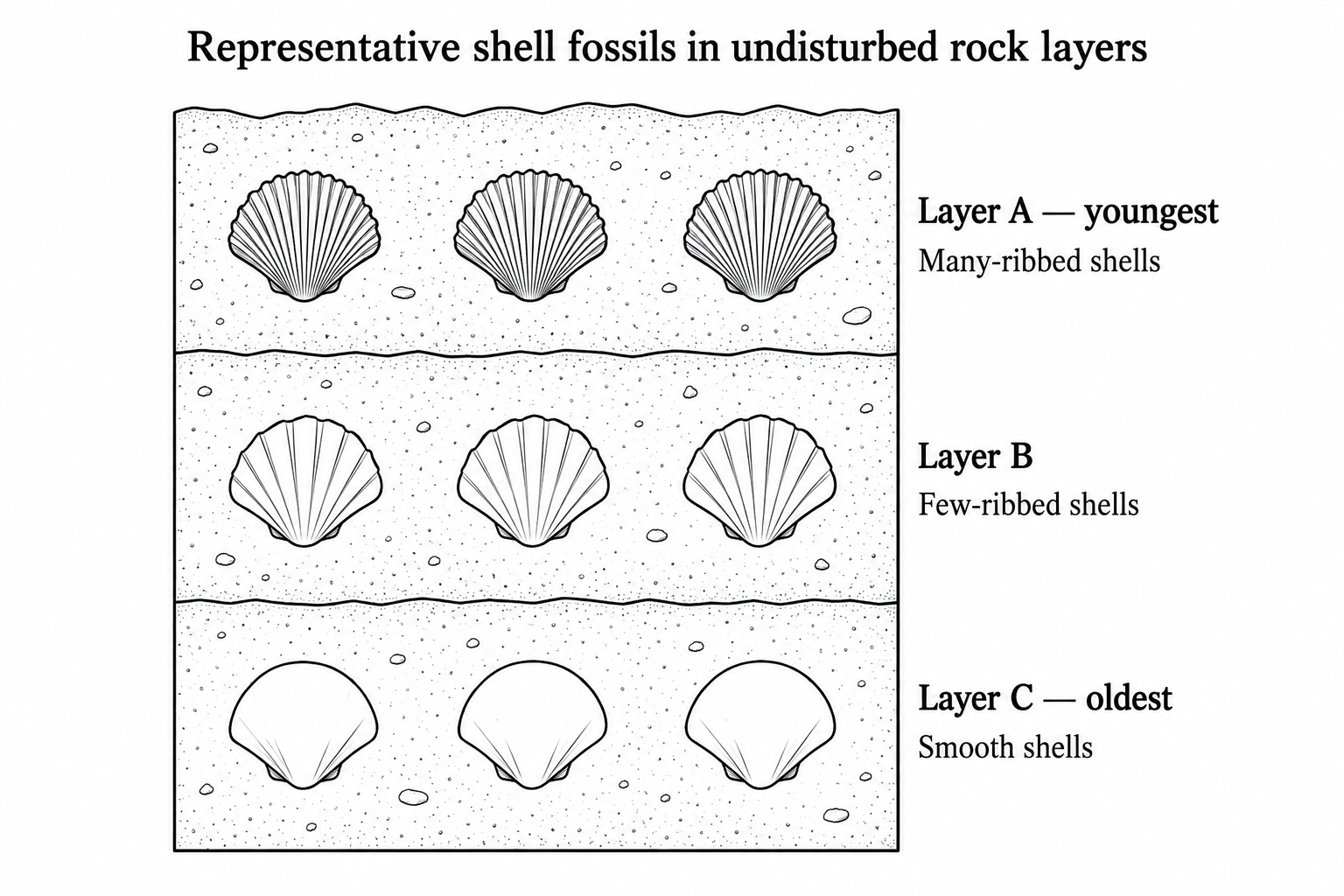
Diagram for question 10: The figure shows representative shell fossils from three undisturbed rock layers at one site. Which…
  1. A) The layers record a change in the shell forms present in this area over time.
  2. B) The shells changed their inherited features after they became buried in rock.
  3. C) The three shell forms must have lived at the same time because they occur at one site.
  4. D) The shell form in the youngest layer must be the ancestor of the forms in the older layers.

What this assessment covers

Concepts Tested

  • Evolution

Question Mix

  • Medium questions included

Skills you build

  • Understand