

PHYSICS - WORK AND POWER
Work Worksheet
- 10 questions
- Recall and use the equation for mechanical working W = Fd = ∆E
- Difficulty: Hard
- Board: CAIE
- Attempt online on the examination portal
Start the 10-question quiz
Free, no sign-up needed. Your score shows instantly.
Here are the first 3 questions. Click “View all questions” to see the complete assessment.
Q1.
Q2.
A hoist raises a load vertically at constant speed through 3.0 m. It does 2.4 kJ of mechanical work. The gravitational potential energy of the load increases by 1800 J. All remaining work is done against a constant frictional force. What is this frictional force?
Q3.
A drilling machine pushes a drill straight into rock. The pushing force is 450 N for the first 4.0 m, then 750 N for the remaining distance. The machine does a total of 6.3 kJ of work on the drill. What is the total distance the drill moves?
Q4.
Motor A pulls a cable with a constant force of 600 N and transfers 3.6 kJ mechanically. Motor B transfers 25% more energy mechanically than motor A, while pulling its cable with a constant force of 900 N. Each cable moves in the direction of its pulling force. How does the distance moved by motor B's cable compare with that moved by motor A's cable?
Q5.
A hand-operated pump transfers energy to water during each downward stroke. The handle moves 25 cm under a constant downward force of 160 N. All work done during a downward stroke is transferred to the water, and no energy is transferred to the water during the return stroke. How many complete downward strokes transfer 1.44 kJ to the water?
Q6.
A worker pushes a crate 3.0 m east and then pushes it 1.2 m west. During each part of the journey, the worker exerts a constant force of 80 N in the direction the crate is moving. What is the total mechanical energy transferred to the crate by the worker's pushing force?
Q7.
A motor can transfer a total of 14 kJ mechanically before stopping. It first pulls a trolley through 12 m with a constant force of 200 N, then through 8.0 m with a constant force of 1000 N. It uses all its remaining available mechanical energy to pull with a constant force of 600 N. All pulling forces act along the trolley's motion. How far does the trolley move during this final part?
Q8.
A cable exerts a constant upward force of 240 N on a rising load whose weight is 180 N. During a particular upward movement, the cable does 600 J of work. Air resistance is negligible. What is the increase in the load's kinetic energy during this movement?
Q9.
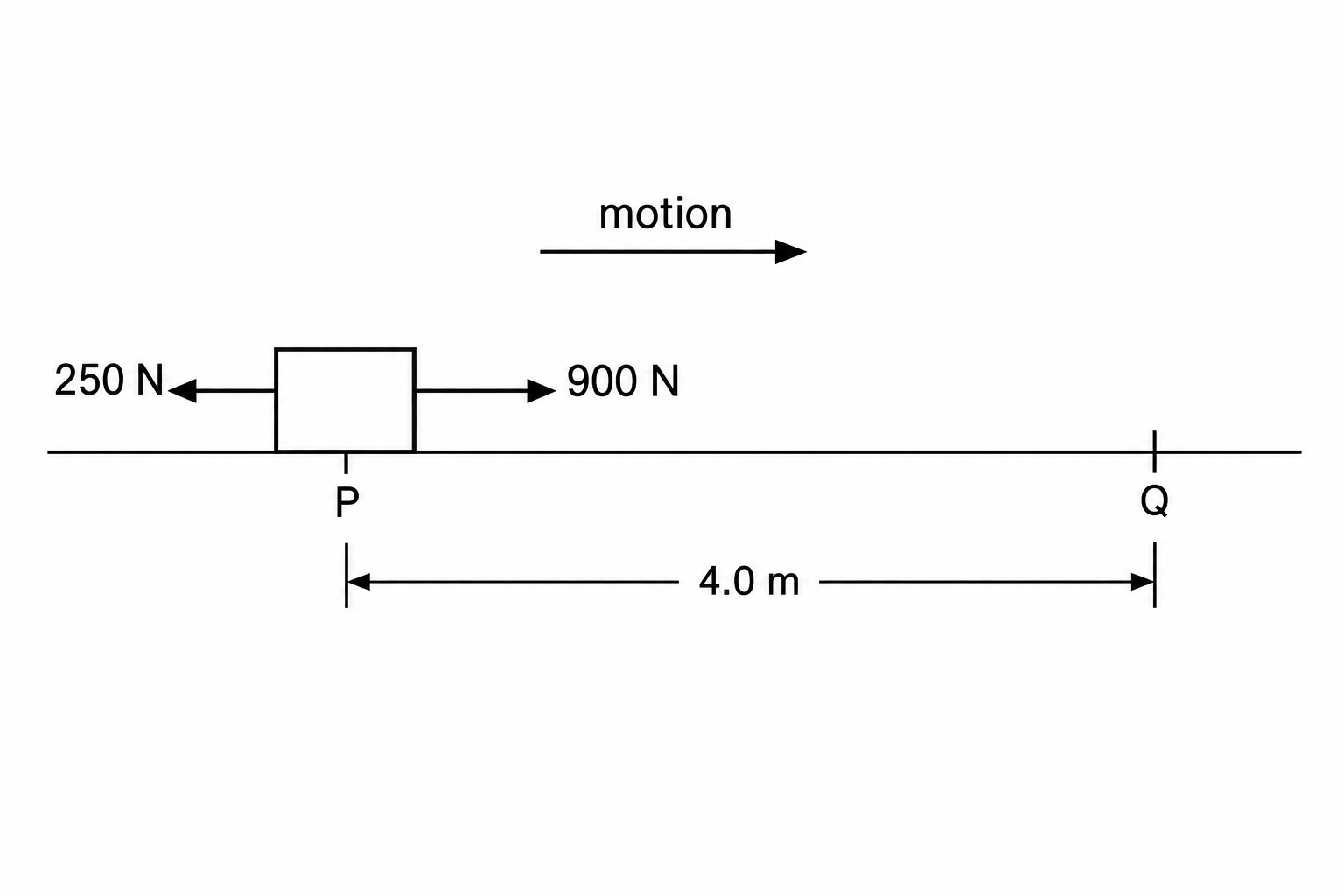
The diagram shows the only horizontal forces acting on a moving block. Both forces remain constant as the block moves from P to Q. At P, the block has kinetic energy 800 J. What is its kinetic energy at Q?
Q10.
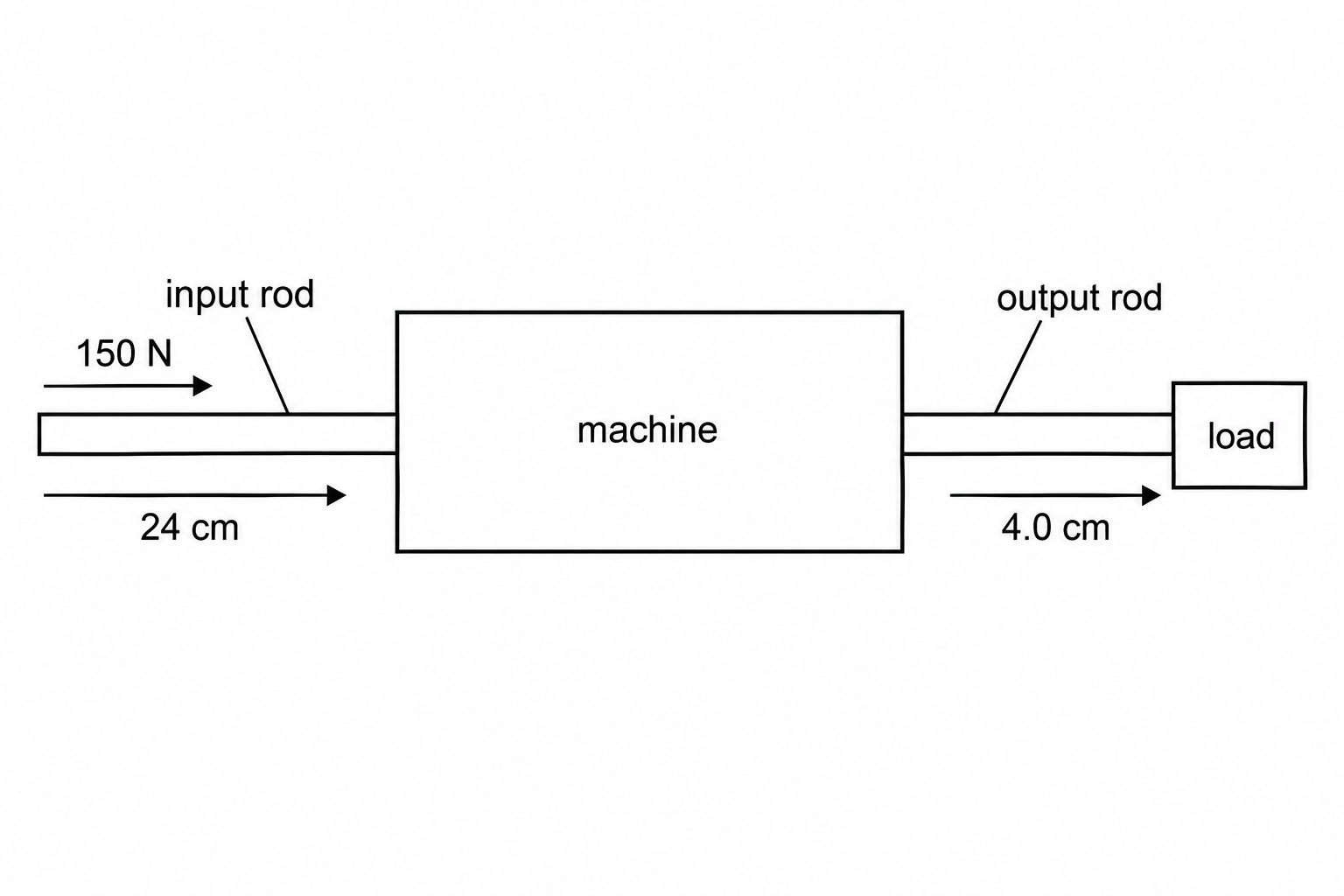
The diagram shows the input and output rods of a machine during one operation. The input force acts along the input rod's displacement. The machine transfers 6.0 J of the input work to thermal energy; all the remaining input work is done by the output rod on a load. The output rod exerts a constant force in the direction of its displacement. What is this output force?
What this assessment covers
Concepts Tested
- Work and Power
- Recall and use the equation for mechanical working W = Fd = ∆E
Question Mix
- Hard questions included
Skills you build
- Apply
Related assessments
More practice
Other assessments in this subject
