

PHYSICS - WAVE PROPERTIES

Wave Properties Worksheet

  • 10 questions
  • Describe the features of a wave in terms of wavefront, wavelength, frequency, crest (peak), trough, amplitude and wave speed
  • Difficulty: Medium
  • Board: CAIE
  • Attempt online on the examination portal
Start the 10-question quiz Free, no sign-up needed. Your score shows instantly.

Here are the first 3 questions. Click “View all questions” to see the complete assessment.

Q1.

A vibrating source produces a wave on a rope. The amplitude of the wave is increased while its frequency stays unchanged. Which statement describes this change?

  1. A) Each point on the rope completes more oscillations each second.
  2. B) The maximum distance of each point from its equilibrium position increases.
  3. C) The distance travelled by a crest each second must increase.
  4. D) The distance between consecutive crests must increase.

Q2.

A sound wave travels through air as a repeating pattern of compressions and rarefactions. Which distance represents one wavelength?

  1. A) The distance from the centre of one compression to the centre of the next compression.
  2. B) The distance an air particle travels during one complete oscillation.
  3. C) The distance from the centre of a compression to the centre of the next rarefaction.
  4. D) The greatest distance an air particle moves from its equilibrium position.

Q3.

A floating marker completes 24 complete oscillations in 6.0\ s as water waves pass. Which statement correctly describes the frequency of the waves?

  1. A) It is 24\ Hz, meaning that twenty-four oscillations are completed each second.
  2. B) It is 0.25\ Hz, meaning that a quarter of an oscillation is completed each second.
  3. C) It is 4.0\ Hz, meaning that four oscillations are completed each second.
  4. D) It is 6.0\ Hz, meaning that six oscillations are completed each second.

Q4.

A student watches a regular water wave travelling across a tank. Which observation directly measures the wave speed?

  1. A) The distance a particular crest advances divided by the time taken.
  2. B) The horizontal distance between two consecutive crests.
  3. C) The greatest vertical distance of the water surface from its undisturbed level.
  4. D) The number of crests passing a fixed point divided by the time taken.

Q5.

A photograph shows several complete waves on a rope beside a ruler. The equilibrium position is marked, but no timing information or wave speed is provided. Which pair of wave properties can be determined from this photograph alone?

  1. A) Wavelength and wave speed.
  2. B) Amplitude and wavelength.
  3. C) Frequency and wave speed.
  4. D) Amplitude and frequency.

Q6.

A transverse wave travels along a horizontal rope. Upward displacement is taken as positive. Which statement correctly describes a crest and a trough?

  1. A) A crest is any point moving upwards, and a trough is any point moving downwards.
  2. B) A crest has maximum positive displacement, and a trough has zero displacement.
  3. C) A crest has maximum positive displacement, and a trough has maximum negative displacement.
  4. D) A crest has zero displacement, and a trough has maximum negative displacement.

Q7.

A student draws a wavefront through a travelling water wave. Which description must apply to the points joined by this wavefront?

  1. A) They include every point with the same displacement, even if some points are rising and others are falling.
  2. B) They have equal distances from the source, whatever the shape of the wave.
  3. C) They are at the same stage of their oscillations at the same instant.
  4. D) They lie along the direction in which the wave travels.

Q8.

The diagram shows the shape of a transverse wave at one instant. What are its amplitude and wavelength?
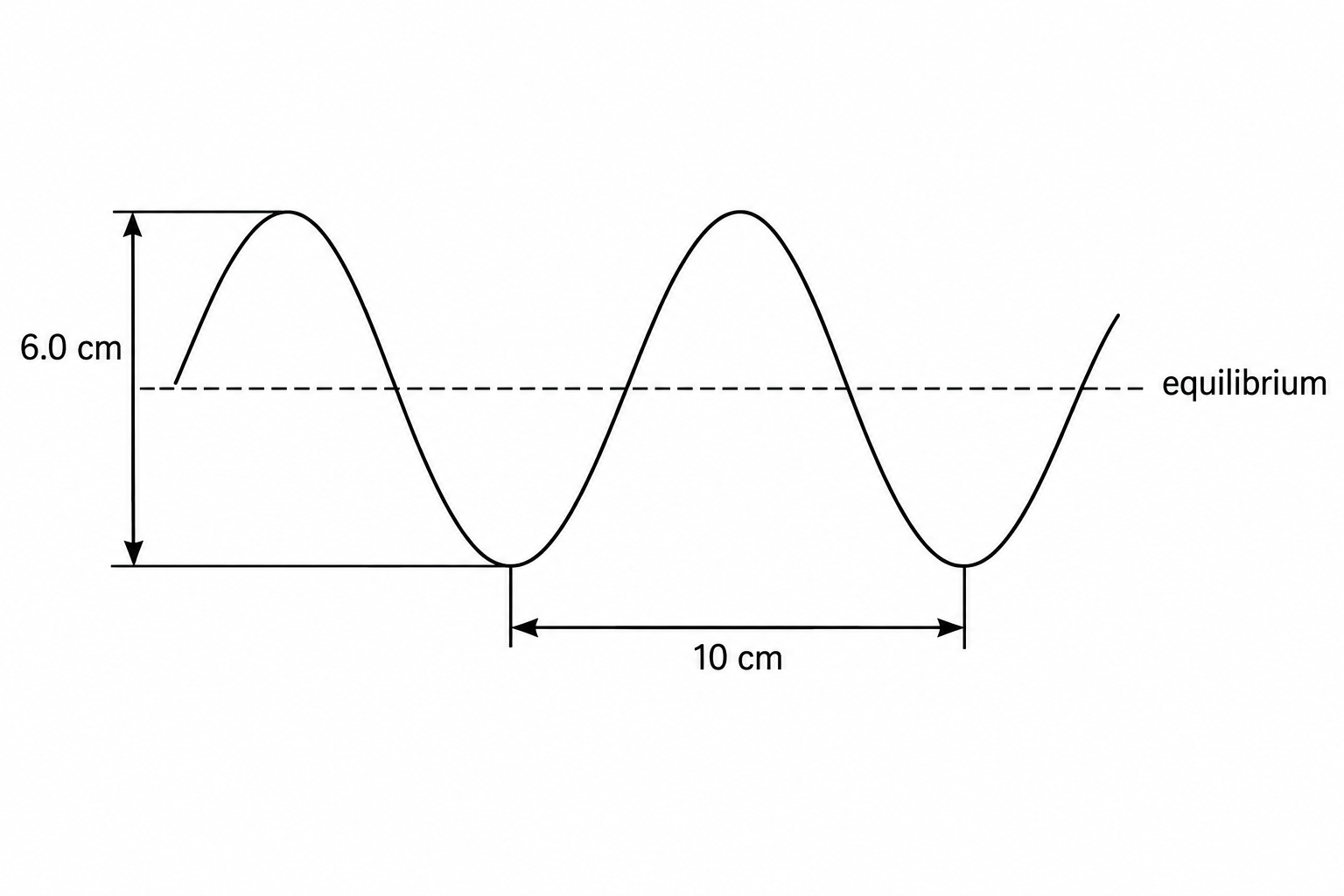
Diagram for question 8: The diagram shows the shape of a transverse wave at one instant. What are its amplitude and wavelength?
  1. A) Amplitude 3.0\ cm; wavelength 5.0\ cm.
  2. B) Amplitude 3.0\ cm; wavelength 10\ cm.
  3. C) Amplitude 6.0\ cm; wavelength 20\ cm.
  4. D) Amplitude 6.0\ cm; wavelength 10\ cm.

Q9.

The diagram shows consecutive crest wavefronts spreading outwards from a point source. The radial gap between neighbouring wavefronts is marked. Which statement correctly describes the wavelength and the direction of travel at point P?
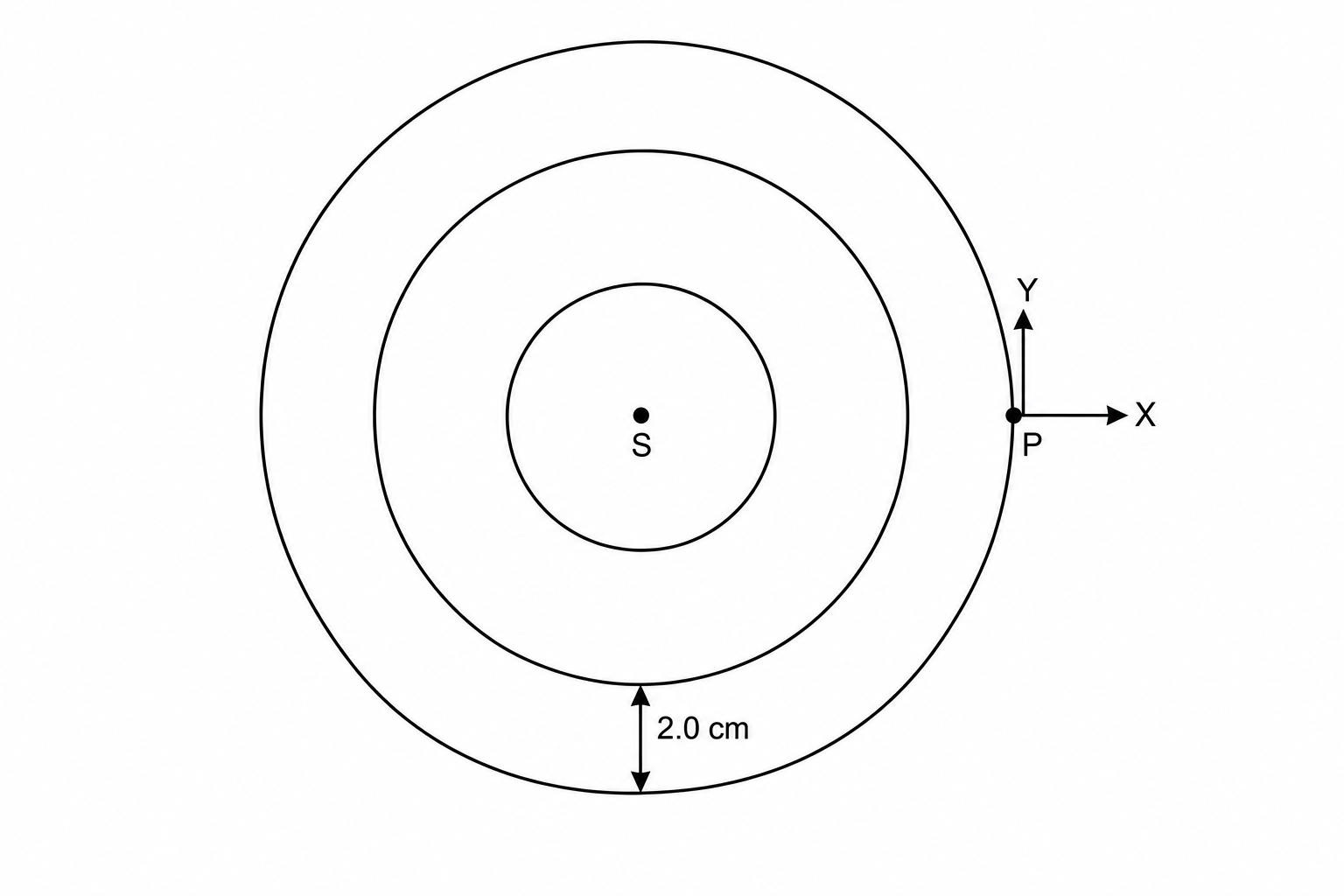
Diagram for question 9: The diagram shows consecutive crest wavefronts spreading outwards from a point source. The radial gap…
  1. A) The wavelength is 4.0\ cm, and the wave travels along arrow Y.
  2. B) The wavelength is 2.0\ cm, and the wave travels along arrow X.
  3. C) The wavelength is 4.0\ cm, and the wave travels along arrow X.
  4. D) The wavelength is 2.0\ cm, and the wave travels along arrow Y.

Q10.

The diagram shows consecutive crest wavefronts in two separate wave trains, A and B, drawn to the same scale. Both wave trains have the same frequency. How do the wavelength and wave speed of B compare with those of A?
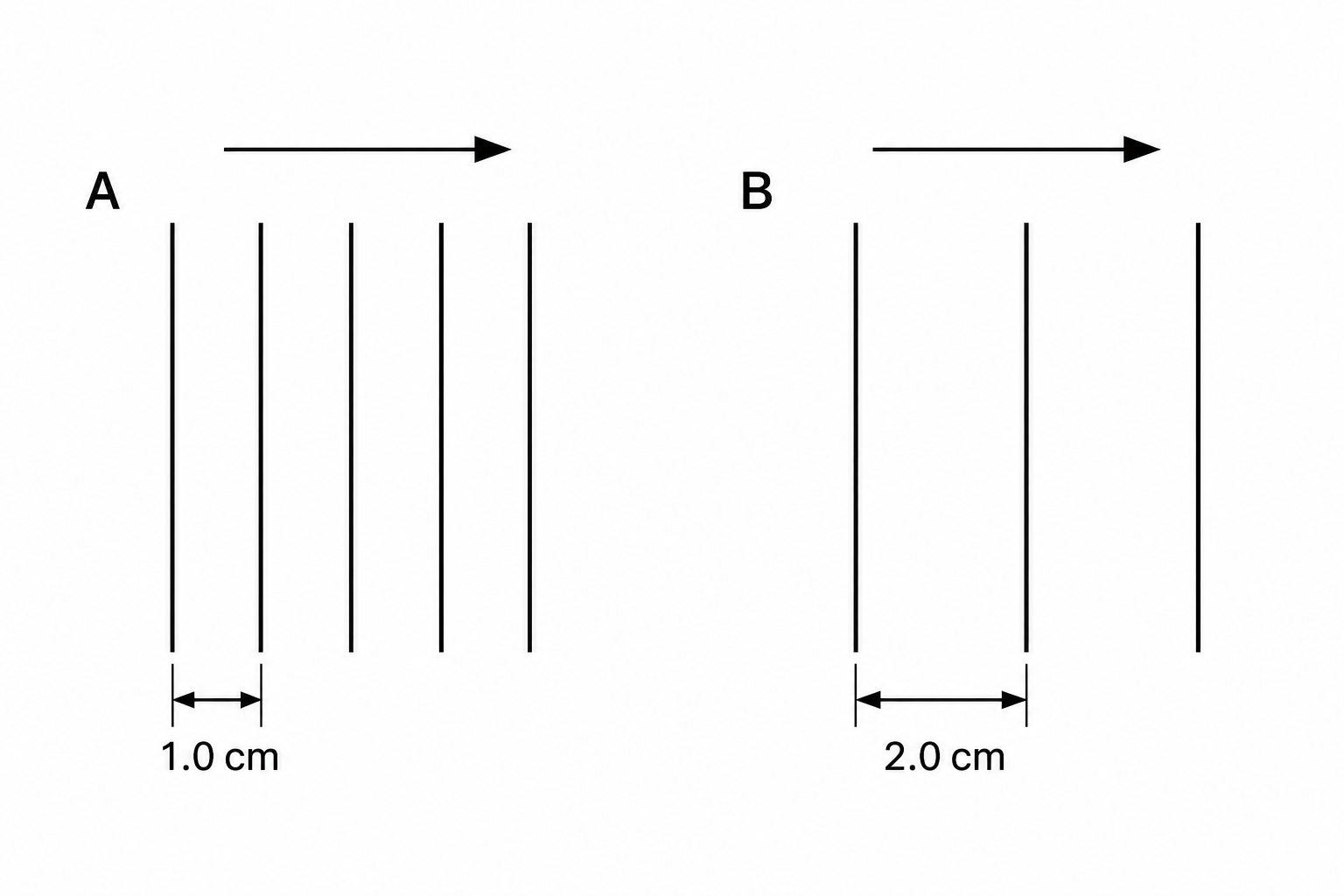
Diagram for question 10: The diagram shows consecutive crest wavefronts in two separate wave trains, A and B, drawn to the same…
  1. A) The wavelength is twice as large, and the wave speed is unchanged.
  2. B) The wavelength is twice as large, and the wave speed is twice as large.
  3. C) The wavelength is half as large, and the wave speed is half as large.
  4. D) The wavelength is unchanged, and the wave speed is twice as large.

What this assessment covers

Concepts Tested

  • Wave Properties
  • Describe the features of a wave in terms of wavefront, wavelength, frequency, crest (peak), trough, amplitude and wave speed

Question Mix

  • Medium questions included

Skills you build

  • Understand