

PHYSICS - ELECTRIC FIELDS

Coulomb's Law Practice Problems

  • 10 questions
  • Difficulty: Medium
  • Board: CAIE
  • Attempt online on the examination portal
Start the 10-question quiz Free, no sign-up needed. Your score shows instantly.

Here are the first 3 questions. Click “View all questions” to see the complete assessment.

Q1.

Two fixed point charges in free space exert a force of magnitude F on each other. Their separation is doubled without changing either charge. What is the new force magnitude?

  1. A) 2F
  2. B) 4F
  3. C) F/2
  4. D) F/4

Q2.

Two small charged spheres are modelled as point charges at a fixed separation in free space. Initially their charges are + 3Q and + Q. Charge is transferred between them so that each has charge + 2Q. Which statement correctly compares the final force with the initial force?

  1. A) It becomes zero because the charges are now equal.
  2. B) It is smaller because the larger charge has decreased.
  3. C) It is unchanged because the total charge is unchanged.
  4. D) It is larger because the product of the charges has increased.

Q3.

Point charges + Q and −4Q are held apart in free space. The force on the positive charge has magnitude F. What is the force on the negative charge?

  1. A) Magnitude F, directed away from the positive charge.
  2. B) Magnitude F, directed towards the positive charge.
  3. C) Magnitude F/4, directed towards the positive charge.
  4. D) Magnitude 4F, directed towards the positive charge.

Q4.

Two point charges in free space are initially + 2Q and −3Q. Both signs are reversed while their positions remain fixed. How does this affect the electrostatic force on each charge?

  1. A) Its magnitude is unchanged, but attraction becomes repulsion.
  2. B) Its magnitude and direction are both unchanged.
  3. C) Its magnitude becomes zero because the signs have been reversed.
  4. D) Its magnitude doubles, but its direction is unchanged.

Q5.

A student uses Coulomb’s point-charge law to estimate the force between two charged conducting spheres in free space. In which situation is treating the spheres as point charges most reliable?

  1. A) The spheres are almost touching, so their separation is easy to measure.
  2. B) Both radii are much smaller than the separation between their centres.
  3. C) Their radii are comparable with their separation, but their charges are equal.
  4. D) Their charges have opposite signs, regardless of their radii and separation.

Q6.

Coulomb’s law is written as F = k(|q_1q_2|)/(r²). Which unit must the constant k have so that the equation gives force in newtons?

  1. A) mathrmN m² C⁻¹
  2. B) mathrmN m⁻² C⁻²
  3. C) mathrmN m² C⁻²
  4. D) mathrmN⁻¹ m⁻² C²

Q7.

Two small charged objects are held at a fixed separation in free space and are modelled as point charges. One object is replaced by another with the same charge but three times the mass. Which statement about the electrostatic force is correct?

  1. A) It becomes one-third as large because the heavier object is harder to move.
  2. B) It remains unchanged because the charges and separation are unchanged.
  3. C) It becomes nine times as large because the force follows a square law.
  4. D) It becomes three times as large because one mass has increased.

Q8.

The separation r of two fixed-magnitude point charges in free space is varied. Their electrostatic force magnitude is F. Which graph would be a straight line through the origin?

  1. A) F against 1/r².
  2. B) F against 1/r.
  3. C) F against r.
  4. D) F against r².

Q9.

The diagram shows two point charges in free space. Which statement describes the electrostatic force on charge A due to charge B?
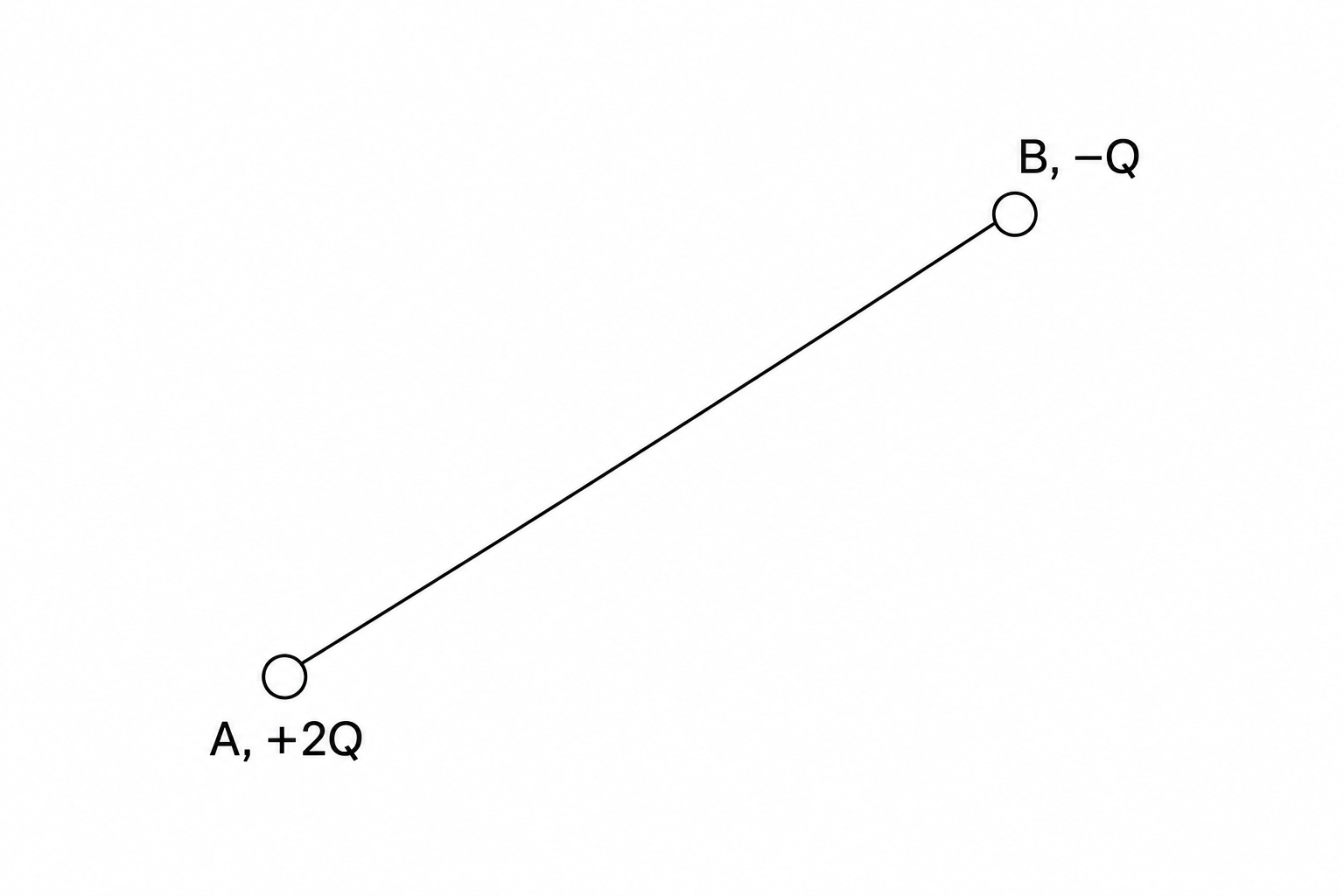
Diagram for question 9: The diagram shows two point charges in free space. Which statement describes the electrostatic force on…
  1. A) It acts vertically upwards.
  2. B) It acts along the line joining the charges, towards B.
  3. C) It acts horizontally to the right.
  4. D) It acts along the line joining the charges, away from B.

Q10.

The diagram shows two charged spheres in free space. Each carries charge + q. A model replaces each sphere by a point charge at its centre. Using this model, which expression gives the force magnitude? Take k = 1/(4πvarepsilon_0).
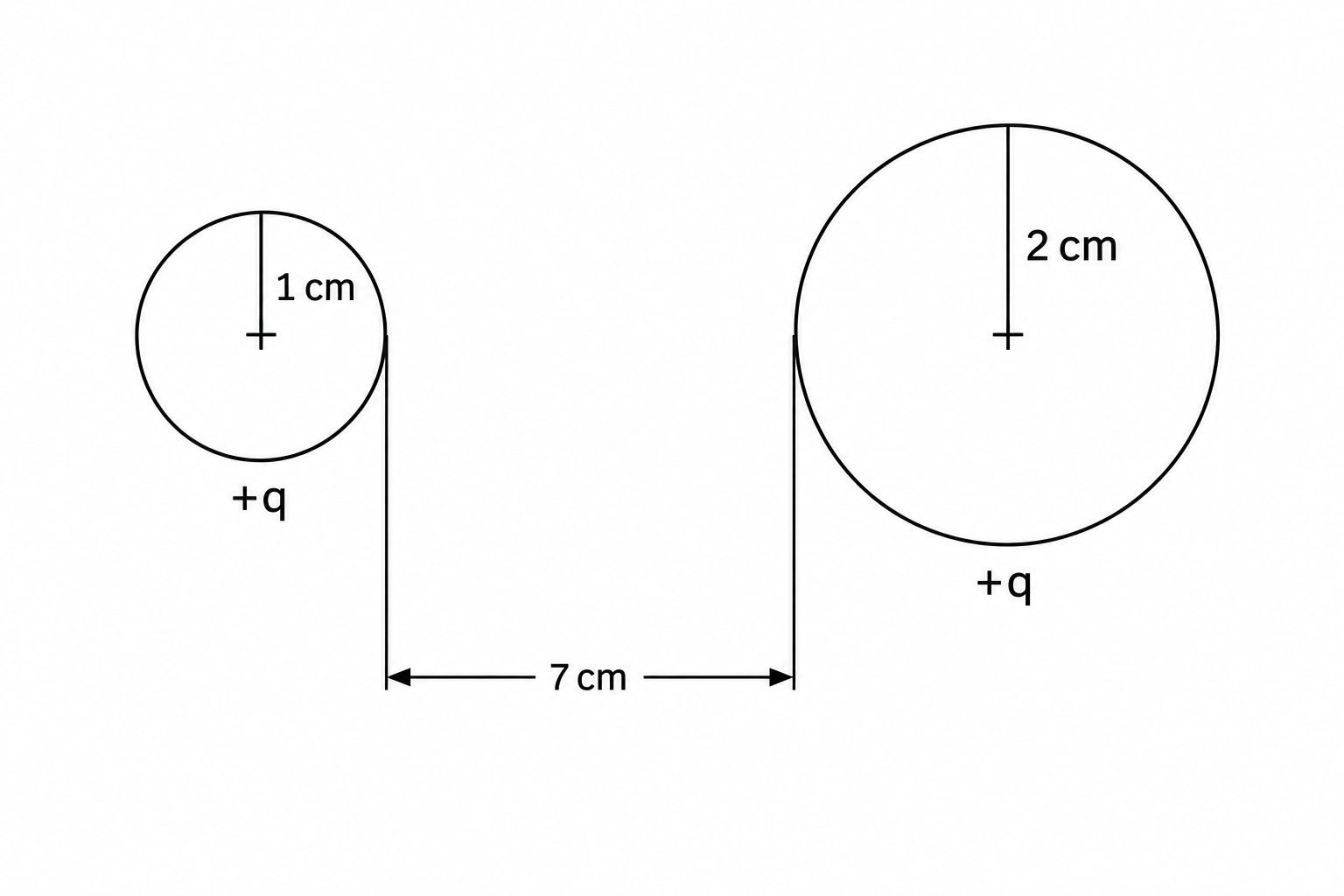
Diagram for question 10: The diagram shows two charged spheres in free space. Each carries charge + q. A model replaces each sphere…
  1. A) frackq²(0.09 m)²
  2. B) frackq²(0.10 m)²
  3. C) frackq²(0.08 m)²
  4. D) frackq²(0.07 m)²

What this assessment covers

Concepts Tested

  • Electric Fields

Question Mix

  • Medium questions included

Skills you build

  • Understand