

PHYSICS - CONSERVATION OF ENERGY

Conservation of Energy Worksheet

  • 10 questions
  • Know the principle of the conservation of energy and apply this principle to simple examples including the interpretation of simple flow diagrams
  • Difficulty: Medium
  • Board: CAIE
  • Attempt online on the examination portal
Start the 10-question quiz Free, no sign-up needed. Your score shows instantly.

Here are the first 3 questions. Click “View all questions” to see the complete assessment.

Q1.

A skydiver falls at a constant speed before opening a parachute. Which statement correctly describes the energy changes during this part of the fall?

  1. A) Gravitational potential energy stays constant because the skydiver's speed is constant.
  2. B) Gravitational potential energy decreases, kinetic energy stays constant, and energy is transferred to the thermal stores of the skydiver and surroundings.
  3. C) Gravitational potential energy decreases, and this energy is destroyed by air resistance.
  4. D) Gravitational potential energy decreases, and all of it becomes additional kinetic energy.

Q2.

A battery-powered torch becomes dim and eventually stops producing light. A student says, 'The torch has used up the energy, so that energy no longer exists.' Which response best corrects the student's explanation?

  1. A) The energy remains unchanged in the battery, but the torch can no longer reach it.
  2. B) Energy from the battery has been transferred to the surroundings by light and heating.
  3. C) The battery has converted its energy into electric charge, which has been used up.
  4. D) The torch has destroyed the useful energy but conserved the wasted energy.

Q3.

A ball is dropped onto a hard floor and rebounds to a lower height. Air resistance is negligible. Which observation would provide evidence for where some of the energy not recovered as gravitational potential energy has gone?

  1. A) The ball has the same mass after the bounce.
  2. B) A sound is produced at impact, and the ball and floor become slightly warmer.
  3. C) The ball accelerates downwards after reaching its greatest rebound height.
  4. D) The ball is momentarily at rest at its greatest rebound height.

Q4.

During a short interval, a refrigerator transfers 200 J of energy from its cold interior. It also receives 80 J of electrical energy. Its own energy stores do not change overall. How much energy does it transfer to the room?

  1. A) 120 J
  2. B) 200 J
  3. C) 80 J
  4. D) 280 J

Q5.

A motor receives 500 J of electrical energy while lifting a load. The load gains 350 J of gravitational potential energy. The motor finishes at the same speed as it started. Which statement is consistent with conservation of energy?

  1. A) The motor created 150 J while lifting the load.
  2. B) The remaining 150 J increased other energy stores or was transferred to the surroundings.
  3. C) Only 350 J was actually supplied to the motor.
  4. D) The remaining 150 J disappeared because the motor was not perfectly efficient.

Q6.

A pendulum is released from rest. Friction and air resistance are negligible. At a point between its release position and its lowest position, which statement correctly compares its energy with that at release?

  1. A) Its decrease in gravitational potential energy equals its increase in kinetic energy.
  2. B) Its kinetic energy equals all the gravitational potential energy it had at release, measured relative to the lowest position.
  3. C) Its gravitational potential energy is unchanged, but its kinetic energy has increased.
  4. D) Its total energy is smaller because some energy is needed to keep it moving.

Q7.

Two identical toy cars are released from rest on different smooth tracks. Both cars start at the same height and finish at the same lower height. One track is steep and short; the other is less steep and longer. Friction and air resistance are negligible. Why do the cars have the same kinetic energy at the finish?

  1. A) The longer track transfers more energy, but the car uses up the extra energy.
  2. B) They lose equal amounts of gravitational potential energy, which become equal amounts of kinetic energy.
  3. C) The steeper track creates more energy, but only during the first part of the motion.
  4. D) They take the same time to reach the finish.

Q8.

A car travels at constant speed along a level road while its engine burns fuel. Which explanation is consistent with conservation of energy?

  1. A) Energy released by the fuel is transferred to the surroundings while the car's kinetic energy remains constant.
  2. B) The fuel releases no energy because the car is not accelerating.
  3. C) The car stores all the energy released by the fuel as additional kinetic energy.
  4. D) The engine destroys energy at the same rate as the fuel creates it.

Q9.

The diagram shows all the energy transfers for a water heater during a short interval. The heater's own energy stores do not change overall. Which statement correctly interprets the diagram?
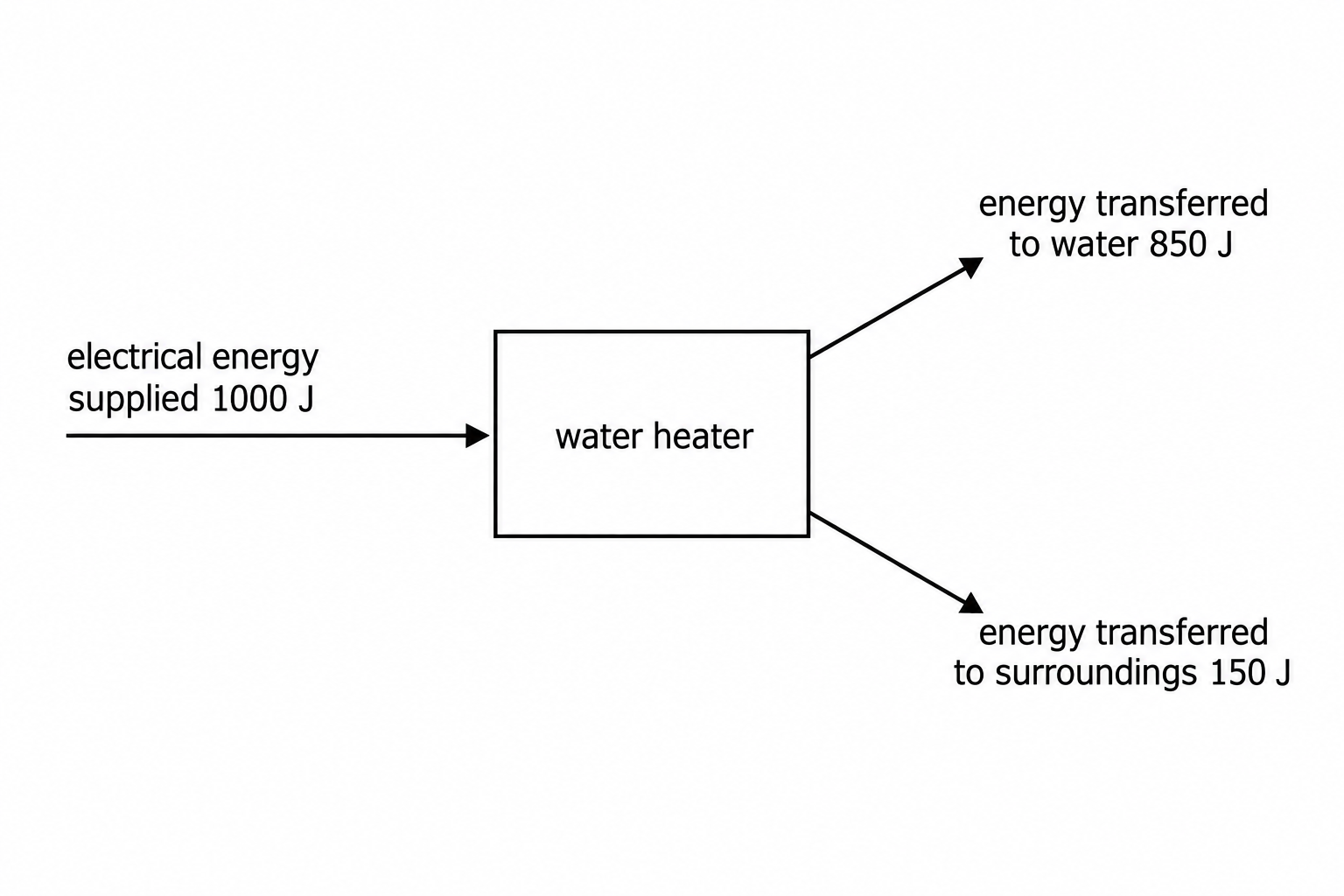
Diagram for question 9: The diagram shows all the energy transfers for a water heater during a short interval. The heater's own…
  1. A) The useful energy transfer is smaller than the input, so total energy is not conserved.
  2. B) The surroundings receive energy that is created by the heater.
  3. C) The two outgoing transfers together account for all the incoming electrical energy.
  4. D) Only the energy transferred to the water needs to be included when checking conservation of energy.

Q10.

The diagram shows energy transfers as a solar panel charges a battery. All transfers during the interval are shown, and the solar panel's energy store does not change. How much energy is transferred to the surroundings in total?
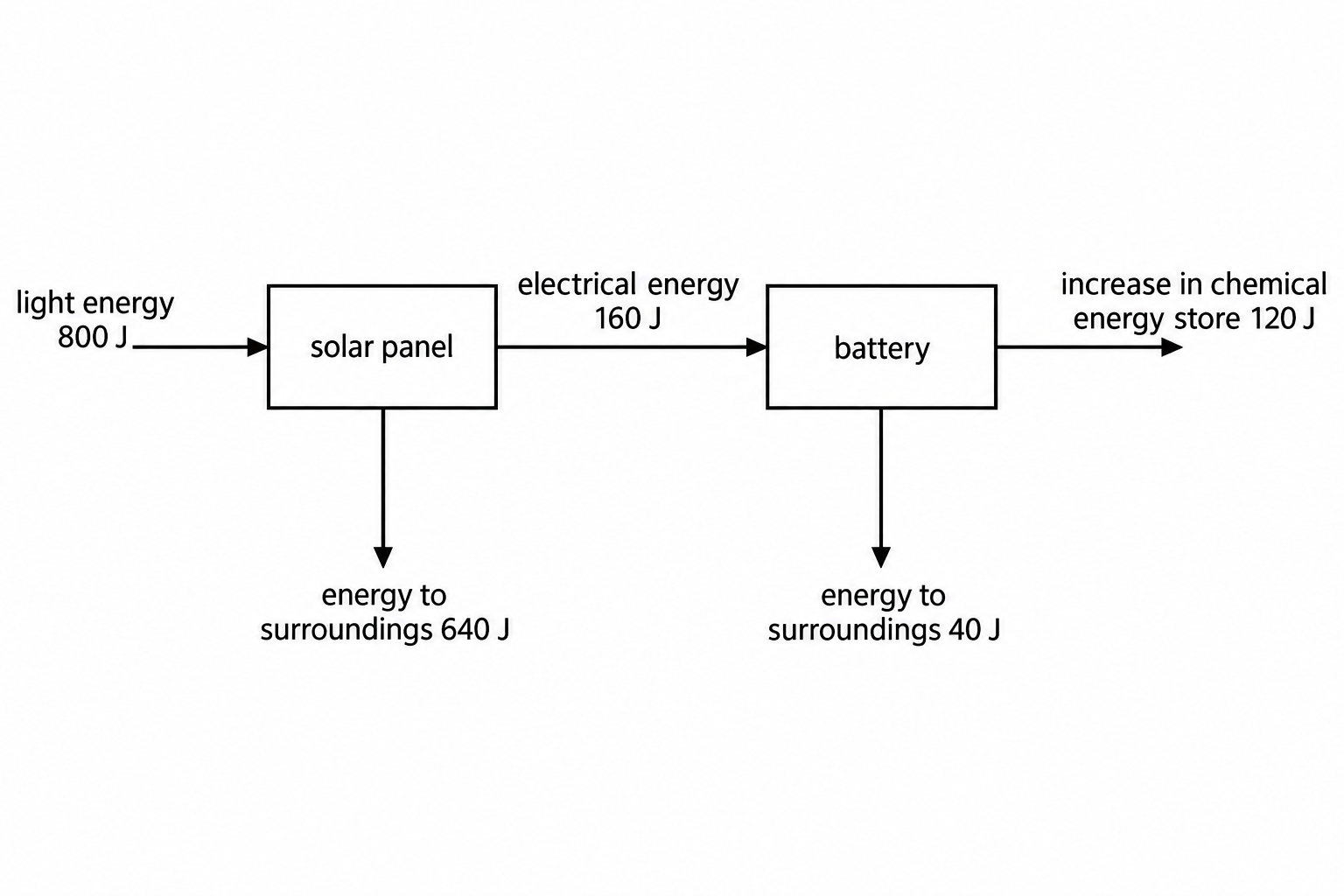
Diagram for question 10: The diagram shows energy transfers as a solar panel charges a battery. All transfers during the interval are…
  1. A) 160 J
  2. B) 840 J
  3. C) 680 J
  4. D) 640 J

What this assessment covers

Concepts Tested

  • Conservation of Energy
  • Know the principle of the conservation of energy and apply this principle to simple examples including the interpretation of simple flow diagrams

Question Mix

  • Medium questions included

Skills you build

  • Understand