

MATHEMATICS - SURFACE AREA AND VOLUME
Volume Worksheet
- Covers volume calculations for various 3D shapes including prisms and cylinders
- Involves complex geometric reasoning and measurement skills
- Focuses on applying formulas to find missing dimensions
- Challenges students with real-world measurement conversions
Start the 10-question quiz
Free, no sign-up needed. Your score shows instantly.
Here are the first 3 questions. Click “View all questions” to see the complete assessment.
Q1.
Q2.
A cylinder has volume 1232 cm³ and height 8 cm. Using π = 22/7, calculate its radius.
Q3.
A prism has a rectangular cross-section measuring 12 cm × 9 cm. A rectangular section measuring 5 cm × 4 cm is removed from one corner along the full length of the prism. If the prism is 15 cm long, what is the volume that remains?
Q4.
A triangular prism has volume 756 cm³. Its triangular cross-section has base 9 cm, and the prism is 14 cm long. What is the perpendicular height of the triangular cross-section?
Q5.
A prism has a regular hexagonal cross-section that can be divided into six congruent triangles. Each triangle has base 6 cm and perpendicular height 5.2 cm. The prism is 10 cm long. Calculate its volume.
Q6.
A cylinder has volume 450 cm³. A second cylinder has twice the radius and 3/4 of the height of the first cylinder. What is the volume of the second cylinder?
Q7.
A cylindrical tank has diameter 1.2 m and length 2.5 m. Using π = 3.142 and 1 m³ = 1000 L, calculate its capacity in litres.
Q8.
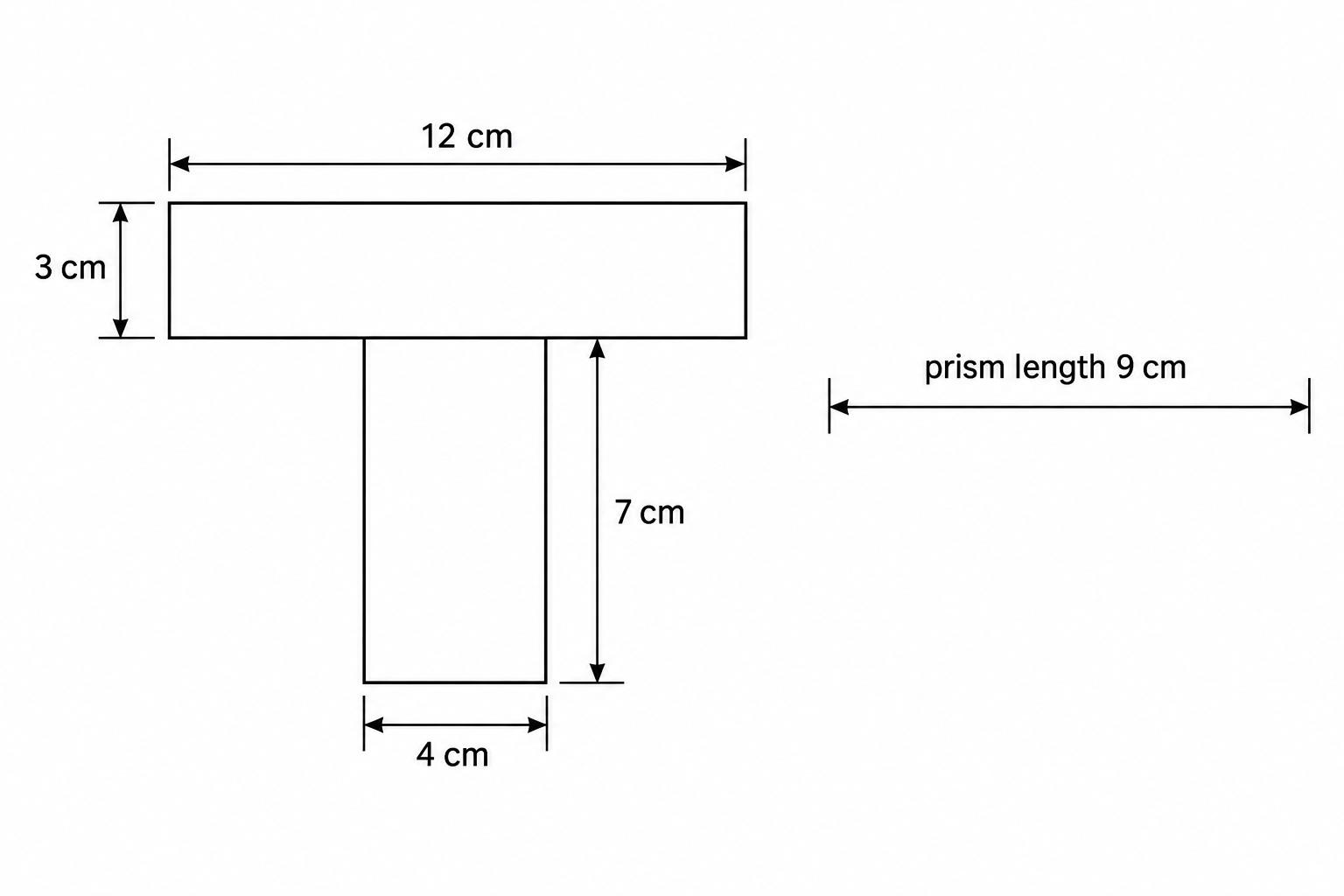
The diagram shows the cross-section and length of a prism. Calculate the volume of the prism.
Q9.
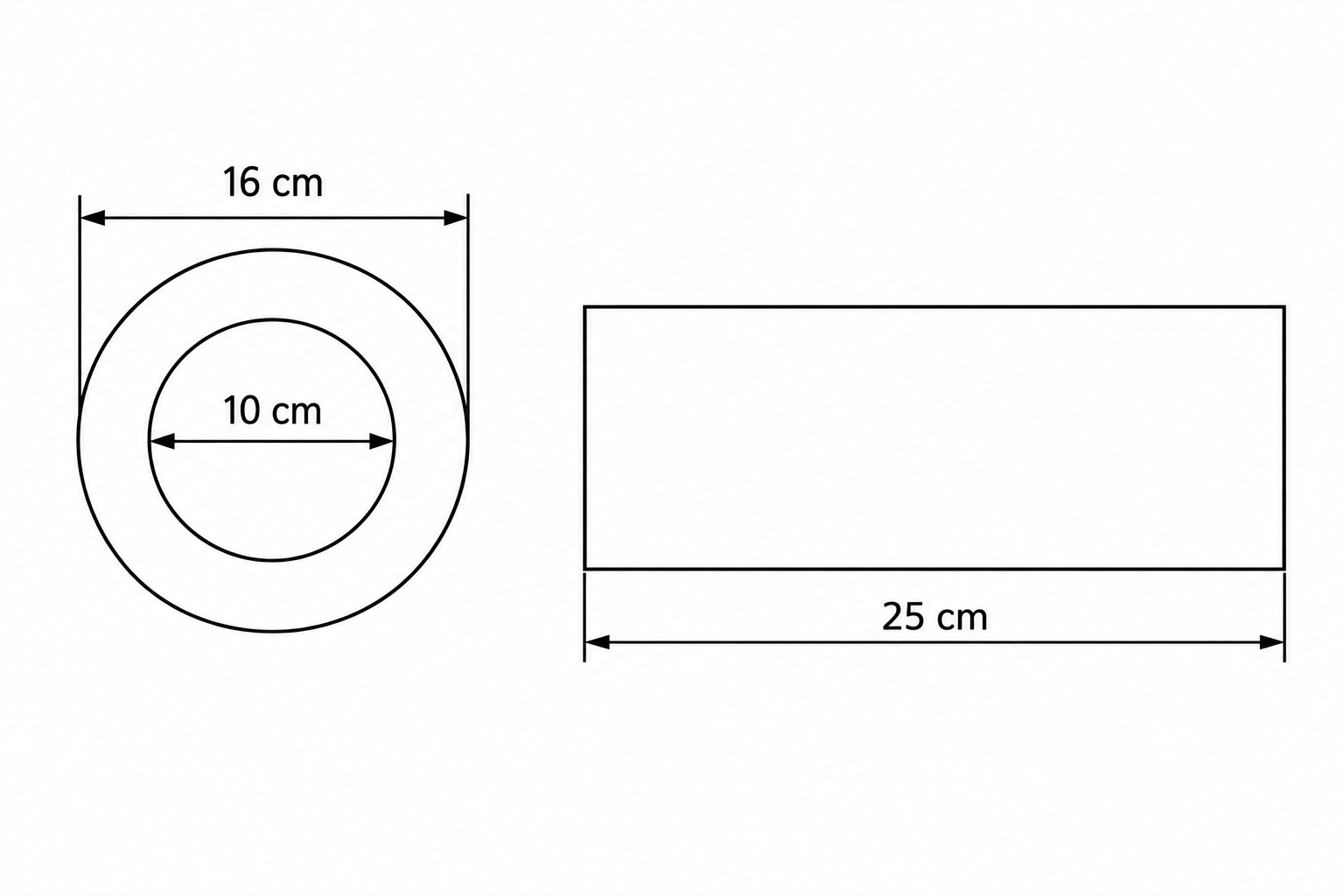
The diagram shows a hollow cylinder. Using π = 3.142, calculate the volume of material in the cylinder.
Q10.
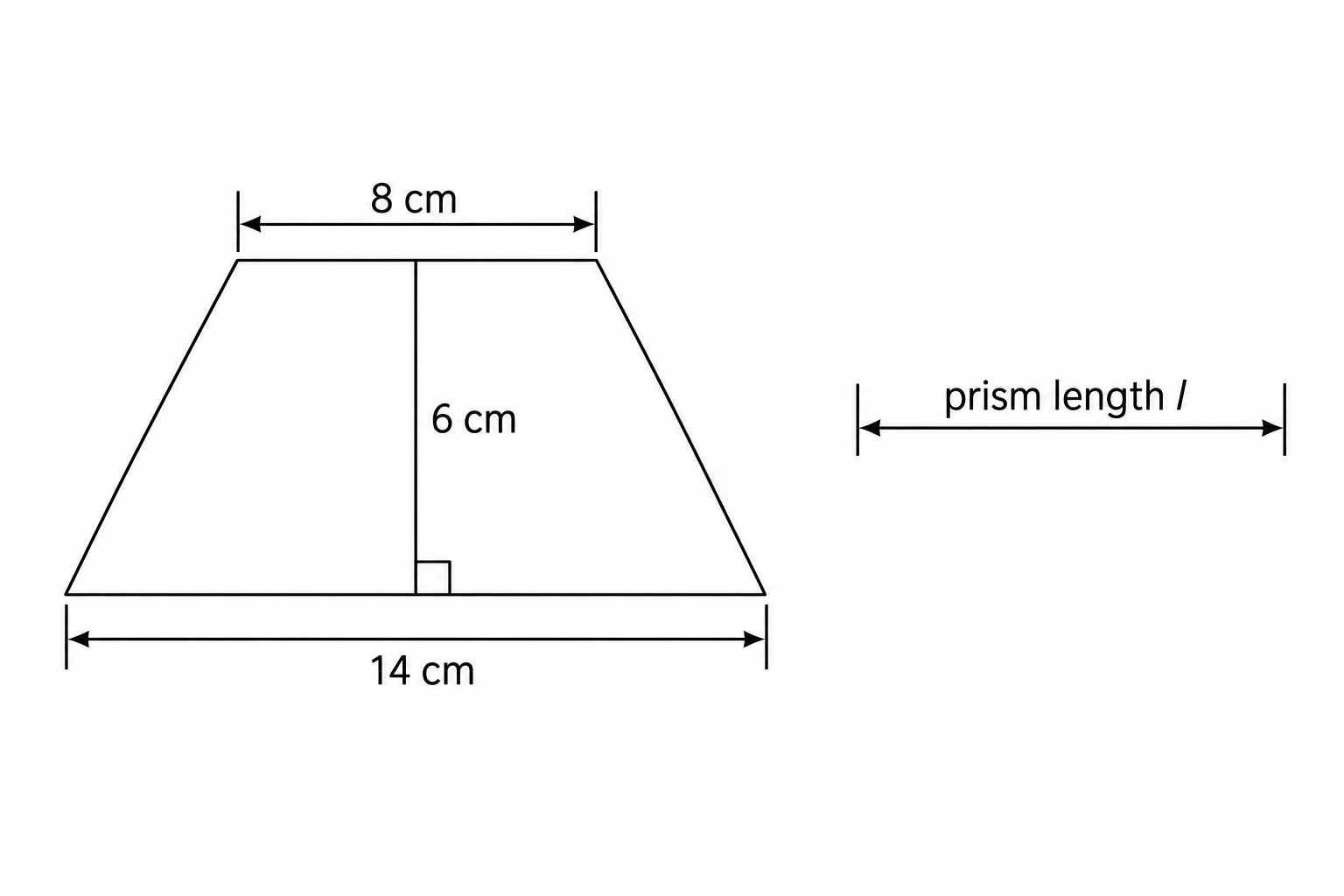
The prism shown has volume 990 cm³. Calculate its length, l.
What this assessment covers
Concepts tested
- Volume calculation of prisms and cylinders
- Understanding of cross-sectional areas
- Application of geometric formulas
- Conversion between units of measurement
- Properties of regular and irregular shapes
Question Mix
- Hard questions included
Skills you build
- Calculate volume of complex shapes
- Apply geometric formulas to solve problems
- Interpret and use diagrams effectively
- Perform unit conversions in measurement
- Analyze and solve multi-step mathematical problems
Related assessments
More practice
Other assessments in this subject
