

MATHEMATICS - SURFACE AREA AND VOLUME
Surface Area Worksheet
- Focuses on calculating surface areas of various 3D shapes
- Includes problems involving cuboids, cylinders, prisms, and pyramids
- Challenges students with complex geometrical reasoning tasks
Start the 10-question quiz
Free, no sign-up needed. Your score shows instantly.
Here are the first 3 questions. Click “View all questions” to see the complete assessment.
Q1.
Q2.
A closed cylinder has diameter 14 cm and height 10 cm. What is its total surface area in terms of π?
Q3.
A triangular prism is 15 cm long. Its cross-section is a right-angled triangle whose perpendicular sides are 6 cm and 8 cm. What is the total surface area of the prism?
Q4.
A square-based pyramid has base edge 10 m. The perpendicular height of each triangular side face, measured from the apex to a base edge, is 13 m. What is the total surface area of the pyramid?
Q5.
A solid is made from 4 identical cubes, each with edge length 3 cm. Three cubes are joined face-to-face in a straight row. The fourth cube is placed directly on top of the middle cube. What is the external surface area of the solid?
Q6.
The dimensions of a cuboid are x cm, (x + 2) cm and 4 cm. Its total surface area is 128 cm². What is the volume of the cuboid?
Q7.
A cylindrical container has radius 3 cm and height 8 cm. It has a circular base but no top. What is the total surface area of the container in terms of π?
Q8.
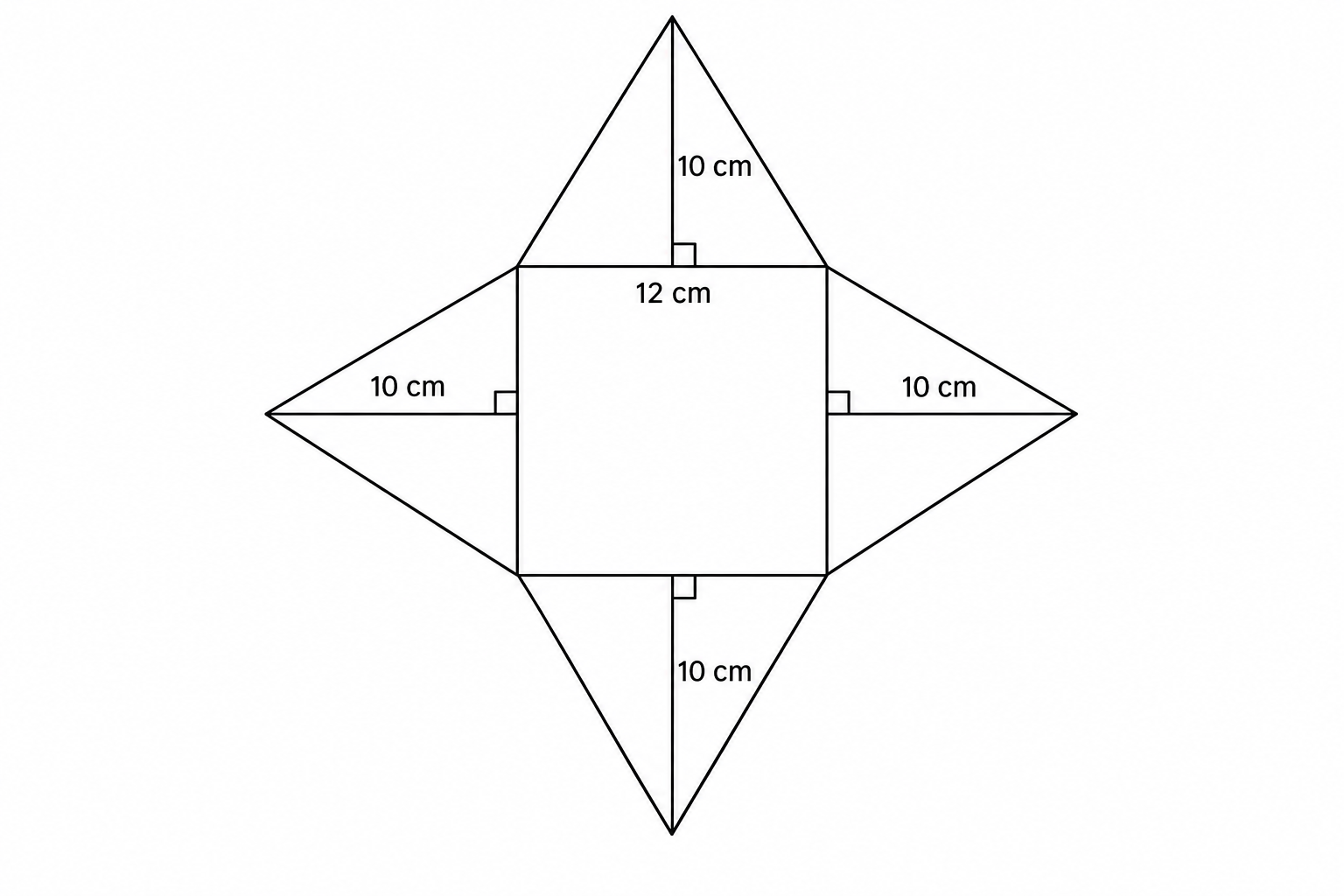
The diagram shows the complete net of a square-based pyramid. What is the total surface area of the pyramid?
Q9.
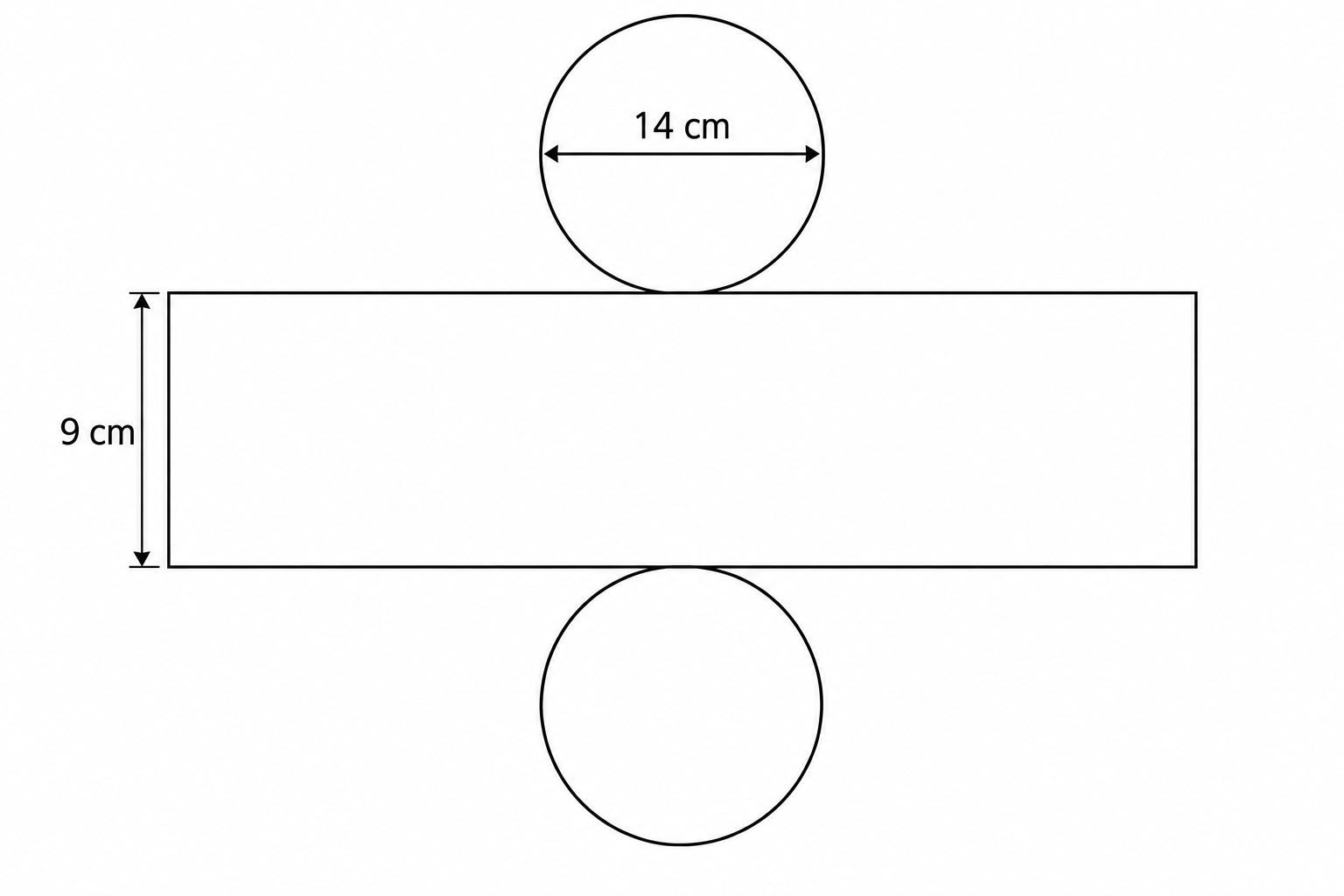
The diagram shows the complete net of a closed cylinder. Using π = 22/7, what is the total surface area of the cylinder?
Q10.
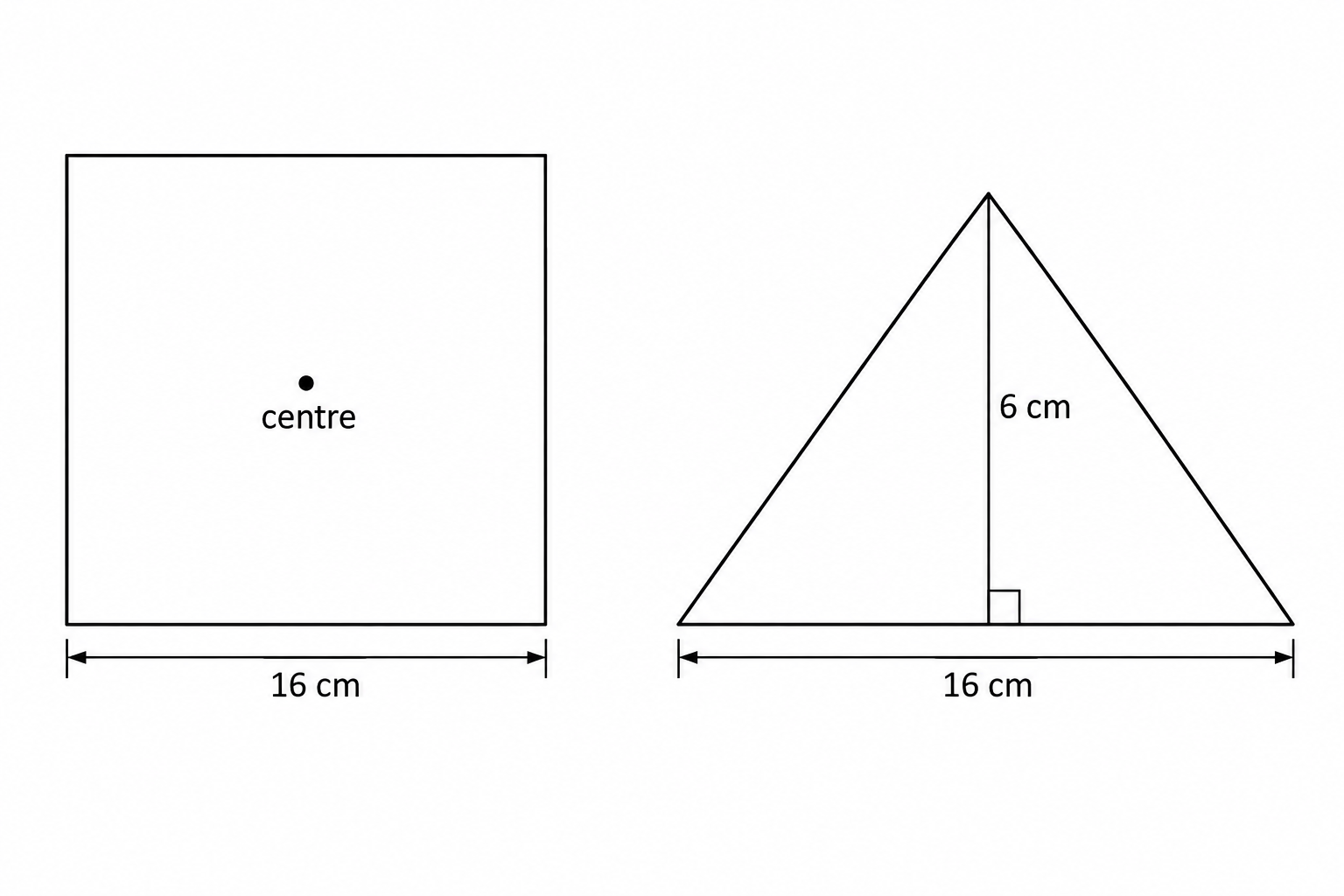
The diagrams show a square-based pyramid and a vertical cross-section through its apex and the midpoints of two opposite base edges. What is the total surface area of the pyramid?
What this assessment covers
Concepts tested
- Surface area of cuboids and open-top containers
- Surface area of cylinders with and without tops
- Surface area of triangular prisms
- Surface area of square-based pyramids
- Understanding and using nets of 3D shapes
Question Mix
- Hard questions included
Skills you build
- Calculate surface area of complex 3D shapes
- Apply formulas for surface area in practical contexts
- Interpret and analyze nets of 3D shapes
- Solve multi-step geometrical problems
- Reason through spatial and measurement challenges
Related assessments
More practice
Other assessments in this subject
