

MATHEMATICS - SURFACE AREA AND VOLUME
Volume Practice Problems
- 10 questions
- Use knowledge of area and volume to derive the formula for the volume of prisms and cylinders. Use the formula to calculate the volume of prisms and cylinders.
- Difficulty: Hard
- Board: CAIE
- Attempt online on the examination portal
Start the 10-question quiz
Free, no sign-up needed. Your score shows instantly.
Here are the first 3 questions. Click “View all questions” to see the complete assessment.
Q1.
Q2.
A straight pipe is a hollow cylinder with an outside diameter of 12 cm and an inside diameter of 8 cm. Its length is 35 cm. What is the volume of material in the pipe?
Q3.
A cylindrical tank has an internal diameter of 70 cm and an internal height of 80 cm. It contains water equal to frac35 of its capacity. How many litres of water does it contain? Use π = 22/7.
Q4.
A triangular prism has a triangular cross-section with base 10 cm and perpendicular height 9 cm. A rectangular hole measuring 3 cm by 2 cm runs through its full length, parallel to its length. The volume of material remaining is 702 cm³. What is the length of the prism?
Q5.
A rectangular concrete slab must be 4.2 m long, 3 m wide and 0.15 m thick. Concrete is supplied in full cylindrical drums with internal diameter 60 cm and internal height 70 cm. Assuming no waste, what is the minimum number of drums needed to supply enough concrete? Use π = 22/7.
Q6.
A cylinder has volume 192π cm³ and height 12 cm. A new cylinder is made with a radius 2 cm greater than the original radius and a height 4 cm less than the original height. What is the volume of the new cylinder?
Q7.
A straight tunnel has a uniform cross-section consisting of a rectangle topped by a semicircle. The internal width is 8 m, and the vertical rectangular walls are 3 m high. The semicircle has the same diameter as the width of the rectangle. The tunnel is 25 m long. What is the volume of the space inside the tunnel?
Q8.
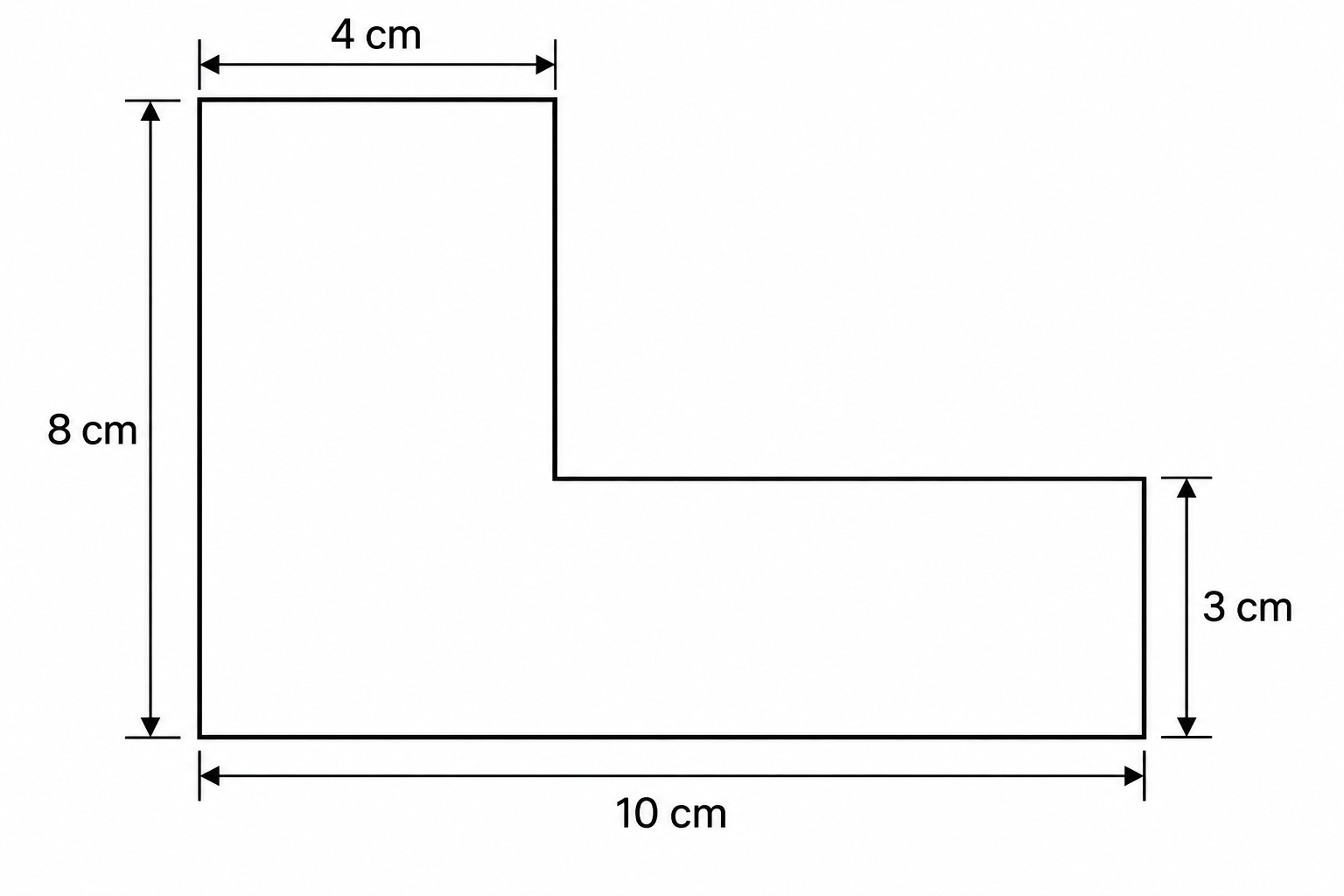
The diagram shows the uniform cross-section of a solid prism. All corners are right angles. The prism is 22 cm long. What is its volume?
Q9.
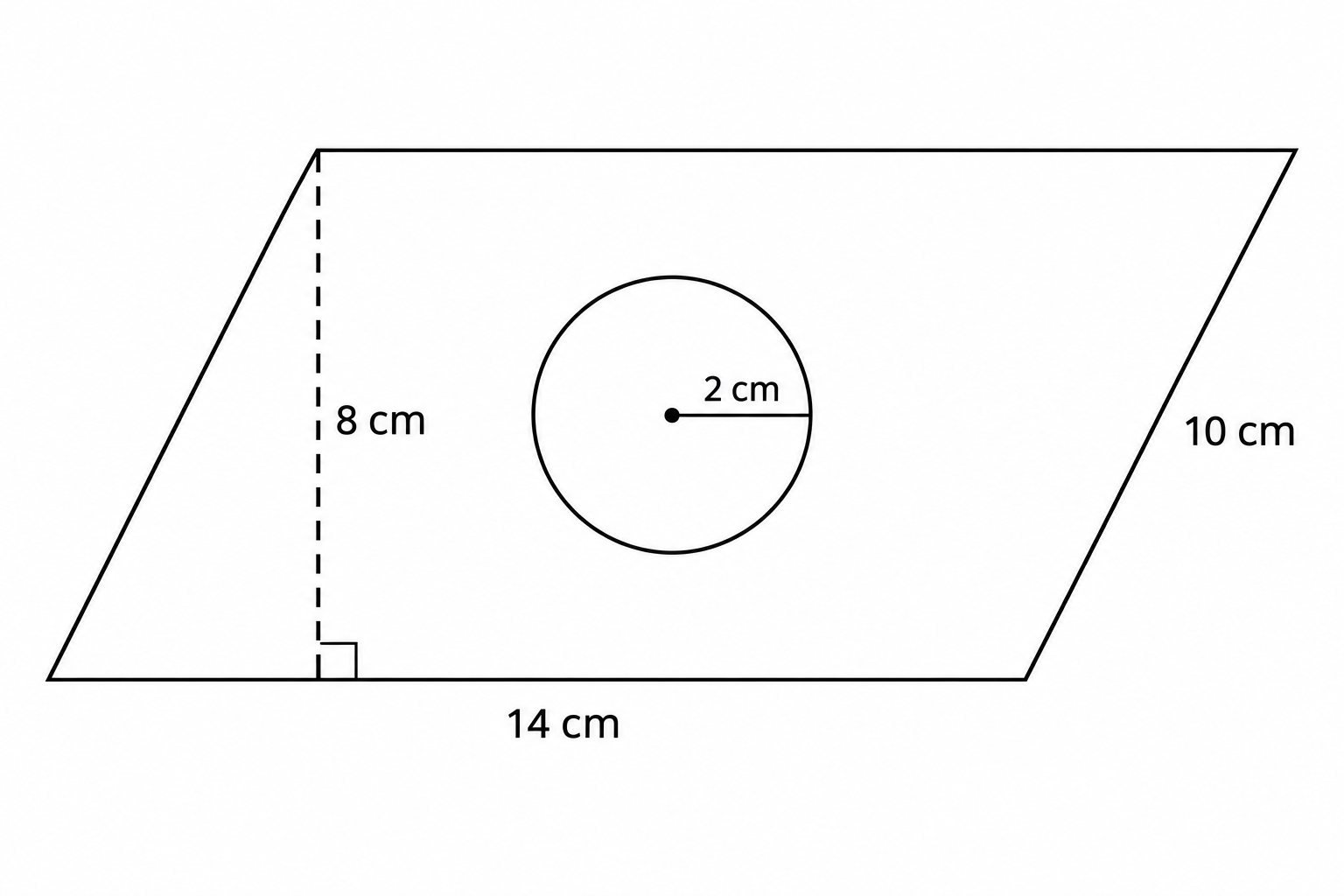
The diagram shows the cross-section of a prism with a circular hole running through its full length. The outer boundary is a parallelogram. The prism is 0.3 m long, and the hole is parallel to its length. What is the volume of material in the prism?
Q10.
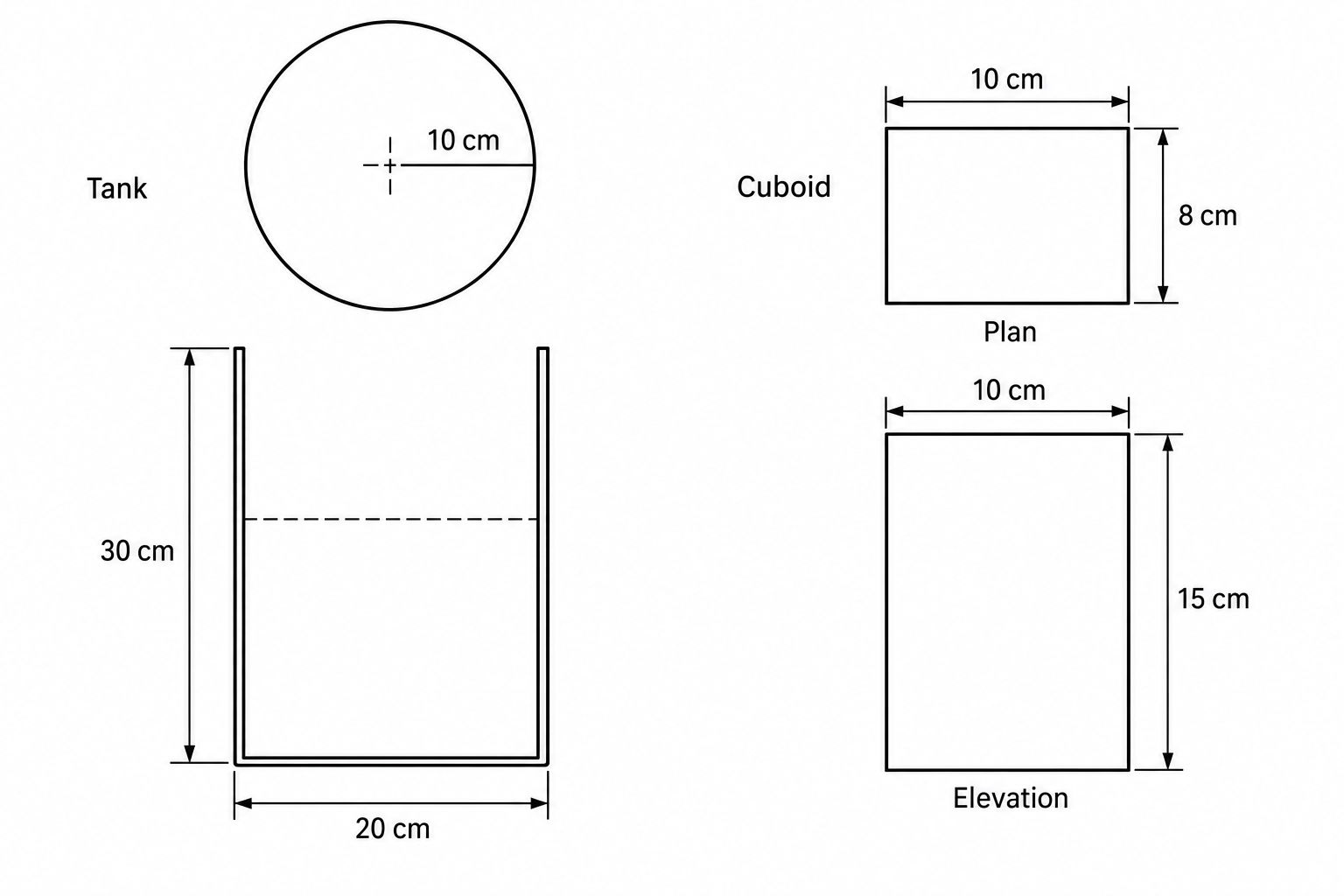
The diagram gives the internal dimensions of a cylindrical tank and the dimensions of a solid metal cuboid. Initially, the water is 18 cm deep. The cuboid is lowered into the tank until it is completely submerged. No water is lost. What is the new depth of the water?
What this assessment covers
Concepts Tested
- Surface Area and Volume
- Use knowledge of area and volume to derive the formula for the volume of prisms and cylinders. Use the formula to calculate the volume of prisms and cylinders.
Question Mix
- Hard questions included
Skills you build
- Apply
Related assessments
More practice
Other assessments in this subject
