

EARTH & ENVIRONMENTAL SCIENCE - WEATHER AND CLIMATE

Weather vs Climate Worksheet

  • 10 questions
  • Describe the difference between climate and weather.
  • Difficulty: Hard
  • Board: CAIE
  • Attempt online on the examination portal
Start the 10-question quiz Free, no sign-up needed. Your score shows instantly.

Here are the first 3 questions. Click “View all questions” to see the complete assessment.

Q1.

A coastal town is described as having mild winters, based on records collected over 30 years. One winter, the town has two days of snow. A reporter claims that the climate description must now be wrong. Which response best applies the difference between weather and climate?

  1. A) The reporter is correct because climate describes conditions during the current winter.
  2. B) The reporter is incorrect because a brief weather event can differ from the long-term pattern.
  3. C) The reporter is correct because the coldest event determines a town's climate.
  4. D) The reporter is incorrect because snowfall is not included when describing climate.

Q2.

A school is choosing a month for an annual outdoor sports event and deciding whether tomorrow's practice should go ahead. It has monthly rainfall averages from 30 years and a detailed forecast for tomorrow. How should the school use these sources?

  1. A) Use tomorrow's forecast to choose the event month and the long-term averages to decide about practice.
  2. B) Use the long-term averages to choose the event month and tomorrow's forecast to decide about practice.
  3. C) Use the long-term averages for both decisions because individual forecasts do not describe climate.
  4. D) Use tomorrow's forecast for both decisions because it is newer than the long-term averages.

Q3.

During a five-day visit to an island, a student measures rainfall each day and calculates the average daily rainfall. The student labels the result 'the island's climate'. Which change would best address the problem with this label?

  1. A) Measure rainfall every hour during the same visit so the average contains more readings.
  2. B) Use rainfall records covering all seasons over many years to describe the long-term rainfall pattern.
  3. C) Replace the average with the wettest day because extreme conditions define climate.
  4. D) Include wind measurements from the same five days so the result describes more conditions.

Q4.

An old harbour diary says, 'Strong winds stopped fishing on three days this week.' A separate archive shows that strong winds occurred most often in winter across 35 years. A museum wants to explain what each source reveals. Which explanation should it use?

  1. A) The diary describes climate because it is old; the archive describes weather because it records winds.
  2. B) The diary describes weather during one week; the archive supports a description of the seasonal climate pattern.
  3. C) The diary describes climate because it covers several days; the archive describes only repeated weather events, not climate.
  4. D) Both sources describe only weather because climate information cannot be obtained from observations.

Q5.

A weather station records warm, calm conditions at sunrise, followed by a sudden temperature drop and strong winds that afternoon. A student writes, 'The climate changed during the day.' Which replacement would make the statement scientifically accurate?

  1. A) The climate changed because both temperature and wind changed together.
  2. B) The climate stayed unchanged because climate includes temperature but not wind.
  3. C) The weather changed only if the new conditions continued for several years.
  4. D) The weather changed during the day; these observations alone do not establish a change in climate.

Q6.

Two towns have the same average annual rainfall over 30 years. In one town, most rain falls in winter. In the other, rain is spread fairly evenly through the year. A student concludes that their rainfall climates are identical. Which judgement is best?

  1. A) The conclusion is justified because equal annual averages mean that all rainfall patterns are the same.
  2. B) The conclusion is not justified because long-term seasonal rainfall patterns are also part of climate.
  3. C) The conclusion is not justified because climate must be determined using rainfall on the same single day.
  4. D) The conclusion is justified because differences between seasons describe weather, never climate.

Q7.

A travel guide states that a city's average afternoon temperature in July is 26 °C, using 30 years of records. A visitor therefore expects the temperature to be exactly 26 °C on the afternoon of 12 July. Which advice best corrects the visitor's reasoning?

  1. A) Expect exactly 26 °C because a climate average predicts each afternoon in that month.
  2. B) Ignore the guide completely because past measurements cannot describe typical conditions.
  3. C) Use 26 °C as a guide to typical July conditions, but check a weather forecast for the particular afternoon.
  4. D) Expect exactly 26 °C unless the city's climate changes before the visit.

Q8.

A website adds today's observations to a weather-station archive. Its daily report changes, but its description of the area as having 'usually dry summers' remains the same. A reader says that keeping the climate description unchanged is inconsistent. Which explanation best resolves this?

  1. A) Daily observations are excluded from climate records, so they cannot affect a climate description.
  2. B) The daily report describes a particular day's conditions, while the climate description summarises a much longer pattern.
  3. C) Climate descriptions are fixed permanently, even if long-term conditions change.
  4. D) A daily report and a climate description should match only when no rain falls.

Q9.

The figure shows four available records. A researcher needs to compare the winter climates of Northport and Southport, rather than their weather during particular events. Which pair provides the most suitable evidence?
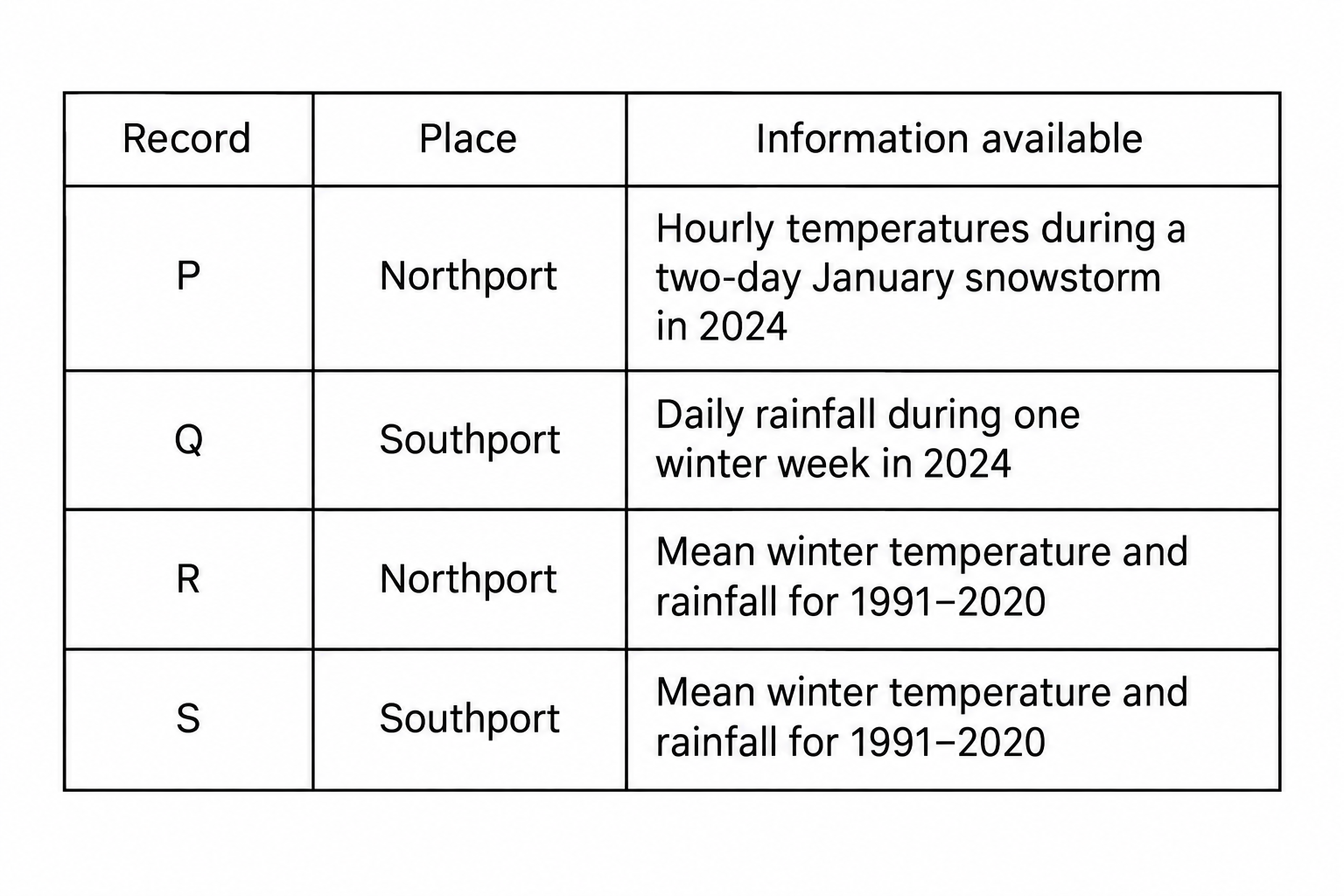
Diagram for question 9: The figure shows four available records. A researcher needs to compare the winter climates of Northport and…
  1. A) Records R and Q
  2. B) Records P and S
  3. C) Records R and S
  4. D) Records P and Q

Q10.

The figure compares observations from two towns. A student says, 'The towns have the same climate because their weather is the same today.' Which conclusion is best supported by the complete figure?
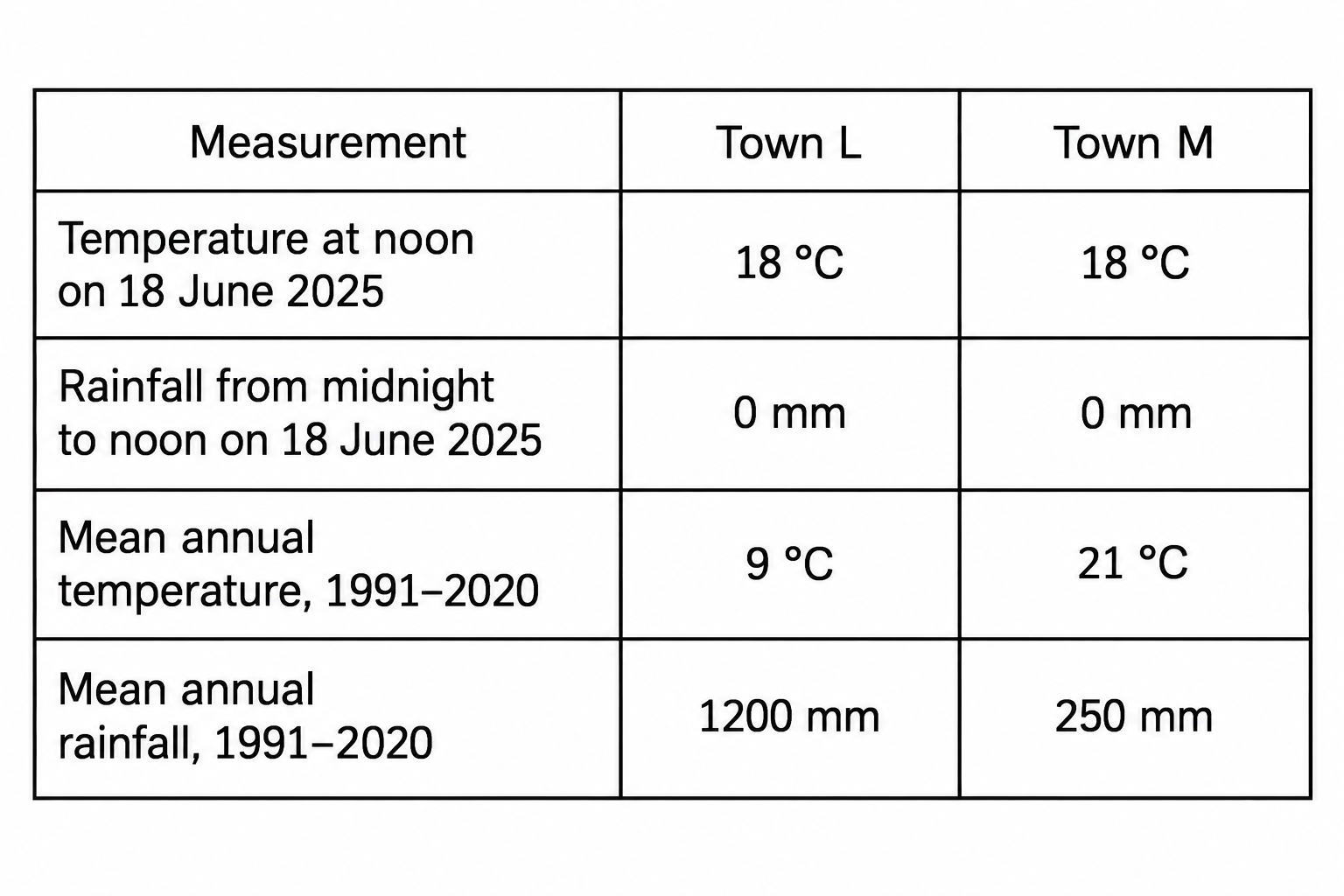
Diagram for question 10: The figure compares observations from two towns. A student says, 'The towns have the same climate because…
  1. A) The towns have similar weather at the observation time, but their long-term records indicate different climates.
  2. B) The towns have different weather at the observation time because their long-term rainfall averages differ.
  3. C) The towns' climates cannot be compared because climate records must exclude temperature measurements.
  4. D) The towns have identical climates because temperature and rainfall match on the observation day.

What this assessment covers

Concepts Tested

  • Weather and Climate
  • Describe the difference between climate and weather.

Question Mix

  • Hard questions included

Skills you build

  • Apply