

EARTH & ENVIRONMENTAL SCIENCE - NATURAL RESOURCES

Renewable vs Nonrenewable Resources Worksheet

  • 10 questions
  • Identify renewable resources (including wind, tidal and solar power, and bioplastics) and non-renewable resources (including fossil fuels), and discuss the importance of using renewable resources.
  • Difficulty: Medium
  • Board: CAIE
  • Attempt online on the examination portal
Start the 10-question quiz Free, no sign-up needed. Your score shows instantly.

Here are the first 3 questions. Click “View all questions” to see the complete assessment.

Q1.

Solar panels contain metals obtained from limited deposits in Earth's crust. Why is solar power still classified as renewable?

  1. A) A solar panel continues producing electricity after sunset.
  2. B) The sunlight used by a solar panel is naturally available again.
  3. C) The metals inside a solar panel are replaced naturally each day.
  4. D) A solar panel produces electricity without using any materials.

Q2.

New fossil fuels can form naturally from the remains of organisms. Why are fossil fuels nevertheless described as non-renewable?

  1. A) They form much more slowly than people use them.
  2. B) They are made from materials that were never living.
  3. C) They stop releasing energy when more deposits are discovered.
  4. D) They can only be used in power stations near the sea.

Q3.

A town replaces some electricity generated by burning natural gas with electricity from wind turbines. Why is this change important for conserving resources?

  1. A) It reduces the amount of a finite fuel that the town uses.
  2. B) It prevents the town from needing any energy in the future.
  3. C) It causes underground natural gas deposits to refill more quickly.
  4. D) It changes the remaining natural gas into a renewable resource.

Q4.

A manufacturer makes a bioplastic from starch in potato crops. Which statement best explains why the starch is a renewable resource?

  1. A) The starch remains unchanged when the bioplastic is thrown away.
  2. B) The starch can be turned into a material with a useful shape.
  3. C) New potato crops can replace the starch used in production.
  4. D) The potatoes obtain their starch from underground oil deposits.

Q5.

A tidal power station produces different amounts of electricity at different times of the day. Which statement correctly explains why tidal power is still renewable?

  1. A) Seawater becomes a fossil fuel as it passes through a turbine.
  2. B) The movement of seawater is naturally repeated rather than used up.
  3. C) Tidal power stations store unlimited amounts of electricity.
  4. D) A resource is renewable whenever its electricity output changes.

Q6.

A school uses solar electricity instead of some electricity generated by burning coal. Which explanation best describes a benefit for the climate?

  1. A) Solar panels remove all carbon dioxide already in the atmosphere.
  2. B) Less coal needs to be burned, reducing carbon dioxide emissions.
  3. C) Sunlight prevents the remaining coal from producing carbon dioxide.
  4. D) Coal becomes renewable when it is used alongside solar power.

Q7.

A company plans to grow crops for bioplastic on land currently used as a wildlife habitat. Which statement gives the most balanced view of this use of a renewable resource?

  1. A) The crops can be replaced, but the effects of using the land must also be considered.
  2. B) The crops will replace themselves without needing land, water or time.
  3. C) The crops become non-renewable whenever they are used to make plastic.
  4. D) The crops are renewable, so growing them cannot affect the environment.

Q8.

A pupil says, 'Crude oil is renewable because plastic made from it can sometimes be recycled.' Which response best corrects this idea?

  1. A) Any resource that can be used more than once is renewable.
  2. B) Crude oil is renewable only when it is made into packaging.
  3. C) Recycling reuses material but does not rapidly replace crude oil deposits.
  4. D) Recycling plastic causes new crude oil to form rapidly underground.

Q9.

The diagram shows two ways of generating electricity. Both use a turbine. Which statement correctly compares their energy resources?
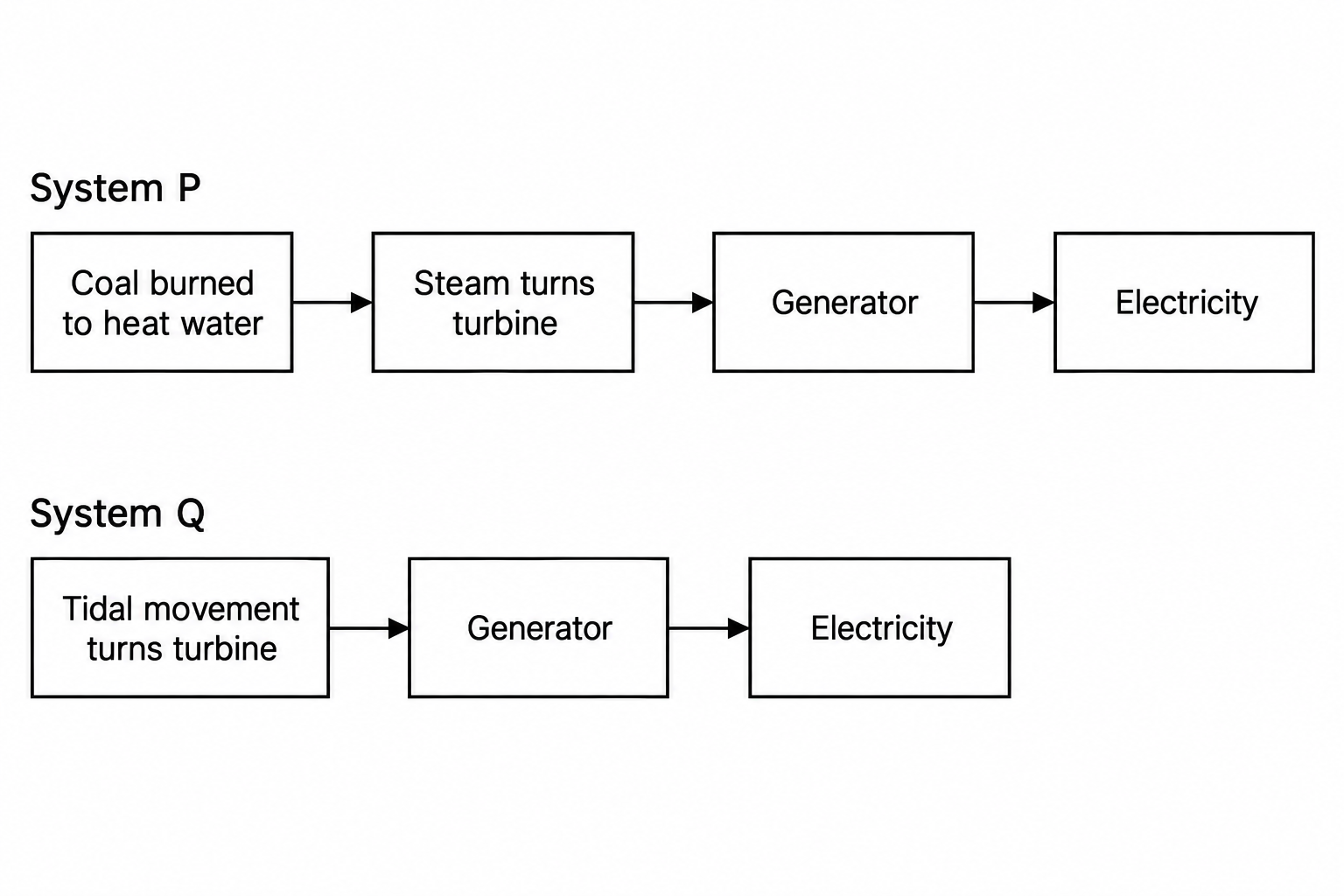
Diagram for question 9: The diagram shows two ways of generating electricity. Both use a turbine. Which statement correctly compares…
  1. A) Both use non-renewable resources because their generators require manufactured parts.
  2. B) System P uses a non-renewable resource, while system Q uses a renewable resource.
  3. C) System P uses a renewable resource, while system Q uses a non-renewable resource.
  4. D) Both use renewable resources because their turbines can turn repeatedly.

Q10.

The diagram compares the raw materials used to make two bags. Which conclusion about using renewable resources is supported by the diagram?
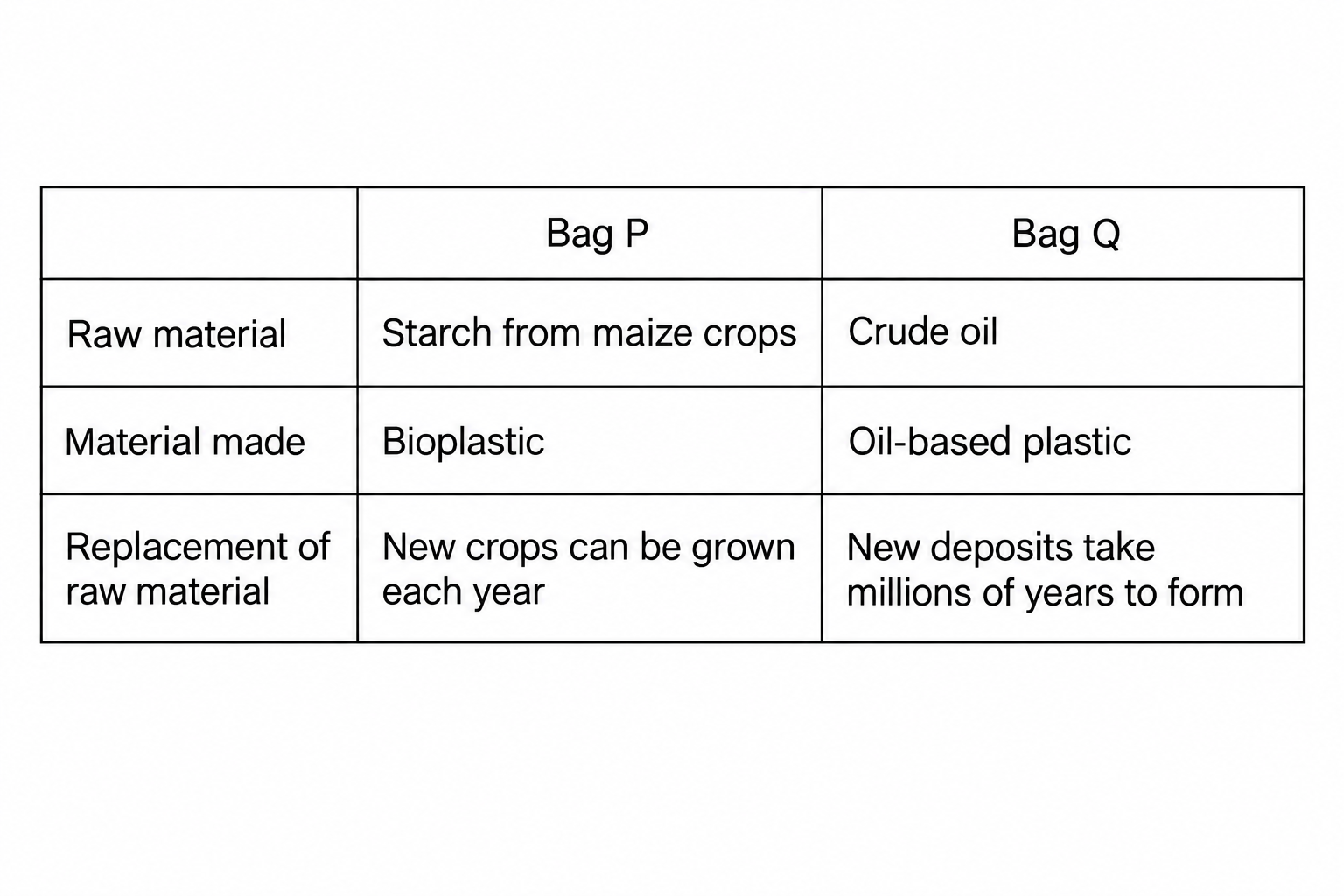
Diagram for question 10: The diagram compares the raw materials used to make two bags. Which conclusion about using renewable…
  1. A) Bag Q can be manufactured repeatedly without reducing any natural resource.
  2. B) Bag P can reduce demand for a finite raw material by using a crop that can be regrown.
  3. C) Bag Q uses a renewable resource because crude oil comes from underground.
  4. D) Bag P must break down rapidly in every natural environment.

What this assessment covers

Concepts Tested

  • Natural Resources
  • Identify renewable resources (including wind, tidal and solar power, and bioplastics) and non-renewable resources (including fossil fuels), and discuss the importance of using renewable resources.

Question Mix

  • Medium questions included

Skills you build

  • Understand