

CHEMISTRY - MOLE CONCEPT

Moles Practice Problems

  • 10 questions
  • Difficulty: Medium
  • Board: CAIE
  • Attempt online on the examination portal
Start the 10-question quiz Free, no sign-up needed. Your score shows instantly.

Here are the first 3 questions. Click “View all questions” to see the complete assessment.

Q1.

A sample contains 1 mol of neon atoms. Another sample contains 1 mol of oxygen molecules, O₂. Which comparison is correct?

  1. A) The number of neon atoms equals the number of oxygen molecules.
  2. B) The oxygen sample contains twice as many molecules as the neon sample contains atoms.
  3. C) The samples contain equal numbers of atoms.
  4. D) The neon sample contains twice as many atoms as the oxygen sample contains molecules.

Q2.

A student writes, ‘This sample contains one mole of hydrogen particles.’ Why should the student specify whether the particles are hydrogen atoms or hydrogen molecules?

  1. A) One mole of hydrogen molecules contains twice as many hydrogen atoms as one mole of hydrogen atoms.
  2. B) The Avogadro constant has a different value for atoms and molecules.
  3. C) The unit mol can be used for atoms but cannot be used for molecules.
  4. D) One mole of hydrogen atoms contains twice as many particles as one mole of hydrogen molecules.

Q3.

A student claims that 1 mol of Mg²⁺ ions contains twice as many ions as 1 mol of Na⁺ ions because each magnesium ion has twice the positive charge. Which response is correct?

  1. A) The claim is correct because the charge determines the number of ions in a mole.
  2. B) The claim is incorrect because both samples contain the Avogadro number of ions, regardless of ionic charge.
  3. C) The claim is incorrect because the mole cannot be used to count charged particles.
  4. D) The claim is incorrect because 1 mol of Mg²⁺ ions contains half the Avogadro number of ions.

Q4.

A sample containing 0.50 mol of N₂ molecules is compared with a sample containing 1.0 mol of separate nitrogen atoms. Which statement correctly compares the samples?

  1. A) The N₂ sample contains twice the total number of nitrogen atoms.
  2. B) They contain equal numbers of separate particles, but different total numbers of nitrogen atoms.
  3. C) The sample of separate atoms contains twice the total number of nitrogen atoms.
  4. D) They contain equal total numbers of nitrogen atoms, but different numbers of separate particles.

Q5.

A sealed container holds 1 mol of liquid water. All the water evaporates without any molecules escaping or reacting. What happens to the amount of water molecules?

  1. A) It remains 1 mol because the number of water molecules is unchanged.
  2. B) It decreases because the molecules move further apart.
  3. C) It increases because the molecules occupy more space.
  4. D) It becomes 3 mol because each water molecule contains three atoms.

Q6.

A sodium chloride sample contains 1 mol of Na⁺ ions and 1 mol of Cl⁻ ions. Which statement correctly describes the total number of ions in the sample?

  1. A) It is twice the Avogadro constant because both types of ion must be counted.
  2. B) It is zero because the positive and negative ions cancel each other.
  3. C) It is half the Avogadro constant because two types of ion are present.
  4. D) It is equal to the Avogadro constant because the sample is electrically neutral.

Q7.

A student argues, ‘One mole of any substance must have the same mass because it contains the same number of particles.’ Which explanation identifies the error?

  1. A) Equal numbers of particles need not have equal masses because the individual particles can have different masses.
  2. B) One mole describes a fixed mass rather than a fixed number of particles.
  3. C) Only substances made of molecules contain the Avogadro number of particles in one mole.
  4. D) Different substances have different values of the Avogadro constant.

Q8.

A non-reacting mixture contains 0.25 mol of helium atoms and 0.75 mol of neon atoms. Which statement describes the particles in the mixture?

  1. A) The total number of atoms is twice 6.02 × 10²³ because two elements are present.
  2. B) Each element contributes 6.02 × 10²³ atoms because both are present in the mixture.
  3. C) The two elements contribute equal numbers of atoms because both consist of single atoms.
  4. D) The total number of atoms is 6.02 × 10²³, but neither element alone contributes that many atoms.

Q9.

The diagram shows one molecule of a substance. A sample contains 6.02 × 10²³ molecules of this substance. Which statement correctly describes the sample?
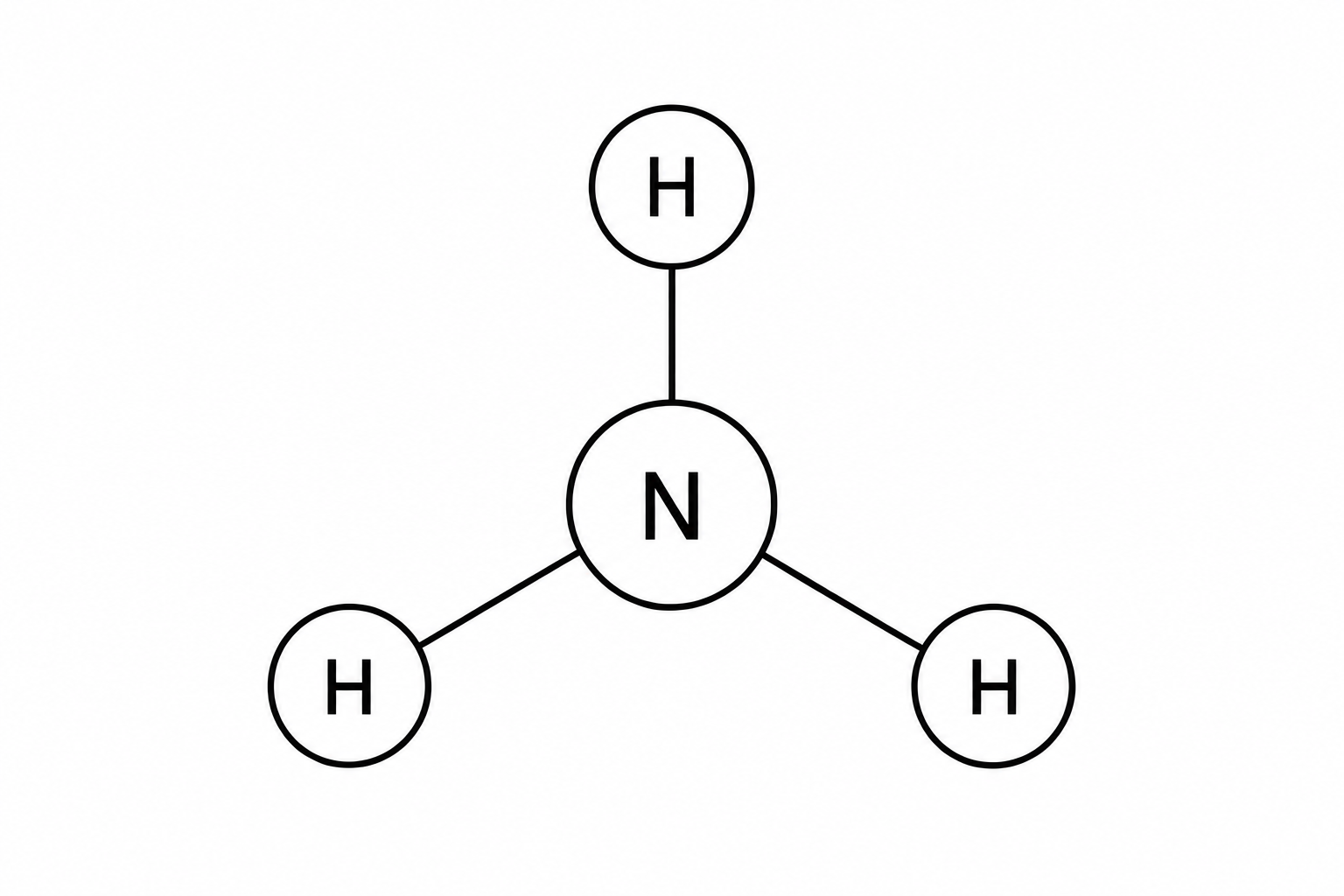
Diagram for question 9: The diagram shows one molecule of a substance. A sample contains 6.02 × 10²³ molecules of this substance.…
  1. A) It contains 1 mol of molecules and 4 mol of atoms in total.
  2. B) It contains 1 mol of molecules and 3 mol of atoms in total.
  3. C) It contains 4 mol of molecules and 1 mol of atoms in total.
  4. D) It contains 4 mol of molecules and 4 mol of atoms in total.

Q10.

The table gives the numbers and types of particles in four samples. Which two samples contain the same amount, in moles, of the particles specified in the table?
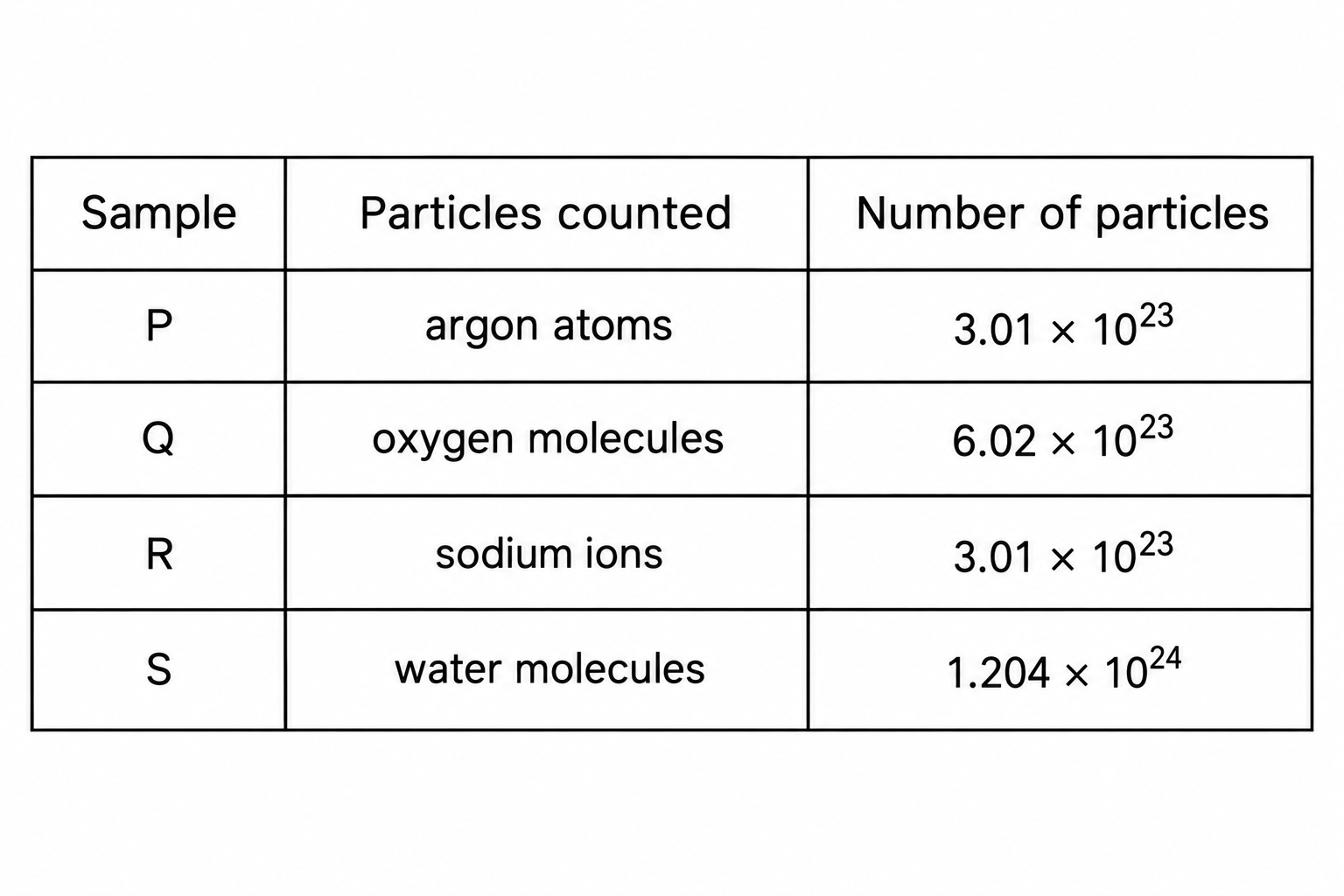
Diagram for question 10: The table gives the numbers and types of particles in four samples. Which two samples contain the same…
  1. A) Q and S
  2. B) P and R
  3. C) R and S
  4. D) P and Q

What this assessment covers

Concepts Tested

  • Mole Concept

Question Mix

  • Medium questions included

Skills you build

  • Understand