

CHEMISTRY - TITRATION
Titration Calculations Worksheet
- 10 questions
- Difficulty: Hard
- Board: CAIE
- Attempt online on the examination portal
Start the 10-question quiz
Free, no sign-up needed. Your score shows instantly.
Here are the first 3 questions. Click “View all questions” to see the complete assessment.
Q1.
Q2.
A 2.80 g sample of impure anhydrous sodium carbonate is dissolved in water and made up to 250.0 cm³. A 25.0 cm³ portion requires 24.0 cm³ of 0.200 mol dm⁻³ hydrochloric acid for complete reaction. The impurities do not react with the acid. The reaction is Na₂CO₃ + 2HCl → 2NaCl + CO₂ + H₂O. What is the percentage by mass of sodium carbonate in the sample? Use Mᵣ(Na₂CO₃) = 106.
Q3.
A 3.575 g sample of pure hydrated sodium carbonate, Na₂CO₃·xH₂O, is dissolved in water and made up to 250.0 cm³. A 25.0 cm³ portion reacts completely with 25.0 cm³ of 0.100 mol dm⁻³ hydrochloric acid. One mole of sodium carbonate reacts with two moles of hydrochloric acid. What is x? Use Mᵣ(Na₂CO₃) = 106 and Mᵣ(H₂O) = 18.
Q4.
A tablet containing calcium carbonate and substances that do not react with hydrochloric acid is added to 25.0 cm³ of 0.800 mol dm⁻³ hydrochloric acid. After the reaction finishes, the solution is transferred quantitatively to a volumetric flask and made up to 100.0 cm³. A 25.0 cm³ portion requires 15.0 cm³ of 0.100 mol dm⁻³ sodium hydroxide to neutralise the remaining acid. The reactions are CaCO₃ + 2HCl → CaCl₂ + CO₂ + H₂O and HCl + NaOH → NaCl + H₂O. What mass of calcium carbonate was in the tablet? Use Mᵣ(CaCO₃) = 100.
Q5.
A 10.0 cm³ sample of hydrochloric acid requires 20.0 cm³ of 0.150 mol dm⁻³ sodium hydroxide for neutralisation. A student has a separate 100.0 cm³ portion of the same acid. How much distilled water must be added to this portion so that 25.0 cm³ of the diluted acid will require 15.0 cm³ of 0.100 mol dm⁻³ sodium hydroxide? Assume volumes are additive. The reaction is HCl + NaOH → NaCl + H₂O.
Q6.
A vinegar sample has a density of 1.05 g cm⁻³. A 10.0 cm³ sample is diluted to 250.0 cm³. A 25.0 cm³ portion of the diluted vinegar requires 17.5 cm³ of 0.100 mol dm⁻³ sodium hydroxide for neutralisation. Ethanoic acid is the only substance in the vinegar that reacts with sodium hydroxide, and the reaction is CH₃COOH + NaOH → CH₃COONa + H₂O. What is the percentage by mass of ethanoic acid in the original vinegar? Use Mᵣ(CH₃COOH) = 60.0.
Q7.
A student prepares 250.0 cm³ of potassium hydroxide solution. Portions of 25.0 cm³ of 0.0400 mol dm⁻³ sulfuric acid are titrated with this solution. The rough titre is 20.60 cm³, followed by accurate titres of 19.85 cm³, 19.90 cm³ and 19.95 cm³. Use the mean of the three accurate titres. What mass of dissolved potassium hydroxide is present in the prepared solution? The reaction is H₂SO₄ + 2KOH → K₂SO₄ + 2H₂O. Use Mᵣ(KOH) = 56.0.
Q8.
A sodium hydroxide solution of unknown concentration is first standardised: 25.0 cm³ of the solution neutralises 20.0 cm³ of 0.125 mol dm⁻³ hydrochloric acid. In a second titration, 30.0 cm³ of the same sodium hydroxide solution neutralises 12.0 cm³ of sulfuric acid. What is the concentration of the sulfuric acid? The reactions are HCl + NaOH → NaCl + H₂O and H₂SO₄ + 2NaOH → Na₂SO₄ + 2H₂O.
Q9.
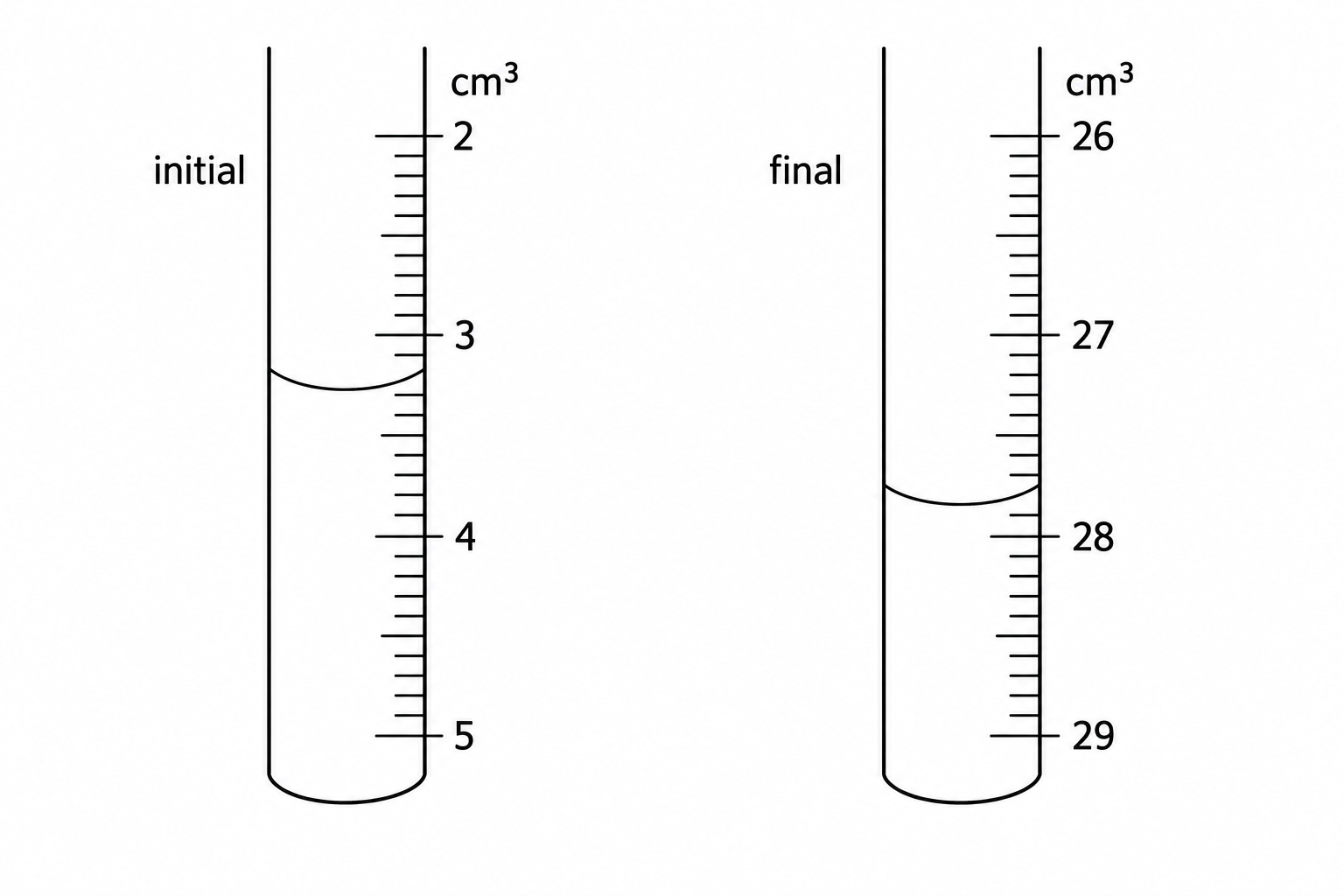
A student dilutes 25.0 cm³ of sulfuric acid to 125.0 cm³. A 20.0 cm³ portion of this diluted acid is titrated with 0.150 mol dm⁻³ sodium hydroxide. The diagram shows the initial and final burette readings. Read the bottom of each meniscus. What is the concentration of the original sulfuric acid? The reaction is H₂SO₄ + 2NaOH → Na₂SO₄ + 2H₂O.
Q10.
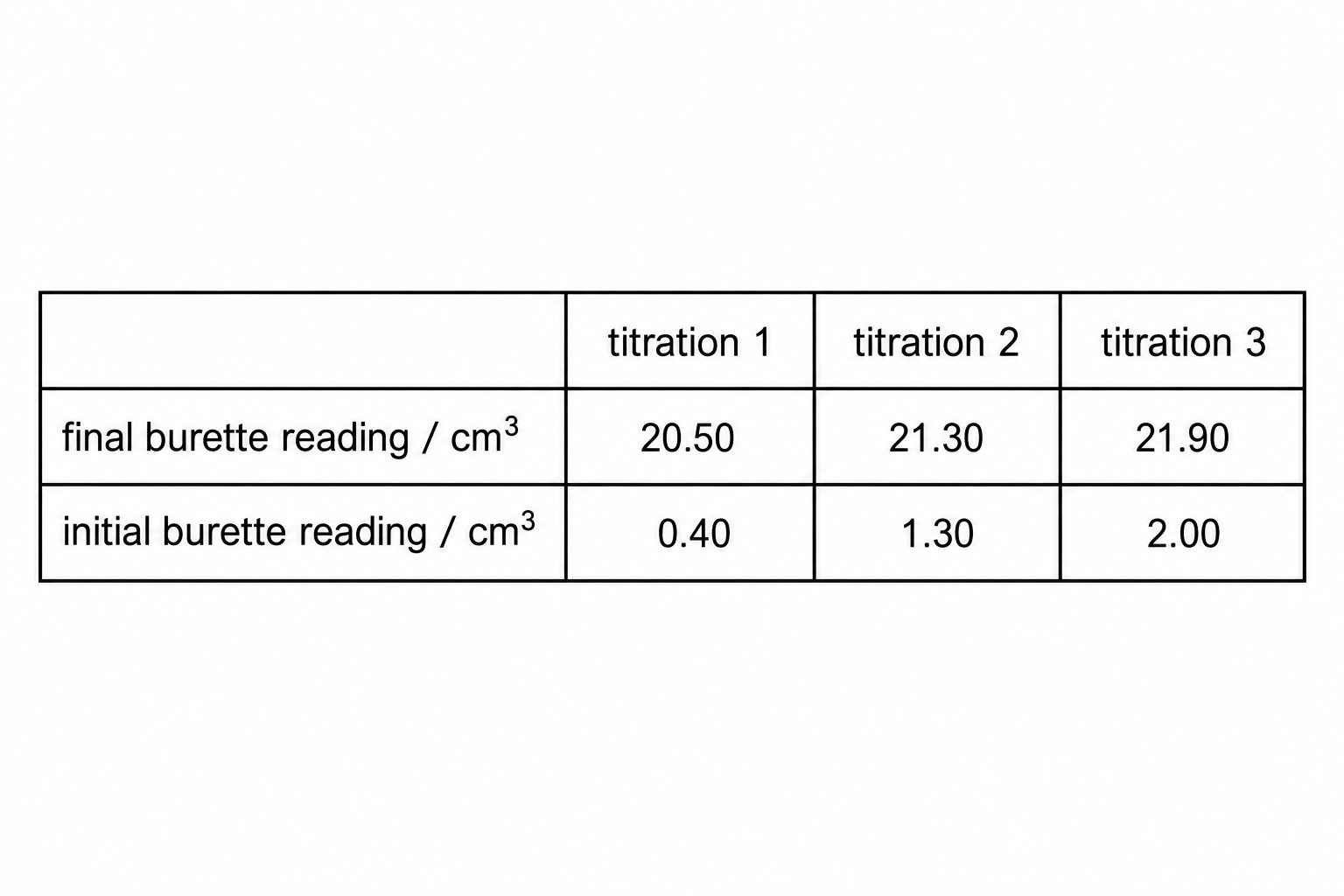
A student dissolves 1.80 g of a pure monobasic acid, HA, in water and makes the solution up to 250.0 cm³. Separate 25.0 cm³ portions are titrated with 0.100 mol dm⁻³ sodium hydroxide. The table shows the burette readings. Use the mean of all three titres. What is the relative molecular mass of HA? The reaction is HA + NaOH → NaA + H₂O.
What this assessment covers
Concepts Tested
- Titration
Question Mix
- Hard questions included
Skills you build
- Apply
Related assessments
More practice
Other assessments in this subject
