

CHEMISTRY - IONIC BONDING

Ions Worksheet

  • 10 questions
  • Difficulty: Medium
  • Board: CAIE
  • Attempt online on the examination portal
Start the 10-question quiz Free, no sign-up needed. Your score shows instantly.

Here are the first 3 questions. Click “View all questions” to see the complete assessment.

Q1.

A calcium atom has the electron arrangement 2,8,8,2. Which change forms a calcium ion with a full outer electron shell?

  1. A) It loses two electrons and becomes Ca²⁺.
  2. B) It loses eight electrons and becomes Ca⁸⁺.
  3. C) It gains six electrons and becomes Ca⁶⁻.
  4. D) It gains two electrons and becomes Ca²⁻.

Q2.

A fluorine atom gains an electron to form a fluoride ion. Why is the particle formed an anion?

  1. A) It now contains more protons than electrons.
  2. B) It has lost the positive charge from its nucleus.
  3. C) Its protons have become negatively charged.
  4. D) It now contains more electrons than protons.

Q3.

A sodium atom contains 11 protons, 12 neutrons and 11 electrons. It forms a sodium ion, Na⁺. Which description explains why the ion is still sodium?

  1. A) It still has 11 protons, although it has lost an electron.
  2. B) It still has 23 particles in total, although their charges have changed.
  3. C) It still has 12 neutrons, although it has lost a proton.
  4. D) It still has 11 electrons, although it has gained a proton.

Q4.

Four particles have the proton and electron numbers given below. Which particle is a cation?

  1. A) A particle with 12 protons and 10 electrons.
  2. B) A particle with 8 protons and 10 electrons.
  3. C) A particle with 10 protons and 12 electrons.
  4. D) A particle with 10 protons and 10 electrons.

Q5.

An atom X forms X³⁺ and an atom Y forms Y²⁻. Which statement correctly describes the formation of both ions from their atoms?

  1. A) X gains three electrons, and Y loses two electrons.
  2. B) X loses three electrons, and Y gains two electrons.
  3. C) X loses three protons, and Y gains two protons.
  4. D) X gains three protons, and Y loses two protons.

Q6.

A neon atom and a sodium ion, Na⁺, each have the electron arrangement 2,8. Why is the sodium particle positively charged while the neon atom is neutral?

  1. A) The sodium ion has gained a proton during ion formation.
  2. B) The sodium ion has fewer electron shells than the neon atom.
  3. C) The sodium ion has 11 protons, while the neon atom has 10.
  4. D) The sodium ion contains positively charged electrons.

Q7.

One magnesium atom loses two electrons when it forms Mg²⁺. Each chlorine atom gains one electron when it forms Cl⁻. If all the electrons lost by this magnesium atom are gained by chlorine atoms, what is formed?

  1. A) One magnesium cation and two chloride anions.
  2. B) Two magnesium cations and one chloride anion.
  3. C) One magnesium anion and two chloride cations.
  4. D) One magnesium cation and one chloride anion.

Q8.

A student says, ‘An aluminium atom becomes Al³⁺ because each of its three outer electrons changes from a negative charge to a positive charge.’ Which correction is accurate?

  1. A) Three neutrons become protons, while all the electrons remain.
  2. B) The atom gains three positively charged electrons.
  3. C) The three outer electrons remain in the atom but lose their charges.
  4. D) The atom loses three electrons, and the remaining electrons keep their negative charges.

Q9.

The diagram shows the particles in an atom before and after an ion forms. Which statement explains the change shown?
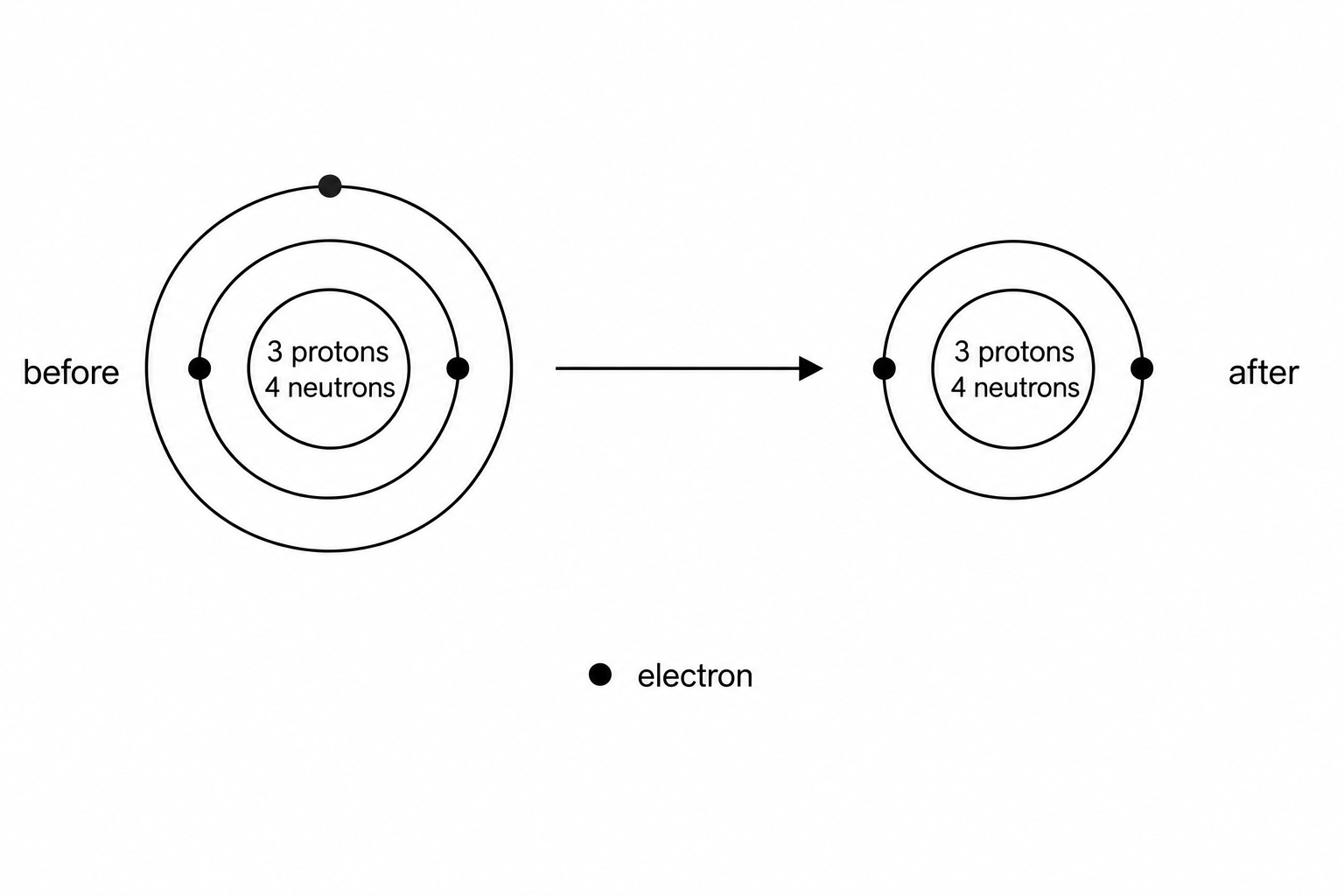
Diagram for question 9: The diagram shows the particles in an atom before and after an ion forms. Which statement explains the…
  1. A) The atom loses a proton and forms an anion.
  2. B) The atom loses an electron and forms a cation.
  3. C) The atom gains an electron and forms an anion.
  4. D) The atom gains a proton and forms a cation.

Q10.

A student draws the model shown for an ion formed from a nitrogen atom. The electron arrangement is correct, but the charge label is incorrect. Which correction should be made?
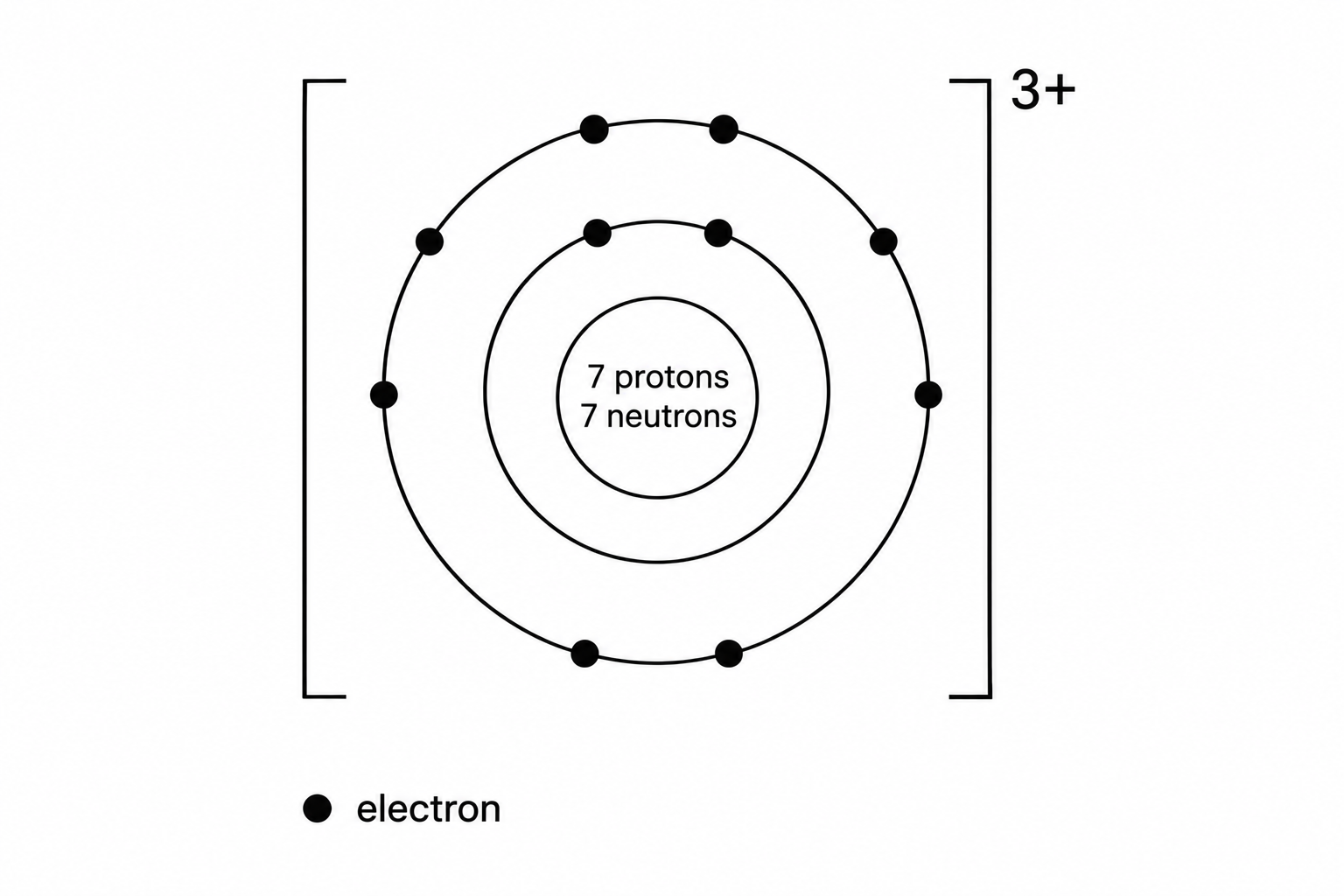
Diagram for question 10: A student draws the model shown for an ion formed from a nitrogen atom. The electron arrangement is correct…
  1. A) Replace 3+ with 3− because the atom has gained three electrons.
  2. B) Replace 3+ with 7+ because the nucleus contains seven protons.
  3. C) Replace 3+ with 10− because the ion contains ten electrons.
  4. D) Replace 3+ with 1− because only the outer shell determines the charge.

What this assessment covers

Concepts Tested

  • Ionic Bonding

Question Mix

  • Medium questions included

Skills you build

  • Understand