

BIOLOGY - PROTEIN SYNTHESIS
Translation Worksheet
- 10 questions
- Explain how a protein is made, limited to: • the gene coding for the protein remains in the nucleus • messenger RNA (mRNA) is a copy of a gene • mRNA molecules are made in the nucleus and move to the cytoplasm • the mRNA passes through ribosomes • the ribosome assembles amino acids into protein molecules • the specific sequence of amino acids is determined by the sequence of bases in the mRNA (knowledge of the details of transcription or translation is not required)
- Difficulty: Hard
- Board: CAIE
- Attempt online on the examination portal
Start the 10-question quiz
Free, no sign-up needed. Your score shows instantly.
Here are the first 3 questions. Click “View all questions” to see the complete assessment.
Q1.
Q2.
A treatment prevents newly made mRNA from leaving the nucleus but does not affect gene copying or ribosomes. After treatment, a previously inactive gene for protein Q becomes active. No mRNA for Q was present before treatment. Which result is expected?
Q3.
Two cells make different proteins, P and Q. A scientist prepares two mixtures containing no nuclei or genes. Mixture X contains only mRNA for P, functional ribosomes from the cell that makes Q, and all required amino acids. Mixture Y contains only mRNA for Q, functional ribosomes from the cell that makes P, and all required amino acids. Which prediction is correct?
Q4.
An isolated mRNA molecule is altered after leaving the nucleus. The altered mRNA directs the production of a protein with a different amino acid sequence from the original protein. The altered mRNA is then transferred to a fresh mixture of normal ribosomes and amino acids, with no other mRNA present. What should happen?
Q5.
A cell normally makes proteins R and S. A treatment continuously destroys only the mRNA for R as soon as it reaches the cytoplasm. Both genes remain intact, both types of mRNA are still made in the nucleus, and ribosomes are unaffected. Which prediction about newly assembled proteins is correct?
Q6.
A cell has no mRNA for protein T. A substance blocks the copying of genes into mRNA but leaves nuclear transport, ribosomes and amino acids unaffected. The gene for T is still present in the nucleus. Which intervention would allow the cell to assemble T while the substance remains active?
Q7.
A cell contains many identical mRNA molecules for a protein, but most are waiting because all its ribosomes are occupied. Amino acids are plentiful. Additional functional ribosomes are introduced, and more of these mRNA molecules begin passing through ribosomes at the same time. Which outcome is expected?
Q8.
A gene that originally coded for protein U is changed so that its new mRNA codes for protein V, which has a different amino acid sequence. For a short period, both the old mRNA and the new mRNA are present in the cytoplasm. Both pass through functional ribosomes. Which prediction about proteins assembled during this period is correct?
Q9.
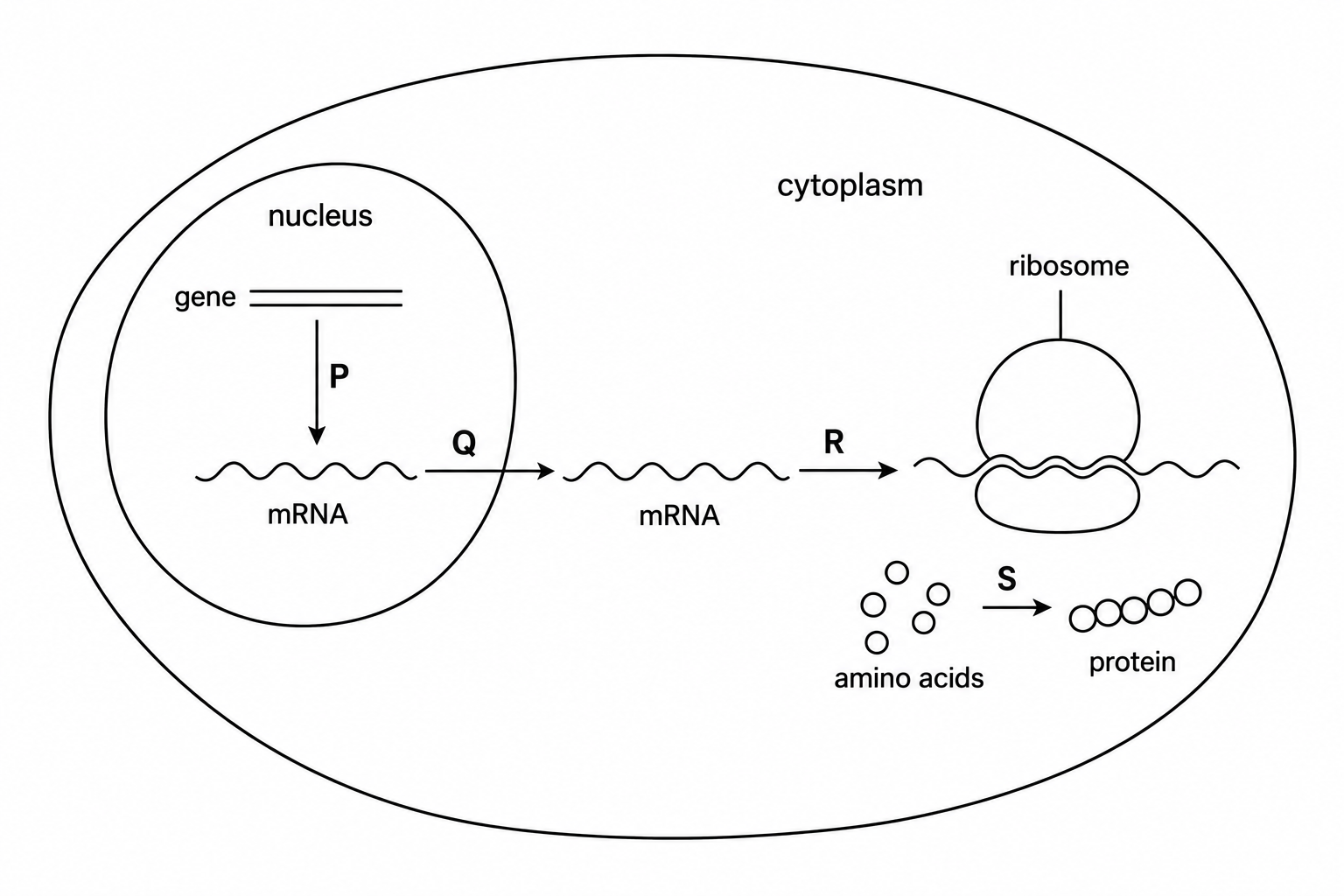
The diagram shows stages involved in making a protein. A substance blocks just one labelled stage. After treatment, new copies of the mRNA accumulate inside the nucleus. Existing cytoplasmic mRNA still passes through ribosomes and directs normal protein assembly. Introducing additional ready-made mRNA into the cytoplasm also allows more protein to be made. Which stage is blocked?
Q10.
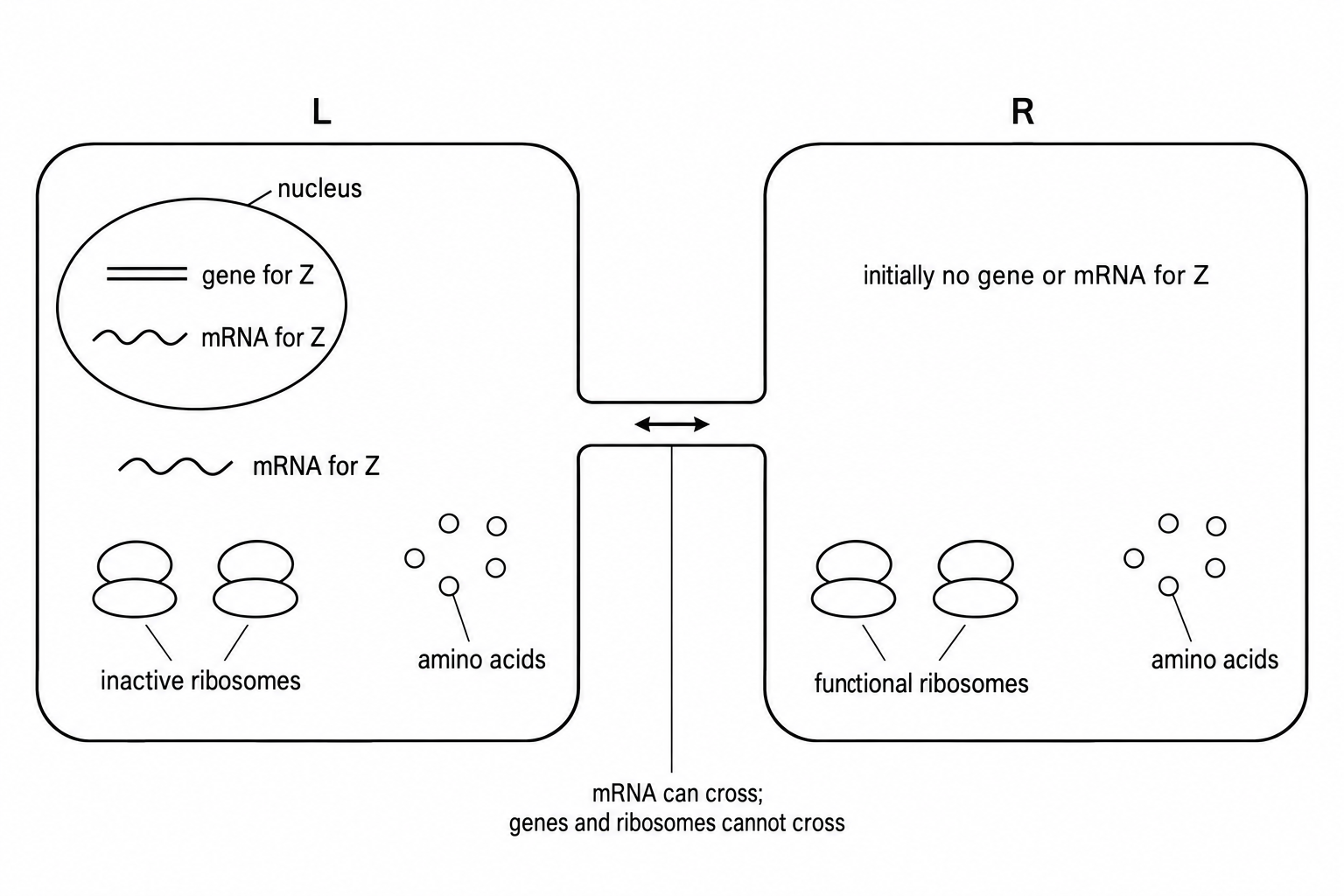
Two experimental cell compartments are connected by the channel shown. The channel allows mRNA to cross but prevents genes and ribosomes from crossing. Initially, only compartment L contains the gene and mRNA for protein Z. Its gene continues to be copied, but all its ribosomes are inactive. Compartment R has functional ribosomes but no gene or mRNA for Z. Both compartments contain all required amino acids. After enough time for mRNA to cross the channel, where will new Z be assembled?
What this assessment covers
Concepts Tested
- Protein Synthesis
- Explain how a protein is made, limited to: • the gene coding for the protein remains in the nucleus • messenger RNA (mRNA) is a copy of a gene • mRNA molecules are made in the nucleus and move to the cytoplasm • the mRNA passes through ribosomes • the ribosome assembles amino acids into protein molecules • the specific sequence of amino acids is determined by the sequence of bases in the mRNA (knowledge of the details of transcription or translation is not required)
Question Mix
- Hard questions included
Skills you build
- Apply
Related assessments
More practice
Other assessments in this subject
