

BIOLOGY - NATURAL SELECTION

Natural Selection Worksheet

  • Explores the process of natural selection in various populations.
  • Focuses on inherited variation and environmental pressures.
  • Examines the role of competition and resource limitation.
Start the 10-question quiz Free, no sign-up needed. Your score shows instantly.

Here are the first 3 questions. Click “View all questions” to see the complete assessment.

Q1.

Which sequence correctly describes natural selection in a population?

  1. A) Competition causes every individual to survive; the alleles of all individuals are therefore passed on equally.
  2. B) Individuals have genetic variation; many offspring are produced; competition occurs; better-adapted individuals reproduce more successfully and pass their alleles to their offspring.
  3. C) Individuals have genetic variation; poorly adapted individuals deliberately change their alleles and then reproduce more successfully.
  4. D) Many offspring are produced; all individuals develop useful features because of competition and pass these acquired features to their offspring.
Q2.

A finch population contains inherited variation in beak size. During a drought, mostly large, hard seeds remain. The finches produce more young than the environment can support. Which statement best describes how natural selection may affect the population?

  1. A) Finches with larger beaks may obtain food more successfully, reproduce more, and pass alleles for larger beaks to their offspring.
  2. B) Finches with smaller beaks reproduce more because difficult conditions always favour the least common feature.
  3. C) The drought directly creates an allele for a larger beak in every finch, so competition is no longer needed.
  4. D) All finches enlarge their beaks by trying to open hard seeds, and their offspring inherit these enlarged beaks.

Q3.

A population of insects contains a few individuals with an allele that gives resistance to an insecticide. Many insects are produced, and the crop provides limited food. After repeated insecticide use, resistance becomes common. Which explanation is correct?

  1. A) The insecticide causes every insect to develop the resistance allele because the insects need it.
  2. B) Non-resistant insects pass the resistance allele to their offspring after they are killed by the insecticide.
  3. C) Resistance becomes common because all surviving insects reproduce equally, regardless of their alleles.
  4. D) Resistant insects are more likely to survive, compete successfully, reproduce, and pass the resistance allele to their offspring.

Q4.

Why is the production of many offspring important in natural selection?

  1. A) It removes genetic variation because all the offspring must have identical alleles.
  2. B) It ensures that every offspring survives and contributes its alleles equally to the next generation.
  3. C) It allows organisms to choose new alleles when resources become limited.
  4. D) More offspring are produced than available resources can support, so competition occurs and better-adapted individuals are more likely to reproduce and pass on their alleles.

Q5.

Two isolated snail populations live in the same changing environment. Population P has inherited variation in shell thickness, while every snail in population Q has the same shell-thickness alleles. Both produce many offspring that compete for limited food. Why is natural selection for shell thickness more likely in population P?

  1. A) Genetic variation in population P allows some snails to be better adapted, reproduce more successfully, and pass their alleles to the next generation.
  2. B) The snails in population P can select which alleles they need before competition begins.
  3. C) Competition causes every snail in population P to develop the same thicker shell during its lifetime.
  4. D) Population Q cannot produce offspring because its snails have similar shell-thickness alleles.

Q6.

Young plants in a population vary genetically in root length. Many seeds germinate close together in dry soil, where water is limited. What role does competition play in natural selection in this population?

  1. A) Competition prevents any plant from producing seeds, so no alleles reach the next generation.
  2. B) Competition gives every plant the same root-length alleles, so all have an equal chance of reproduction.
  3. C) Plants compete for water; those with an advantageous inherited root length may survive and reproduce more, passing the associated alleles to their seeds.
  4. D) Plants that obtain little water intentionally lengthen their roots and pass this acquired change to their seeds.

Q7.

A rabbit population has inherited variation in fur density. The rabbits produce many young, but food and shelter are limited during a series of cold winters. After several generations, dense fur is more common. Which description accounts for this change?

  1. A) Rabbits with alleles for denser fur were better adapted, had a greater chance of reproducing during competition, and passed these alleles to more offspring.
  2. B) The large number of young removed competition, so dense-furred and thin-furred rabbits passed on their alleles equally.
  3. C) Rabbits with thin fur changed their alleles after experiencing the cold and then passed the changed alleles to all their young.
  4. D) Cold weather caused each rabbit to grow denser fur, and this acquired fur was inherited by its young.

Q8.

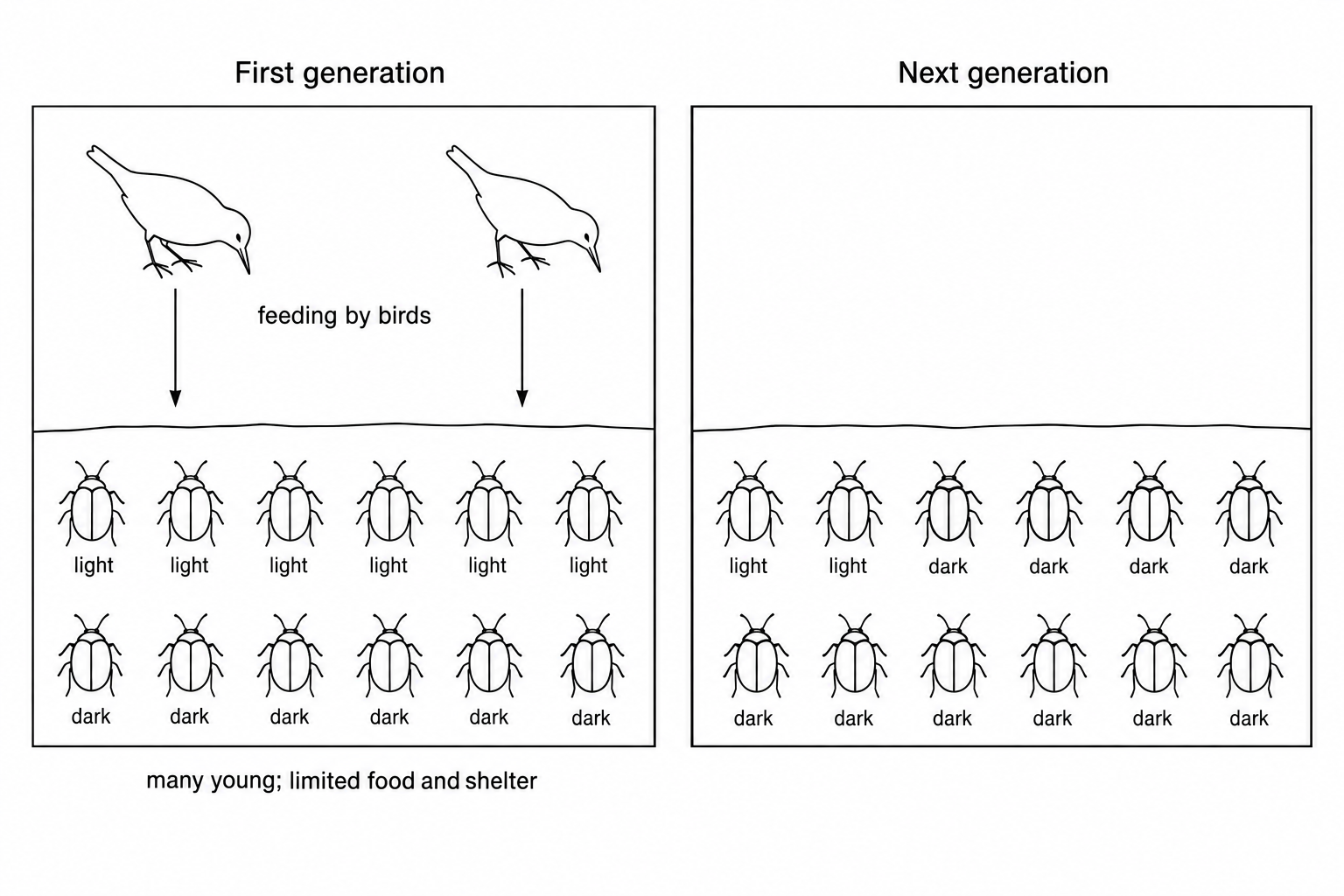
The diagram shows changes in a beetle population living on dark ground. Beetle body colour is inherited. Many young beetles are produced, and birds feed on them. Which statement best explains the pattern shown?

Diagram for question 8: The diagram shows changes in a beetle population living on dark ground. Beetle body colour is inherited.…
  1. A) Birds cause new dark-colour alleles to appear in every surviving beetle.
  2. B) Each light beetle becomes dark after seeing the ground, and its offspring inherit this acquired colour.
  3. C) Light and dark beetles reproduce equally, so body-colour alleles do not affect the next generation.
  4. D) Dark beetles are less visible to birds, so they are more likely to survive, reproduce, and pass alleles for dark colour to their offspring.

Q9.

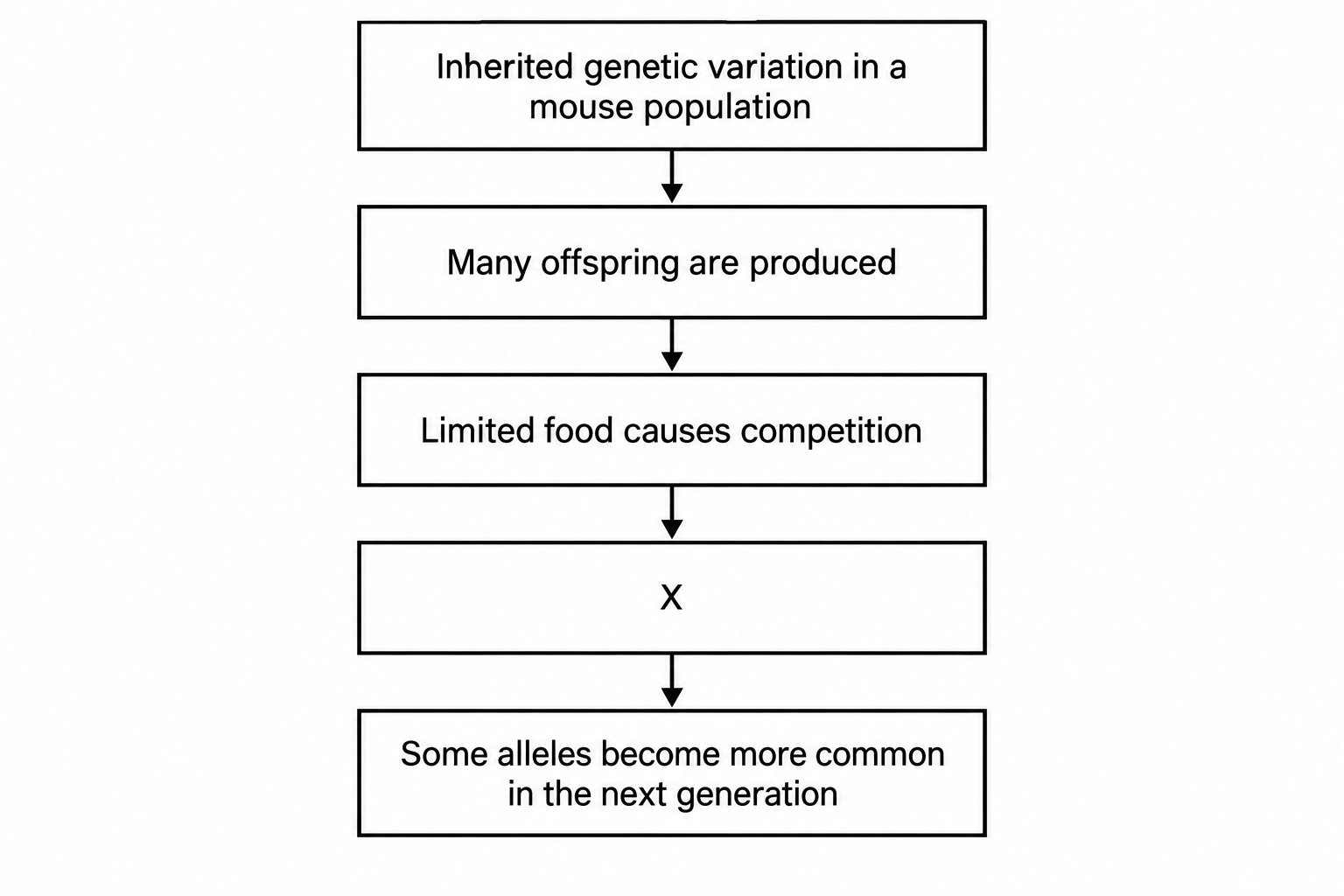
The diagram summarises natural selection in a mouse population. Which statement should replace box X?

Diagram for question 9: The diagram summarises natural selection in a mouse population. Which statement should replace box X?
  1. A) Poorly adapted mice reproduce most and pass acquired features to their offspring.
  2. B) Competition makes all mice equally likely to survive and reproduce.
  3. C) Every mouse changes its alleles so that it can obtain enough food.
  4. D) Better-adapted mice have a greater chance of reproducing and pass their alleles to their offspring.

Q10.

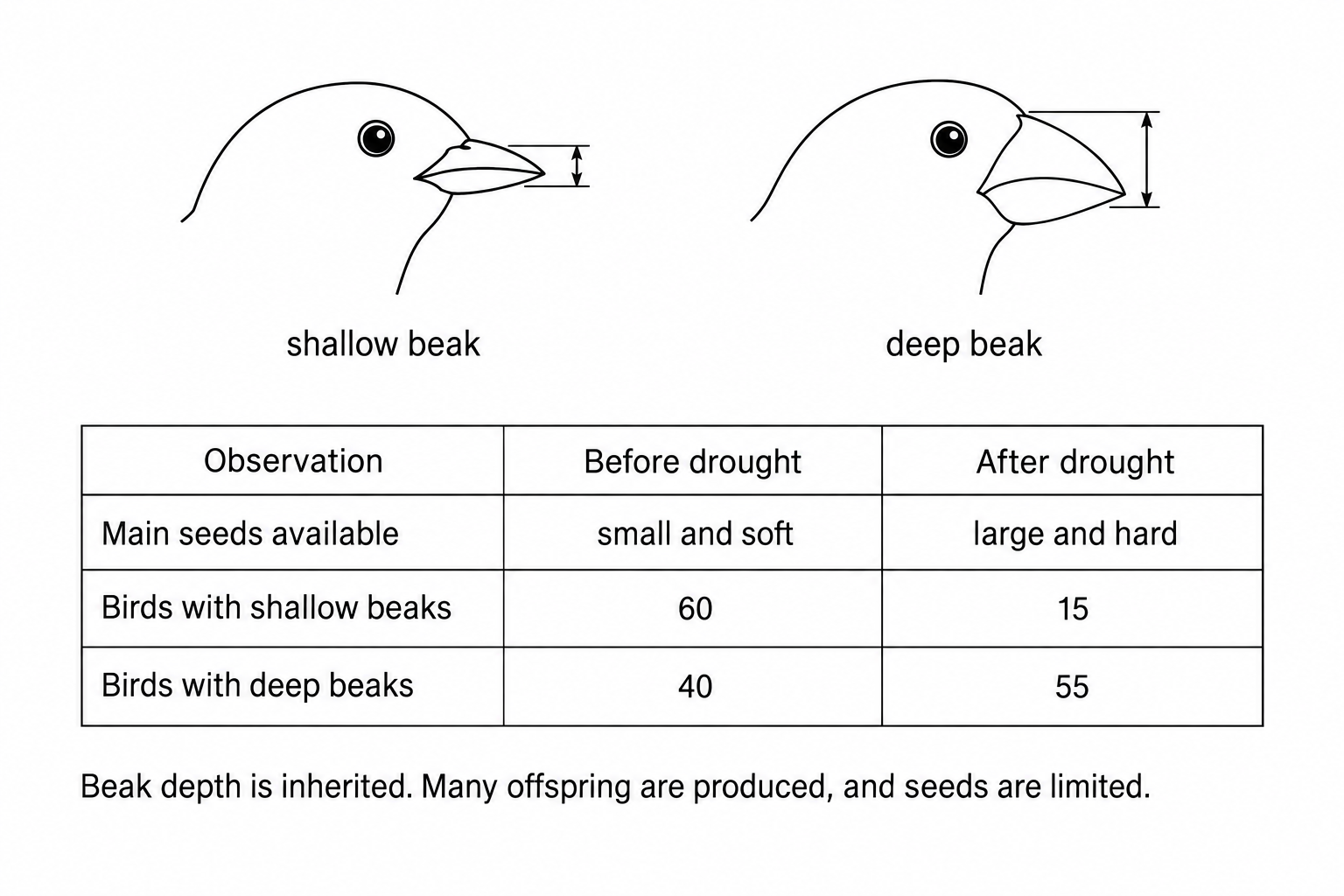
The figure shows inherited variation in beak depth in a bird population before and after a drought. The birds produce many offspring, but seeds are limited. Which explanation best describes the change?

Diagram for question 10: The figure shows inherited variation in beak depth in a bird population before and after a drought. The…
  1. A) Seed competition gave every bird identical alleles for beak depth.
  2. B) Birds with deeper beaks were better able to use the remaining seeds, so they reproduced more and passed deep-beak alleles to their offspring.
  3. C) The drought caused all birds to deepen their beaks during life, and this acquired change was inherited.
  4. D) Birds with shallow beaks produced more offspring because they were less suited to the available seeds.

What this assessment covers

Concepts tested

  • Natural selection and its mechanisms
  • Role of inherited variation in populations
  • Impact of environmental changes on species
  • Competition and survival of the fittest
  • Adaptation to changing environments

Question Mix

  • Medium questions included

Skills you build

  • Analyze scenarios of natural selection
  • Interpret diagrams related to population changes
  • Evaluate the effects of environmental pressures
  • Understand genetic variation and its importance
  • Apply concepts of adaptation and survival