

BIOLOGY - MITOSIS
Mitosis Practice Problems
- 10 questions
- Describe mitosis as nuclear division giving rise to genetically identical cells (details of the stages of mitosis are not required)
- Difficulty: Hard
- Board: CAIE
- Attempt online on the examination portal
Start the 10-question quiz
Free, no sign-up needed. Your score shows instantly.
Here are the first 3 questions. Click “View all questions” to see the complete assessment.
Q1.
Q2.
Two daughter cells produced by mitosis are placed in different nutrient solutions. Later, one produces much more of a particular enzyme than the other. No changes to nuclear DNA have occurred. A student claims that the enzyme difference proves the cells were not produced by mitosis. Which response is correct?
Q3.
A culture starts with one cell whose nucleus contains 14 chromosomes. After several rounds of mitosis, there are 32 cells. No cells have fused, and no genetic changes have occurred. What should be found in each daughter nucleus after its division is complete?
Q4.
The nucleus of a cell from plant X is removed and replaced with a nucleus from plant Y. The replacement cell then divides repeatedly by mitosis. Assume that no nuclear DNA changes occur. Which prediction about the daughter nuclei is correct?
Q5.
A researcher observes one nucleus dividing into two. Both resulting nuclei have the same chromosome number as the original nucleus. The researcher concludes that the division produced genetically identical nuclei. Which additional finding would most directly support this conclusion?
Q6.
A student records four events in living cells. Which event should be identified as mitosis rather than merely a change in cell shape, cell number or nuclear number?
Q7.
A culture contains two cell types. Type X has nuclear DNA markers A and B but not C or D. Type Y has markers C and D but not A or B. Both types reproduce only by mitosis. There is no DNA transfer, cell fusion or mutation. Which result would contradict these conditions?
Q8.
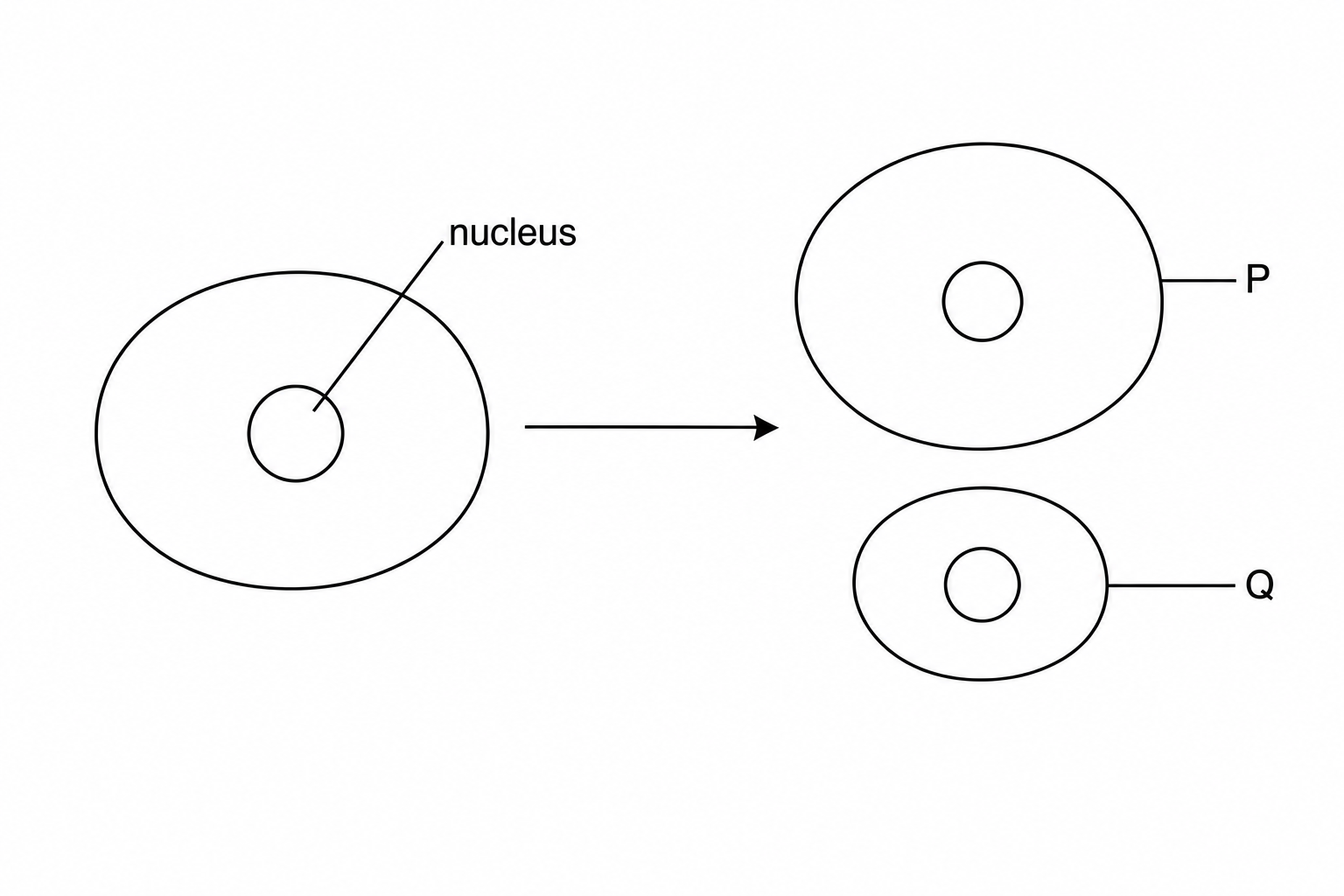
The diagram shows a cell before division and its two daughter cells, P and Q. Nuclear division occurred by mitosis, but the cytoplasm was divided unequally. No DNA changes occurred. Which comparison of P and Q is correct?
Q9.
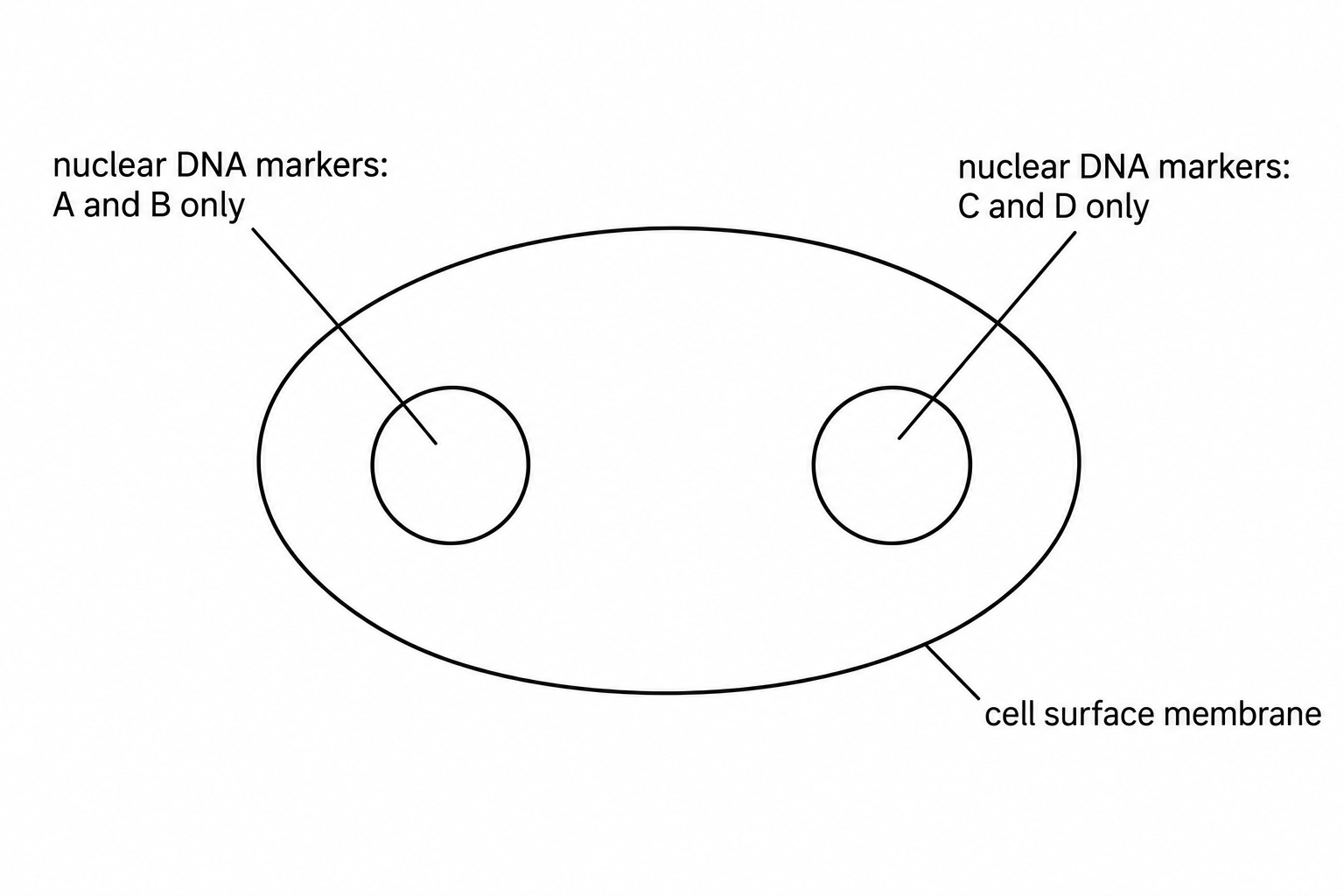
The cell shown contains two nuclei with different nuclear DNA marker sets, as labelled. Each nucleus undergoes mitosis once, but the cell does not divide. No nuclei fuse and no DNA changes occur. Which description of the resulting cell is correct?
Q10.
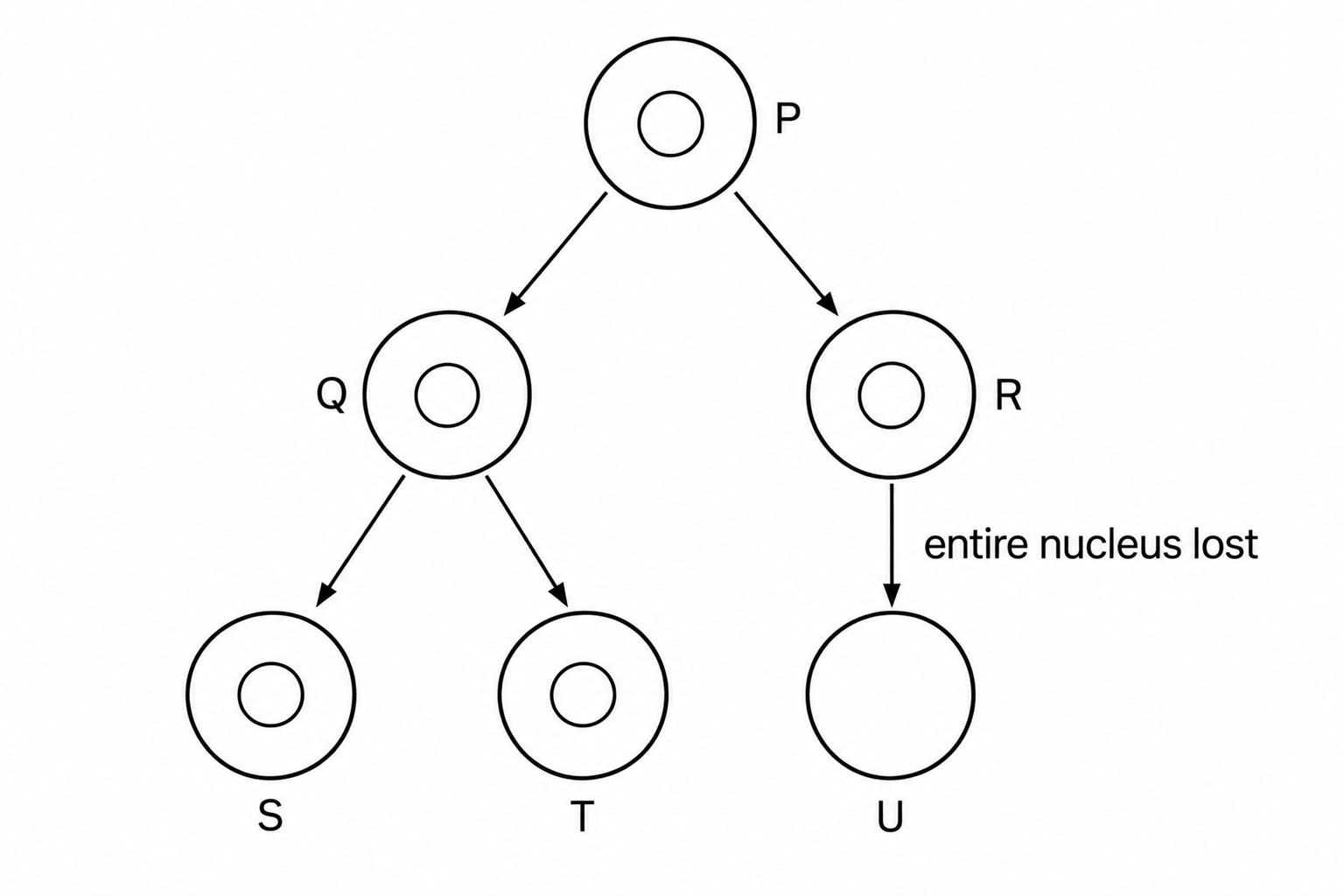
The diagram shows a cell lineage. Every branching event is mitosis followed by cell division. After the last division, U loses its entire nucleus but remains alive for a time. No DNA changes occur in the other cells. Which statement correctly describes the cells present at the end?
What this assessment covers
Concepts Tested
- Mitosis
- Describe mitosis as nuclear division giving rise to genetically identical cells (details of the stages of mitosis are not required)
Question Mix
- Hard questions included
Skills you build
- Apply
Related assessments
More practice
Other assessments in this subject
