

BIOLOGY - FOOD CHAINS AND FOOD WEBS

Food Chains and Food Webs Worksheet

  • 10 questions
  • Describe a food chain as showing the transfer of energy from one organism to the next, beginning with a producer
  • Difficulty: Medium
  • Board: CAIE
  • Attempt online on the examination portal
Start the 10-question quiz Free, no sign-up needed. Your score shows instantly.

Here are the first 3 questions. Click “View all questions” to see the complete assessment.

Q1.

A student says, “A food chain is a list of all the organisms living in a habitat.” Which correction best explains what a food chain shows?

  1. A) It shows the transfer of energy from one organism to the next, beginning with a producer.
  2. B) It shows how organisms are grouped according to their size, beginning with the smallest.
  3. C) It shows how energy returns from the last consumer to the producer.
  4. D) It shows the movement of organisms between habitats, beginning with a consumer.

Q2.

A food chain is shown as wheat plant → mouse → snake. What does the arrow between the wheat plant and the mouse represent?

  1. A) The wheat plant moves towards the mouse before it is eaten.
  2. B) Energy is transferred from the wheat plant to the mouse when the mouse feeds.
  3. C) The mouse supplies the wheat plant with energy needed to produce food.
  4. D) Energy is transferred from the mouse to the wheat plant when the mouse feeds.

Q3.

In a pond, water fleas eat microscopic algae, sticklebacks eat water fleas, and herons eat sticklebacks. Which sequence correctly describes a food chain showing energy transfer?

  1. A) Microscopic alga → stickleback → water flea → heron
  2. B) Heron → stickleback → water flea → microscopic alga
  3. C) Microscopic alga → water flea → stickleback → heron
  4. D) Water flea → microscopic alga → stickleback → heron

Q4.

A student writes sunlight → grass → rabbit → fox and says that sunlight is the first organism in the food chain. Which explanation corrects this statement?

  1. A) The fox is the first organism because energy transfer starts with the final predator.
  2. B) The rabbit is the first organism because a food chain begins with an animal that eats plants.
  3. C) Sunlight is the first organism because anything supplying energy is a producer.
  4. D) Grass is the first organism because it is a producer; sunlight is an energy source, not an organism.

Q5.

A child looks at lettuce → slug → thrush and says, “The arrows mean that the lettuce travels after the slug and the slug travels after the thrush.” Which response best explains the arrows?

  1. A) They show which organism chases the next organism in the chain.
  2. B) They show energy passing from each consumer back to its food.
  3. C) They show energy passing from food to the organism that eats it.
  4. D) They show that each organism changes into the next organism as it grows.

Q6.

A grasshopper eats grass, a frog eats the grasshopper, and a snake eats the frog. A student records only grasshopper → frog → snake. Why does this not show the food chain beginning with its producer?

  1. A) The grass should be included before the grasshopper to show where energy enters this chain of organisms.
  2. B) The snake should be placed first because it eats another consumer.
  3. C) The frog should be placed first because it receives energy from the grasshopper.
  4. D) The arrows should point towards the grasshopper because it is the smallest animal.

Q7.

A seal eats a fish that has fed on seaweed. Seaweed is a producer. How does the food chain explain the connection between the seaweed and the energy obtained by the seal?

  1. A) The seal transfers energy backwards through the fish to the seaweed.
  2. B) The fish creates new energy, so the seal's food has no energy connection to the seaweed.
  3. C) The seal must eat the seaweed directly to obtain any energy that passed through it.
  4. D) Energy passes from the seaweed to the fish and then from the fish to the seal.

Q8.

The diagram shows a food chain arranged from right to left. Which statement correctly describes the energy transfer shown?
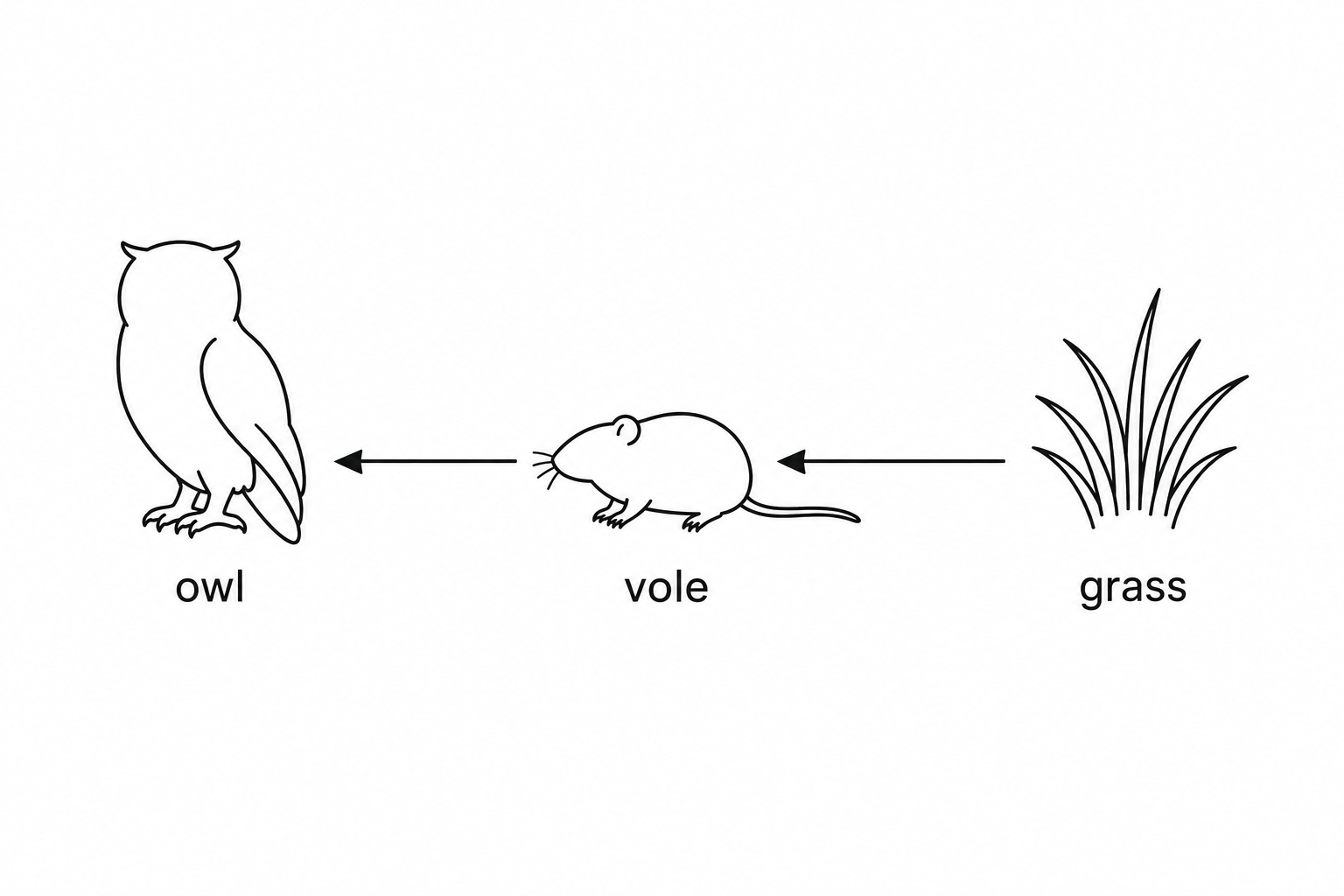
Diagram for question 8: The diagram shows a food chain arranged from right to left. Which statement correctly describes the energy…
  1. A) Energy begins with the grass producer and passes through the vole to the owl.
  2. B) Energy passes from the grass directly to the owl without passing through the vole.
  3. C) Energy passes from the vole to both the grass and the owl.
  4. D) Energy begins with the owl and passes through the vole to the grass.

Q9.

The diagram shows two feeding transfers in a pond. Which description correctly explains both labelled arrows?
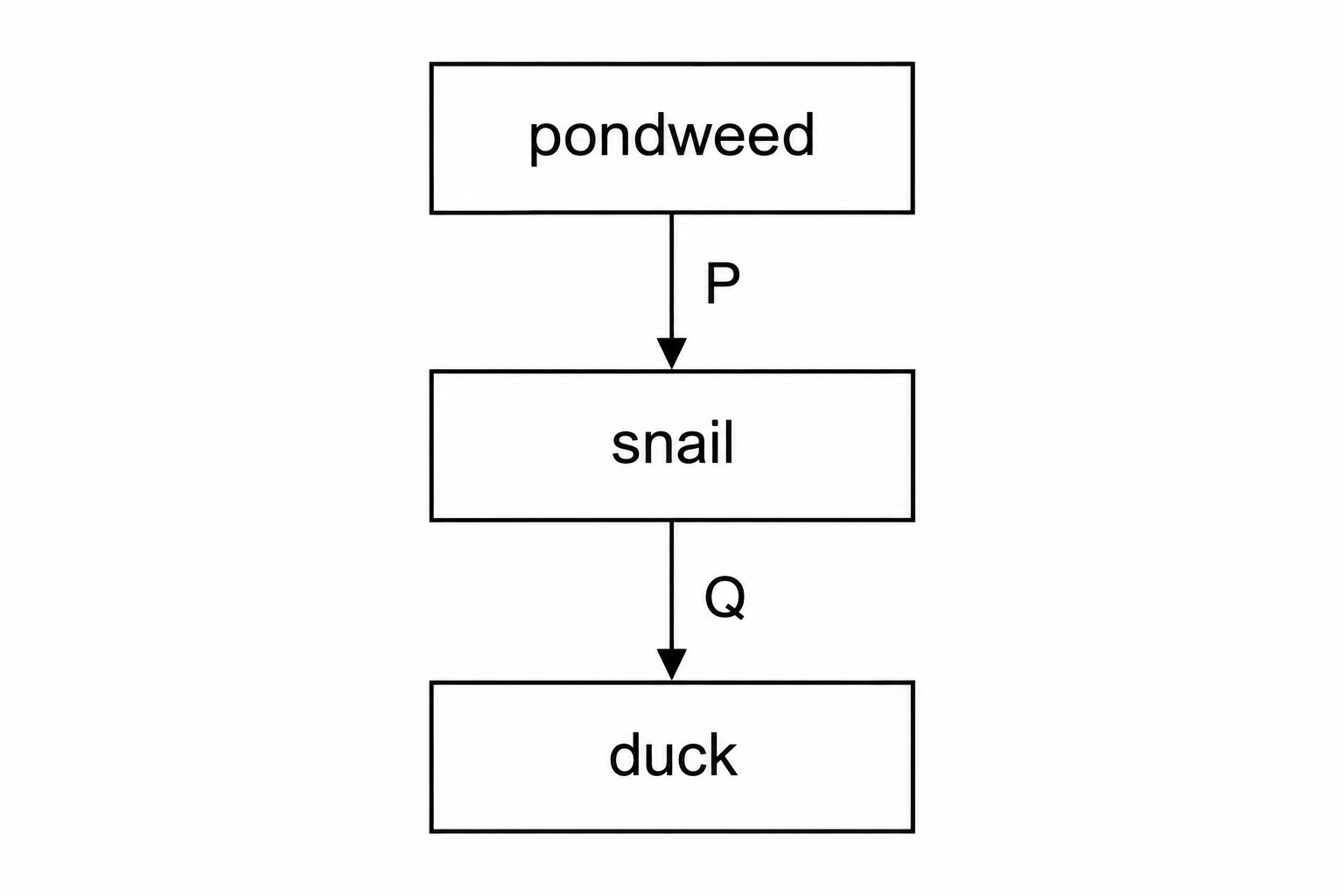
Diagram for question 9: The diagram shows two feeding transfers in a pond. Which description correctly explains both labelled arrows?
  1. A) P shows energy transfer from pondweed to snail; Q shows energy transfer from snail to duck.
  2. B) P shows the movement of pondweed towards the snail; Q shows the movement of the snail towards the duck.
  3. C) P shows energy transfer from snail to pondweed; Q shows energy transfer from duck to snail.
  4. D) P shows energy transfer from pondweed to duck; Q shows energy transfer from duck to snail.

Q10.

The diagram represents a food chain beginning with the organism labelled X. Which description of X explains why it can occupy this position?
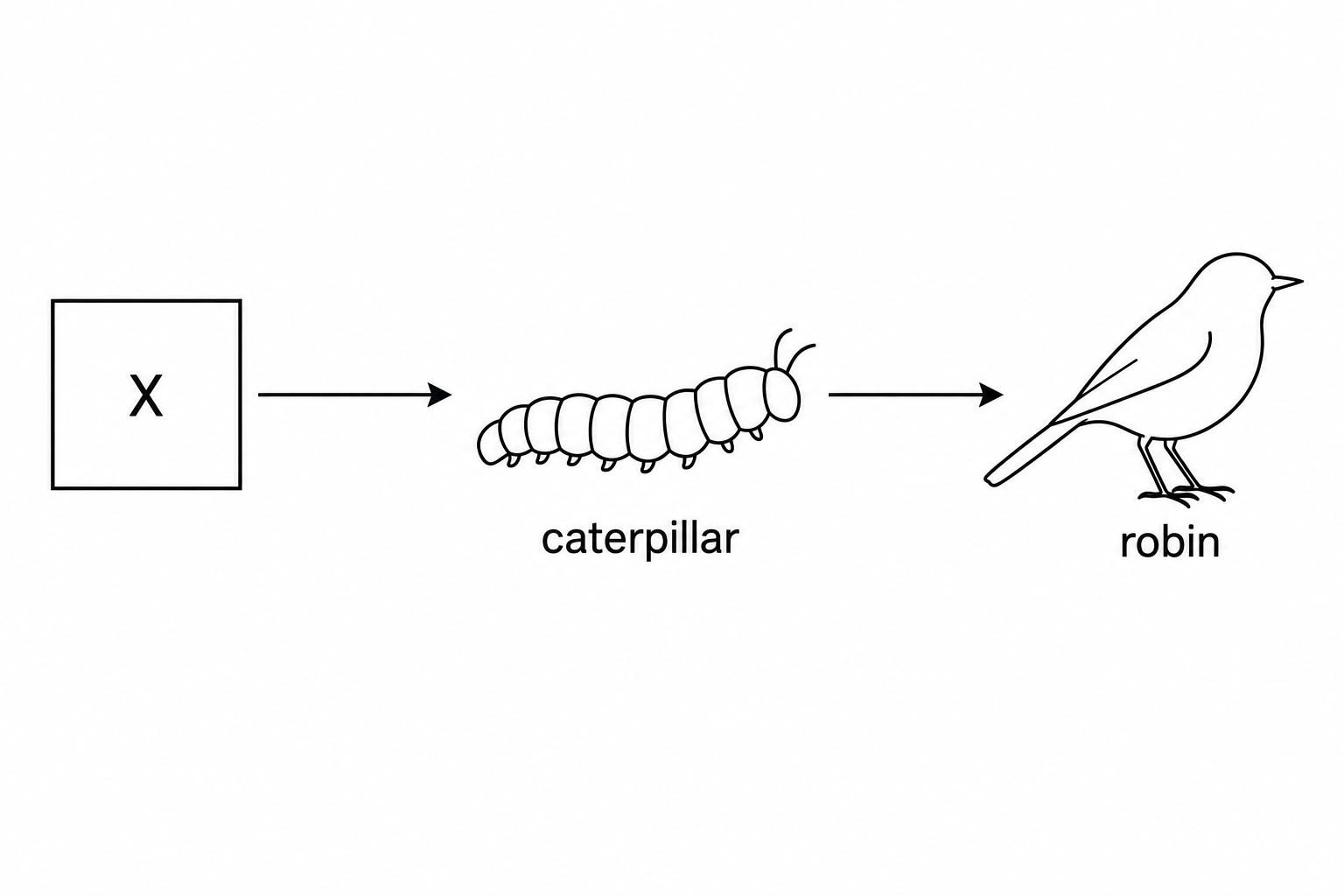
Diagram for question 10: The diagram represents a food chain beginning with the organism labelled X. Which description of X explains…
  1. A) It is a predator that obtains energy by eating the robin.
  2. B) It is a consumer that receives energy from both animals shown.
  3. C) It is a producer that makes food using light energy and supplies energy to the caterpillar.
  4. D) It is an animal that obtains energy by eating the caterpillar.

What this assessment covers

Concepts Tested

  • Food Chains and Food Webs
  • Describe a food chain as showing the transfer of energy from one organism to the next, beginning with a producer

Question Mix

  • Medium questions included

Skills you build

  • Understand