

BIOLOGY - ECOSYSTEMS
Ecological Succession Worksheet
- 10 questions
- Difficulty: Hard
- Board: US
- Attempt online on the examination portal
Start the 10-question quiz
Free, no sign-up needed. Your score shows instantly.
Here are the first 3 questions. Click “View all questions” to see the complete assessment.
Q1.
Q2.
On a young lava flow, a pioneer shrub grows in cracks containing small amounts of mineral material. Its roots contain nitrogen-fixing bacteria. Tree seedlings are common beneath the shrubs but rare in open cracks. Experiments show that tree seedlings grow well in open cracks when nitrogen-rich organic material is added. Which prediction best applies these results to succession on the lava flow?
Q3.
Beavers create a pond by damming a forest stream. Trees die in the flooded area, and aquatic plants become established. After the beavers leave, the dam breaks. The exposed pond sediment supports sedges, and groundwater measurements show that it remains waterlogged throughout the growing season. Local tree seedlings cannot survive prolonged waterlogging. Which forecast is most consistent with these conditions?
Q4.
An abandoned field near a forest has remained dominated by grasses for 25 years. Researchers plant equal numbers of native tree seedlings in four treatments. After three years, seedling survival is 12% in untreated plots, 15% where grass is clipped, 76% inside deer fences, and 79% where fencing and clipping are combined. If the goal is to restart succession toward woodland, which action is most directly supported by these results?
Q5.
A salt marsh previously recovered after storms because surviving plants trapped sediment and raised the marsh surface. Sea level is now rising faster than sediment accumulates. In the lowest areas, flooding lasts longer than the dominant marsh grass can tolerate. An undeveloped, gently sloping upland borders one side of the marsh. Which management action best uses these processes to support the continued presence of a marsh community?
Q6.
Succession on abandoned mine waste has stalled at sparse grass cover. Native shrubs grow nearby, but most shrub seedlings on the waste die. Tests show strongly acidic soil. In a trial, shrub survival is 8% without treatment, 10% with added seeds, 14% with fertilizer, and 72% with an amendment that neutralizes acidity. Which restoration sequence best applies this evidence?
Q7.
A forest landscape normally contains patches at several stages of succession. Insect outbreaks kill mature trees in scattered patches, while surviving patches provide seeds for recovery. A proposed salvage operation would remove all surviving trees across the affected landscape. Assume the operation would not alter soil conditions or future insect abundance. Which prediction best applies the role of the surviving patches?
Q8.
After a windstorm creates canopy gaps, a forest usually maintains similar total plant biomass as gap plants grow and surviving trees expand. Several tree species can tolerate shade, but only one can tolerate both shade and extended drought. A new pattern of prolonged drought kills that species and prevents the other shade-tolerant species from establishing. Sun-loving shrubs survive in the gaps. Which outcome is most likely if the drought pattern continues?
Q9.
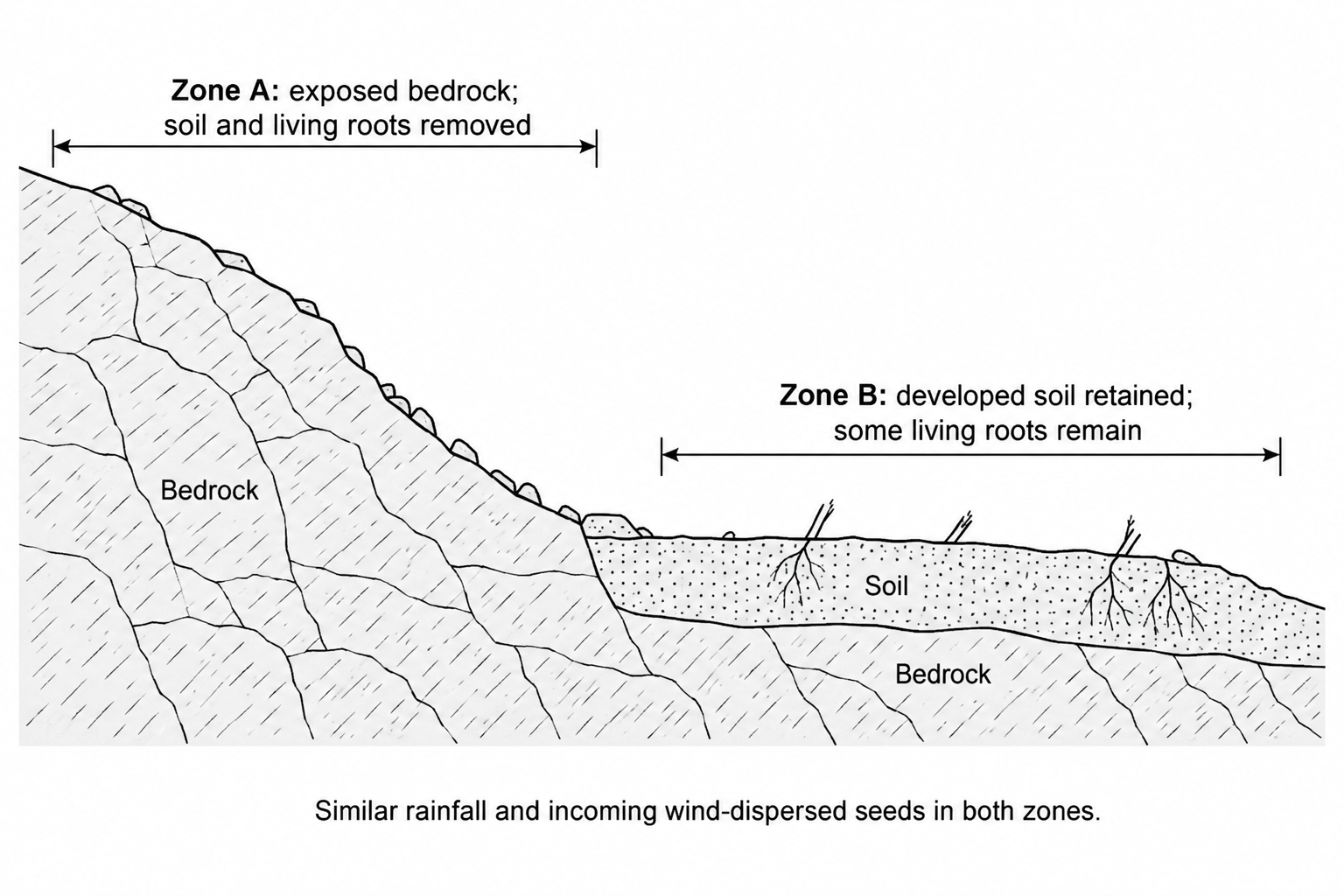
The diagram shows two zones immediately after a landslide. Both receive similar rainfall and incoming wind-dispersed seeds. Local woodland plants require developed soil to establish, while lichens can colonize bare rock. If neither zone is disturbed again, which prediction best applies the conditions shown?
Q10.
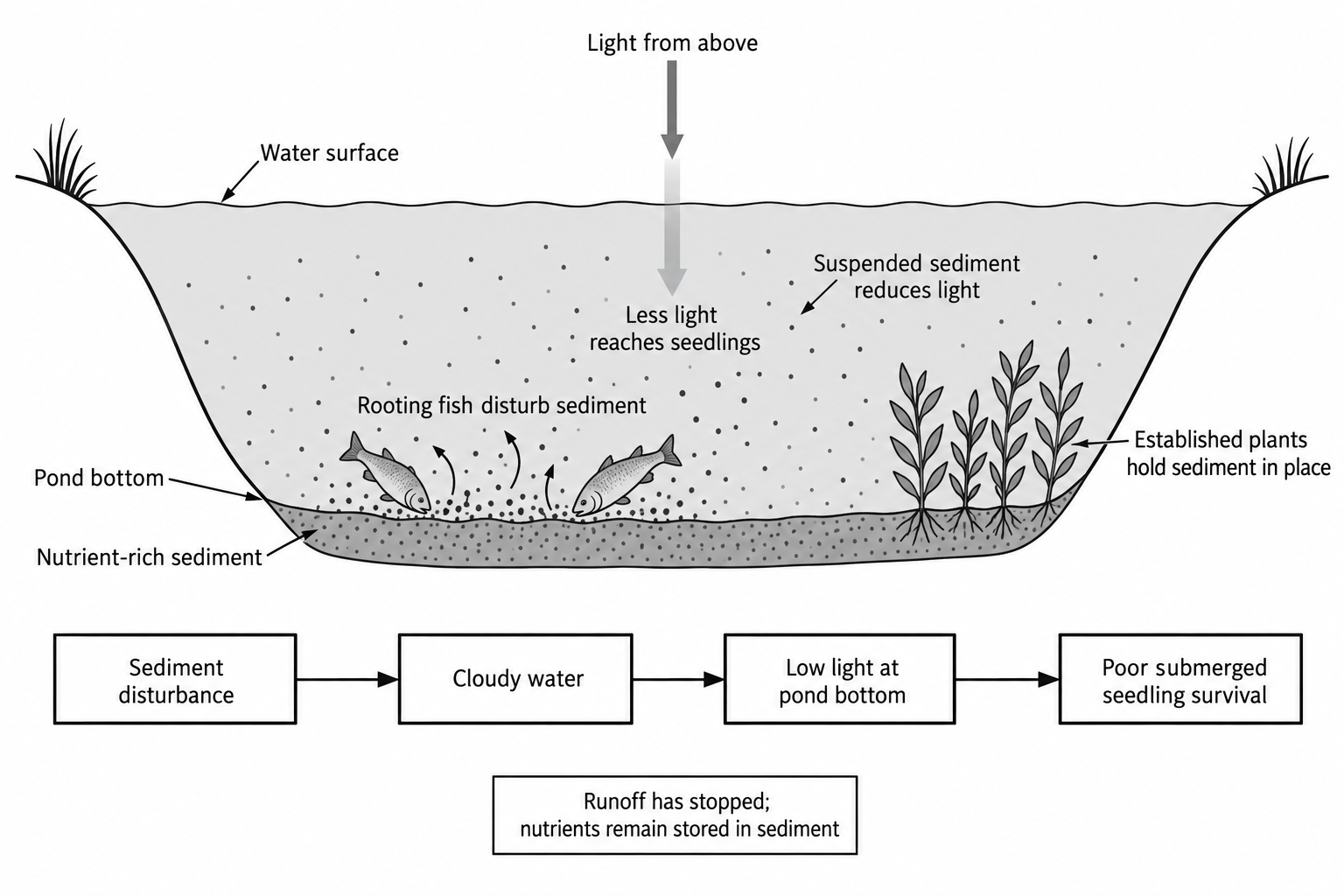
The diagram summarizes interactions in a shallow pond that shifted from submerged plants to persistent cloudy water after years of fertilizer runoff. Managers have stopped the runoff, but sediment still contains abundant nutrients. Rooting fish remain common, and planted submerged seedlings repeatedly die from insufficient light. Which additional action is most likely to help the pond return to a plant-dominated community?
What this assessment covers
Concepts Tested
- Ecosystems
Question Mix
- Hard questions included
Skills you build
- Apply
Related assessments
More practice
Other assessments in this subject
