

BIOLOGY - CELL STRUCTURE

Cell Theory Worksheet

  • 10 questions
  • State that new cells are produced by division of existing cells
  • Difficulty: Hard
  • Board: CAIE
  • Attempt online on the examination portal
Start the 10-question quiz Free, no sign-up needed. Your score shows instantly.

Here are the first 3 questions. Click “View all questions” to see the complete assessment.

Q1.

A sealed chamber initially contains nine living cells. Later, it contains seventeen living cells. No cells enter, leave or die, and each division replaces one cell with two cells. Some cells may divide more than once. How many cell divisions occurred?

  1. A) Nine divisions
  2. B) Four divisions
  3. C) Eight divisions
  4. D) Seventeen divisions

Q2.

A student claims that dissolved substances released by living cells can assemble into new cells without any existing cell dividing. Which comparison best tests this claim against the explanation that new cells arise by division of existing cells?

  1. A) Compare equal volumes of the same cell-free liquid, adding washed living cells to one sample and keeping the other free of cells.
  2. B) Compare two cell-free samples of the same liquid, keeping both under identical conditions.
  3. C) Compare a large sample containing many living cells with a small sample containing few living cells.
  4. D) Compare two samples containing equal numbers of living cells, adding more nutrient solution to one sample.

Q3.

A small piece of living donor tissue is placed in a chamber supplied with cell-free liquid from a patient. No patient cells can enter. Continuous observation shows donor cells dividing, and eventually the chamber contains many more cells. Which explanation correctly identifies the origin of the additional cells?

  1. A) They were produced by division of donor cells and their descendants.
  2. B) They were patient cells because all cells formed using the patient's liquid belong to the patient.
  3. C) They formed from the patient's liquid because it supplied the materials for growth.
  4. D) They formed directly from the chamber surface after contact with donor tissue.

Q4.

A researcher examines a small drop from a bottle of nutrient liquid and sees no cells. The bottle is then sealed so that no cells can enter. Several days later, many cells are present. Which explanation is consistent with the principle that new cells come from existing cells?

  1. A) Sealing the bottle caused its dissolved nutrients to become cells.
  2. B) The absence of cells in the examined drop proves that cells formed without a parent cell.
  3. C) At least one cell was already elsewhere in the bottle and produced descendants by division.
  4. D) Cells must have entered through the sealed bottle even though entry was prevented.

Q5.

Living cells in a closed culture are treated with a substance that completely prevents cell division but does not kill them. Their number remains unchanged. The substance is then removed, and the number of cells increases. No cells enter or leave at any stage. Which explanation accounts for both observations?

  1. A) Existing cells stored complete new cells during treatment and released them afterwards without dividing.
  2. B) Existing cells could produce additional cells only after division was possible again.
  3. C) The treatment prevented nutrients from assembling into cells, but existing cells were not involved.
  4. D) The treatment made newly formed cells invisible until it was removed.

Q6.

A student writes: 'A growing cell takes in dissolved materials, so the new cells in a growing tissue are produced directly from those materials rather than from older cells.' Which correction preserves the valid part of the statement while correcting its explanation of cell origin?

  1. A) Cells can take in materials for growth, but additional cells are produced when existing cells divide.
  2. B) Existing cells produce new cells only when no dissolved materials are available.
  3. C) Dissolved materials provide new cells, while existing cells only arrange them into tissue.
  4. D) Dissolved materials first become complete cells outside the tissue and are then absorbed.

Q7.

A researcher follows one cell as it divides into two. Each daughter cell then divides, producing four cells. Three of these four cells are removed, and the remaining cell later divides. A student claims that the final two cells did not come from an existing cell because the original cell no longer exists as a single cell. Which response is correct?

  1. A) The claim is incorrect because the final pair arose by division of the remaining descendant cell.
  2. B) The claim is correct because only the original cell could produce cells by division.
  3. C) The claim is incorrect because the removed cells returned and formed the final pair.
  4. D) The claim is correct because removing cells breaks the relationship between parents and descendants.

Q8.

A culture contains groups of cells stuck together. A student counts each group as one object. After shaking the culture, the student counts many more separate objects and concludes that cell division has occurred. Which evaluation of this conclusion is best?

  1. A) It is not established because separating groups can reveal existing cells without producing new cells.
  2. B) It is justified because every increase in the number of visible objects represents newly produced cells.
  3. C) It is justified because shaking provides the parent cells needed for division.
  4. D) It is impossible because cells in groups cannot divide.

Q9.

The diagram shows the initial contents of two compartments in a sealed apparatus. The partition allows dissolved nutrients to pass but prevents cells from crossing. Both compartments provide conditions suitable for cell division. No cells enter from outside, and no cells die. Which later observation is consistent with the origin of new cells by division of existing cells?
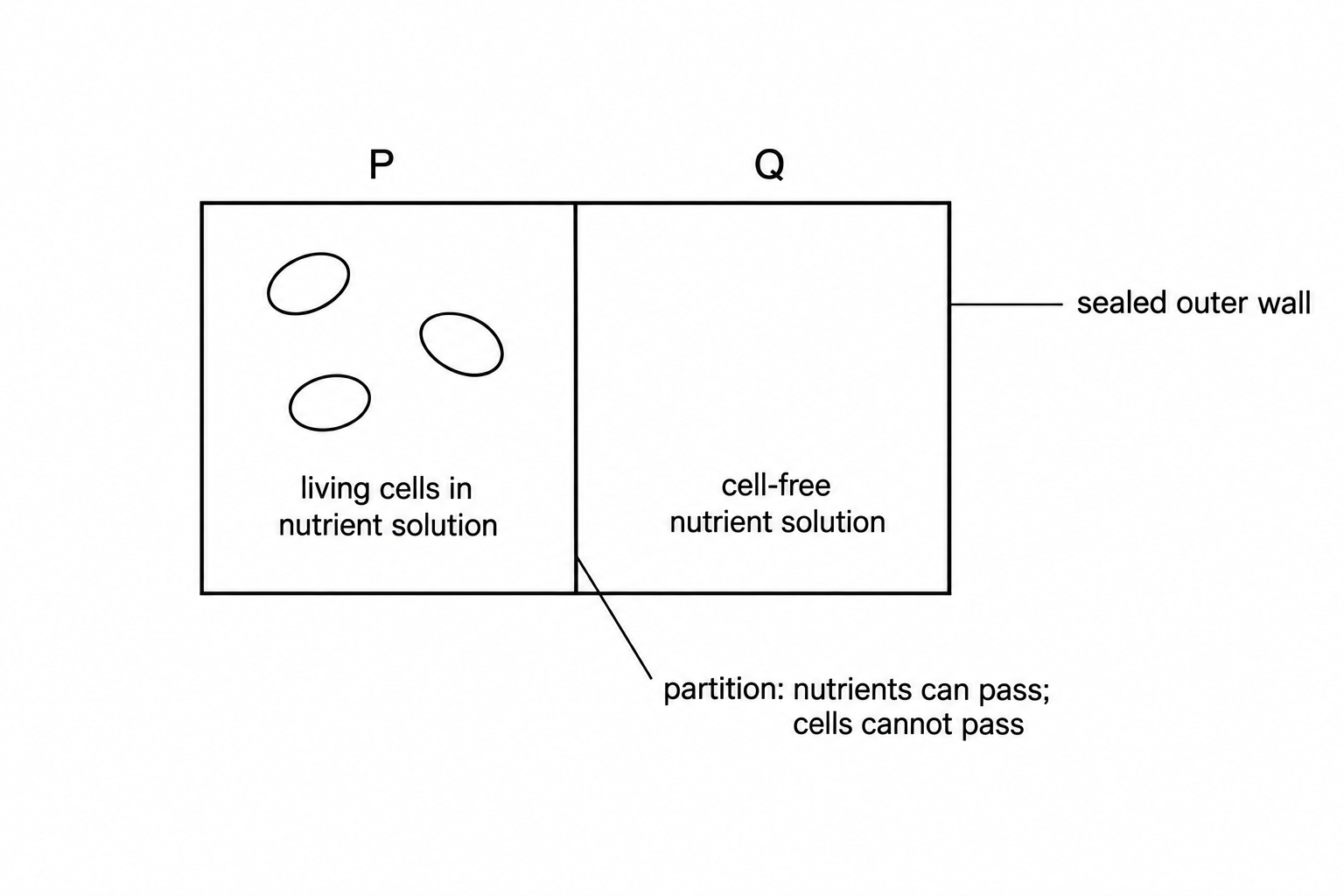
Diagram for question 9: The diagram shows the initial contents of two compartments in a sealed apparatus. The partition allows…
  1. A) The number of cells increases in both compartments because nutrients pass through the partition.
  2. B) The number of cells decreases in compartment P, while cells appear in compartment Q without crossing the partition.
  3. C) Both compartments become populated because the partition allows materials used to make cells to pass.
  4. D) The number of cells increases in compartment P, while compartment Q remains cell-free.

Q10.

The table shows records for four separate sealed cultures. No cells can enter or leave, but cells may die. Where division is recorded as prevented, it is completely prevented throughout the investigation. Which culture has a record that cannot be explained by new cells arising only through division of existing cells?
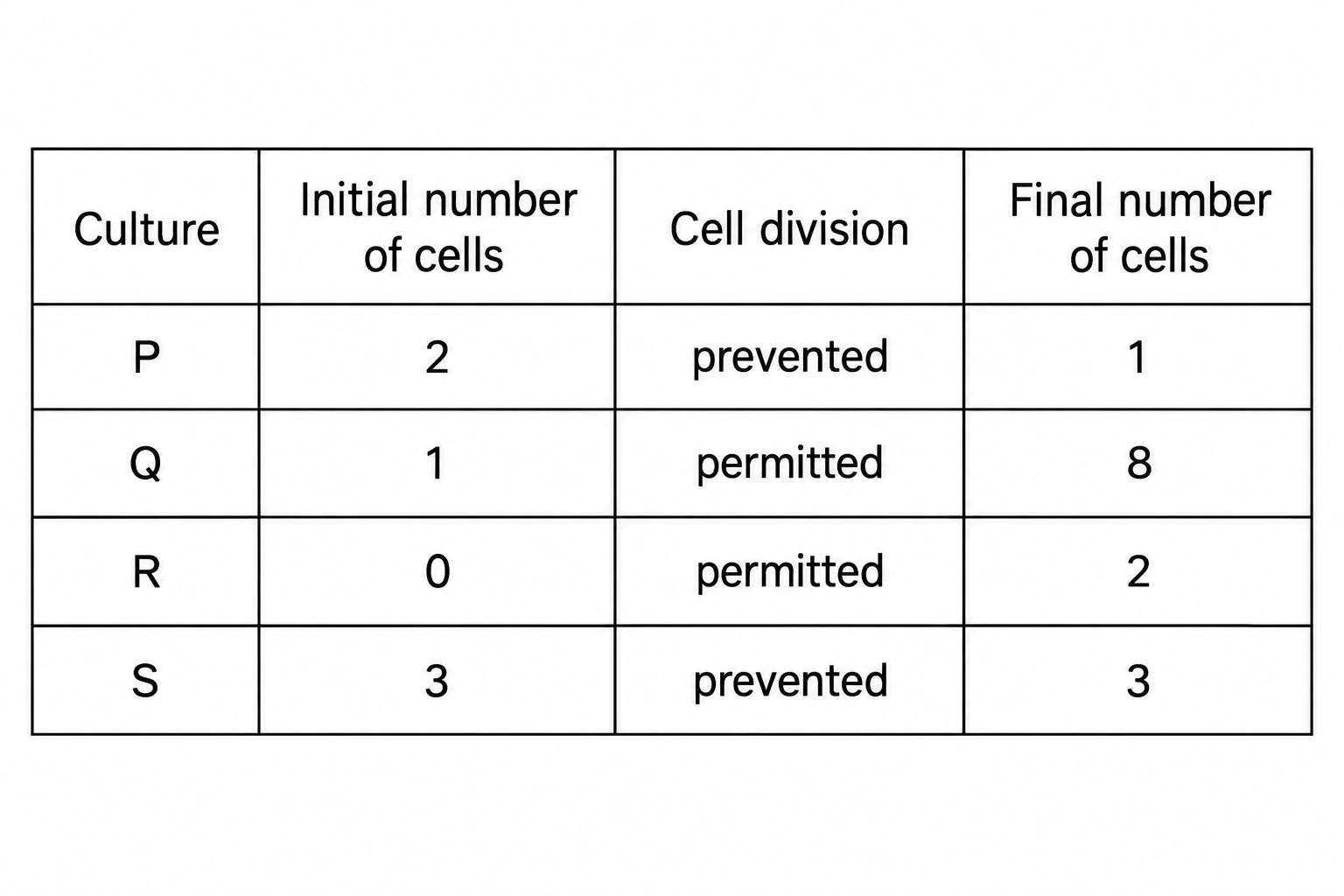
Diagram for question 10: The table shows records for four separate sealed cultures. No cells can enter or leave, but cells may die.…
  1. A) Culture R
  2. B) Culture Q
  3. C) Culture P
  4. D) Culture S

What this assessment covers

Concepts Tested

  • Cell Structure
  • State that new cells are produced by division of existing cells

Question Mix

  • Hard questions included

Skills you build

  • Apply