

MATHEMATICS - TWO-STEP EQUATIONS
Two Step Equations Practice Problems
- Focuses on solving two-step equations in real-world contexts
- Includes problems involving both positive and negative numbers
- Covers equations with variables representing different quantities
- Medium difficulty
Start the 10-question quiz
Free, no sign-up needed. Your score shows instantly.
Here are the first 3 questions. Click “View all questions” to see the complete assessment.
Q1.
Q2.
Which option correctly describes and solves the equation 5m − 9 = 31?
Q3.
Six identical pens and a delivery charge of four dollars cost forty dollars altogether. If p is the price of one pen in dollars, which option represents and solves the situation?
Q4.
A temperature starts at 18^(\)circC and falls by 4^(\)circC each hour. It eventually reaches −6^(\)circC. If h is the number of hours, which equation and solution are correct?
Q5.
Which situation is represented by 7p + 5 = 54, and what is the value of p?
Q6.
Mina has three fewer than twice as many stickers as Leo. Mina has nineteen stickers. If l is the number of stickers Leo has, which option gives the correct equation and solution?
Q7.
A number is multiplied by negative three, and then seven is added. The result is negative eleven. If the number is x, which equation and solution are correct?
Q8.
Which option correctly describes and solves the equation 2q + 8 = 24?
Q9.
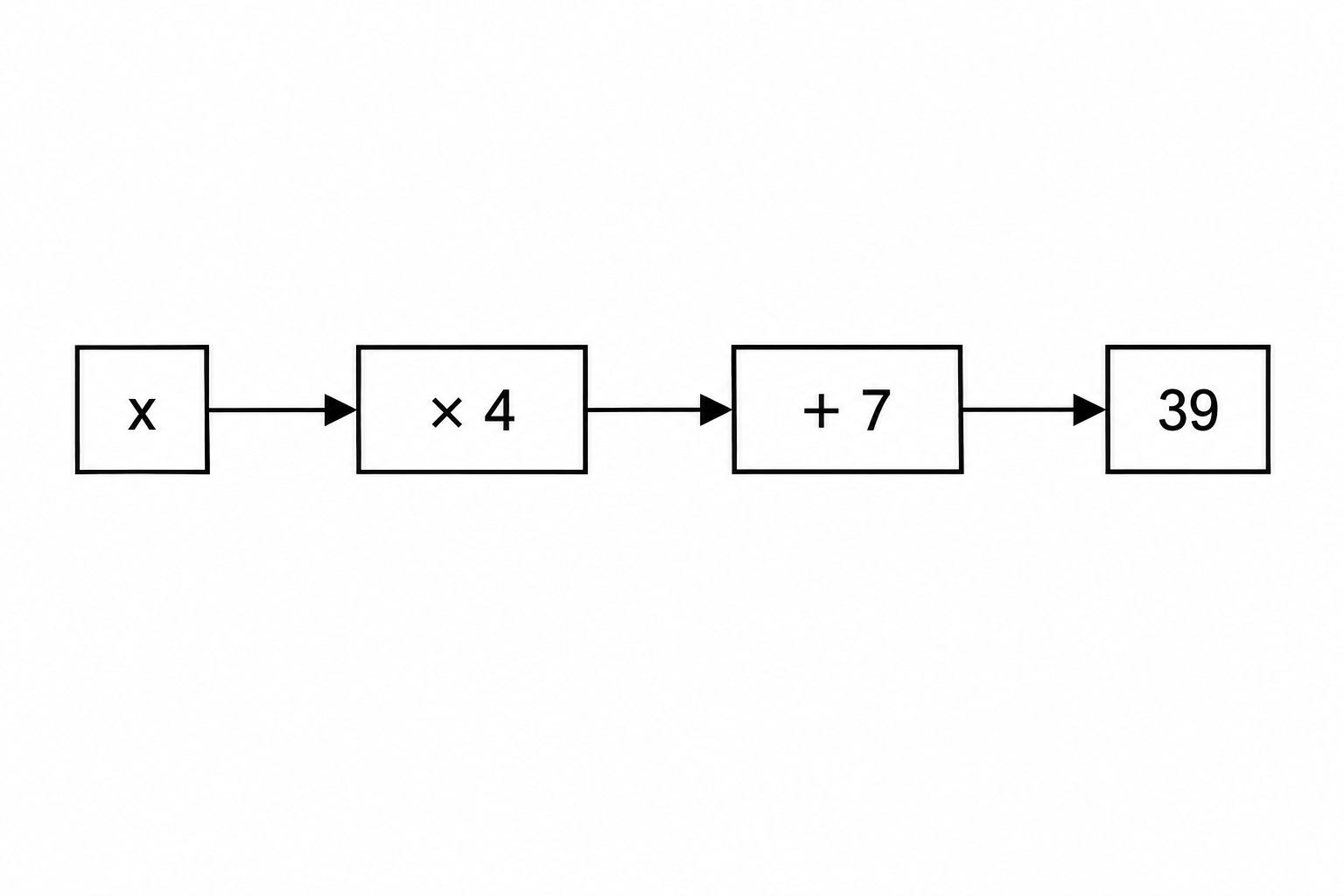
The number machine in the diagram starts with an unknown input. Which option gives the equation represented by the machine and the value of the input?
Q10.
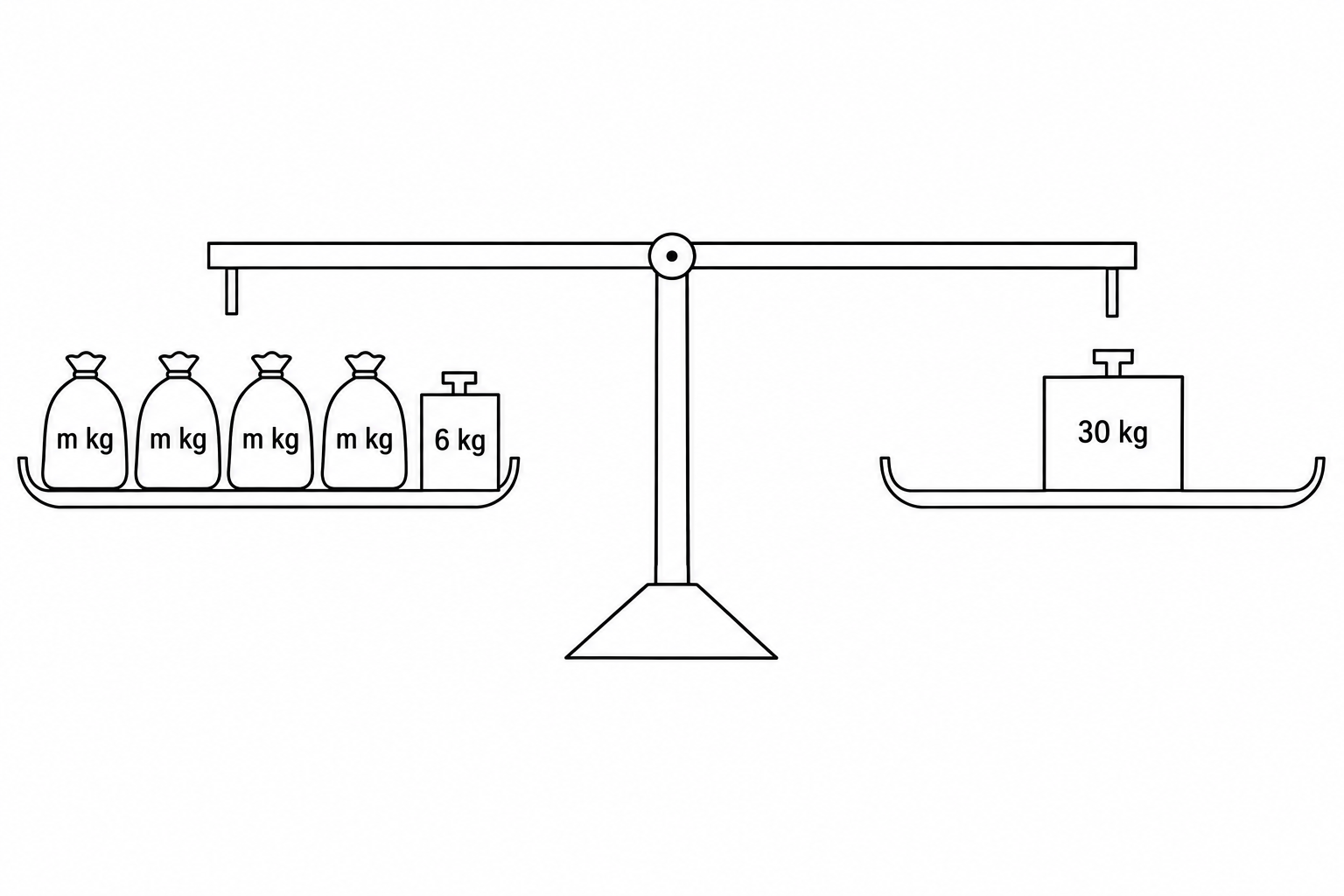
The balanced scale shows four identical bags and an additional mass on one side. Which option gives the equation represented by the balance and the mass of each bag?
What this assessment covers
Concepts tested
- Two-step equations
- Variables in equations
- Real-world problem representation
- Balancing equations
- Interpreting mathematical expressions
Question Mix
- Medium questions included
Skills you build
- Formulating equations from word problems
- Solving two-step equations
- Interpreting solutions in context
- Applying arithmetic operations to solve equations
- Understanding relationships between variables
Related assessments
More practice
Other assessments in this subject
