

MATHEMATICS - TWO-STEP EQUATIONS
7th Grade Two Step Equations Worksheet
- Covers solving two-step equations in real-world contexts
- Focuses on translating word problems into algebraic equations
- Includes multiple choice questions for practice and assessment
- Designed for 6th to 7th-grade mathematics students
Start the 10-question quiz
Free, no sign-up needed. Your score shows instantly.
Here are the first 3 questions. Click “View all questions” to see the complete assessment.
Q1.
Q2.
The equation 6m − 4 = 32 represents a situation. Which description and solution are correct?
Q3.
Seven less than four times a number n is 25. Which equation represents this statement, and what is the solution?
Q4.
The equation 5p + 9 = 44 models counters in packets and loose counters. Which situation and solution match the equation?
Q5.
A journey costs a fixed booking charge of 4 dollars plus 3 dollars for each kilometre travelled. The total cost is 25 dollars. Which equation represents the journey, and how many kilometres, d, were travelled?
Q6.
A number z is multiplied by 3. Then 4 is added, giving a result of −11. Which equation and solution are correct?
Q7.
A player scores 8 points in each round but loses 6 points as a penalty. The final score is 42. Which equation represents the number of rounds r, and what is its solution?
Q8.
Seven is added to negative twice a number q. The result is 19. Which equation represents the statement, and what is the solution?
Q9.
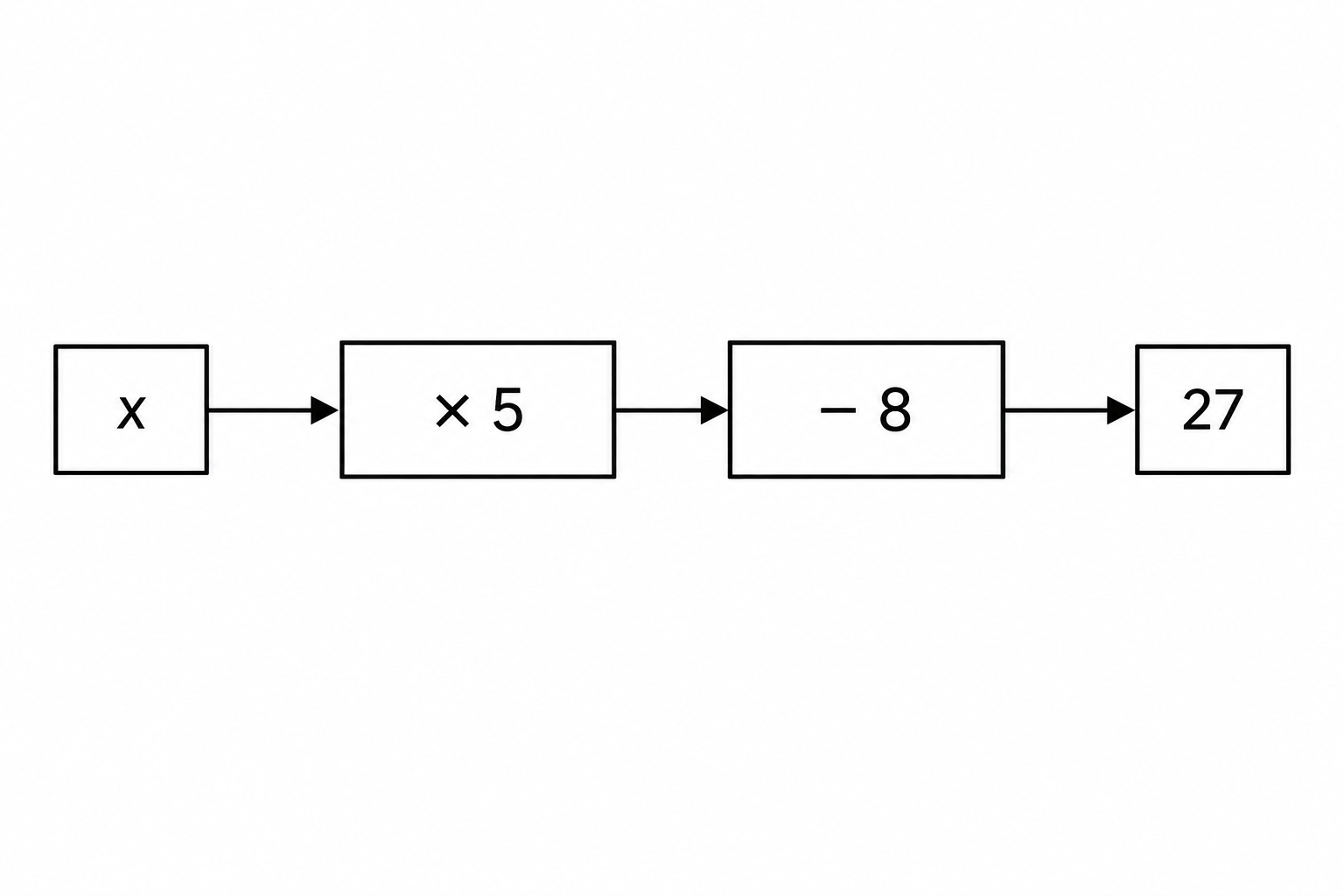
The process diagram shows what happens to an input x. Which equation represents the process, and what is the input?
Q10.
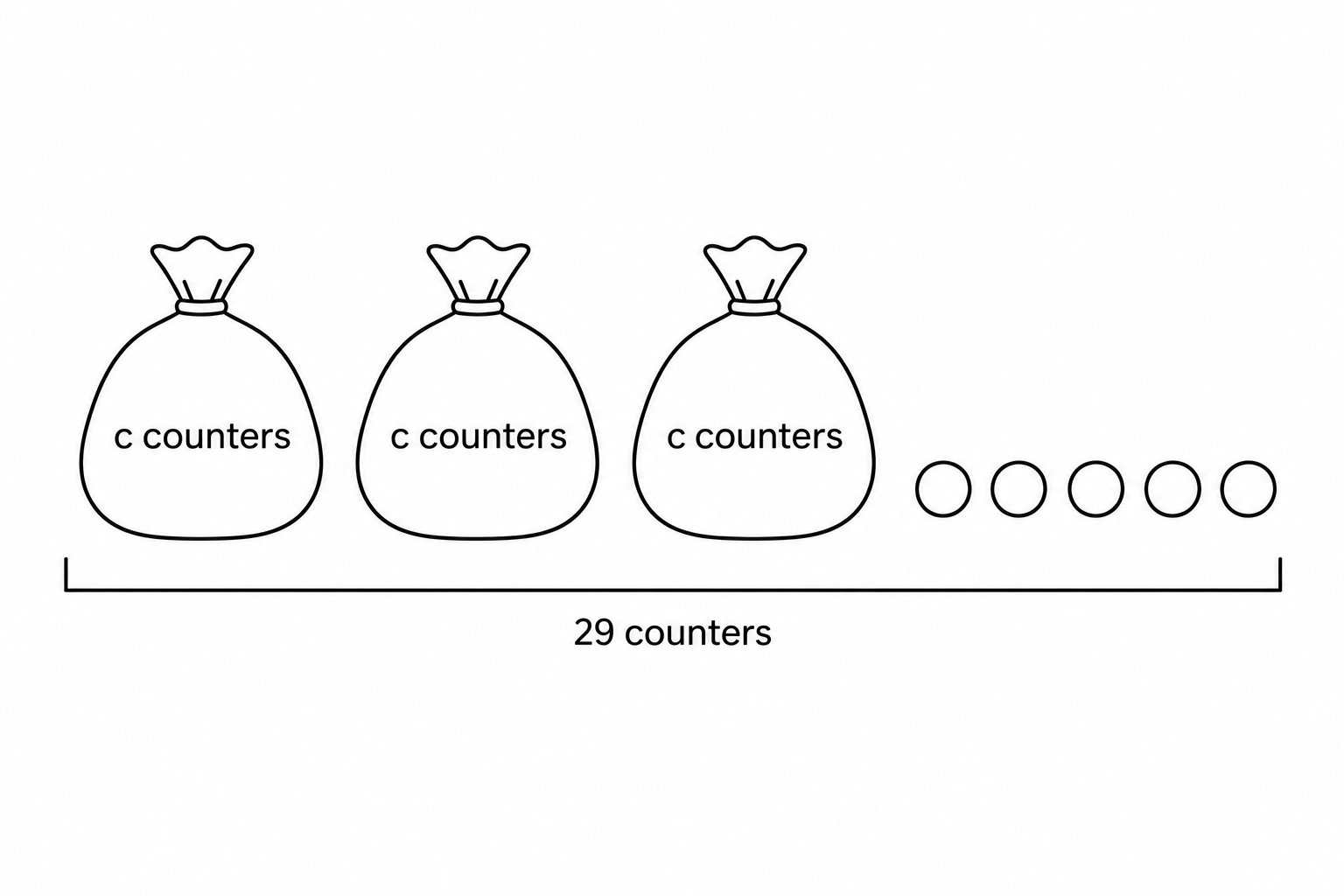
The diagram represents a total number of counters. Each bag contains the same number, c, of counters. Which equation represents the diagram, and how many counters are in each bag?
What this assessment covers
Concepts tested
- Two-step equations
- Translating verbal descriptions into equations
- Solving equations with variables on one side
- Understanding algebraic expressions
- Interpreting real-world mathematical problems
Question Mix
- Medium questions included
Skills you build
- Formulating equations from word problems
- Solving two-step algebraic equations
- Interpreting mathematical situations
- Applying arithmetic operations in equations
- Analyzing and understanding problem statements
Related assessments
More practice
Other assessments in this subject
