MATHEMATICS - ABSOLUTE VALUE

Mean Absolute Deviation Worksheet

  • 10 questions
  • Difficulty: Medium
  • Board: US
  • Attempt online on the examination portal
Start the 10-question quiz Free, no sign-up needed. Your score shows instantly.

Here are the first 3 questions. Click “View all questions” to see the complete assessment.

Q1.

A class records how many books each student reads during a year. The mean is 12 books, and the mean absolute deviation is 3 books. Which statement correctly explains the mean absolute deviation?

  1. A) The difference between the greatest and least book counts is 3 books.
  2. B) Every student reads exactly 3 books more or less than the mean.
  3. C) The average distance between a student's book count and the mean is 3 books.
  4. D) Exactly 3 students read the mean number of books.

Q2.

Two groups record the number of minutes spent waiting for a bus. Group A records 4,\ 6,\ 8. Group B records 2,\ 6,\ 10. Both groups have a mean of 6 minutes. Which statement correctly compares their mean absolute deviations?

  1. A) Group B has the greater mean absolute deviation because its values are farther from the shared mean on average.
  2. B) They are equal because each group contains the same number of values.
  3. C) They are equal because the groups have the same mean.
  4. D) Group A has the greater mean absolute deviation because its smallest value is greater.

Q3.

For a set of five measurements, the absolute deviations from the mean are 0,\ 2,\ 2,\ 4,\ 8. Which expression correctly finds the mean absolute deviation?

  1. A) (0 + 2 + 2 + 4 + 8)/(3), because only distinct nonzero deviations should be counted.
  2. B) (0 + 2 + 2 + 4 + 8)/(4), because only nonzero deviations should be counted.
  3. C) (0 + 2 + 2 + 4 + 8)/(8), because the greatest deviation is the divisor.
  4. D) (0 + 2 + 2 + 4 + 8)/(5), because every measurement contributes a deviation.

Q4.

A set of game scores has a mean of 20 points and a mean absolute deviation of 4 points. A bonus of 3 points is added to every score. What happens to the mean and the mean absolute deviation?

  1. A) The mean becomes 23 points, and the mean absolute deviation remains 4 points.
  2. B) The mean remains 20 points, and the mean absolute deviation becomes 7 points.
  3. C) The mean becomes 23 points, and the mean absolute deviation becomes 7 points.
  4. D) The mean becomes 23 points, and the mean absolute deviation becomes 1 point.

Q5.

Each data set below has a mean of 9. Which data set has a mean absolute deviation of zero?

  1. A) 8,\ 8,\ 9,\ 10,\ 10
  2. B) 5,\ 9,\ 9,\ 9,\ 13
  3. C) 7,\ 8,\ 9,\ 10,\ 11
  4. D) 9,\ 9,\ 9,\ 9,\ 9

Q6.

The lengths of several ribbons have a mean absolute deviation of 0.8 cm. The same lengths are rewritten in millimeters, using 1 cm = 10 mm. Which statement describes the mean absolute deviation in millimeters?

  1. A) It is 0.08 mm, because the number of millimeters is found by dividing by ten.
  2. B) It is 8 mm, because every distance from the mean is multiplied by ten.
  3. C) It is 0.8 mm, because changing units does not change the numerical value.
  4. D) It is 80 mm, because the distances are multiplied by one hundred.

Q7.

A gardener records plant heights of 8,\ 9,\ 10,\ 11,\ 12 cm. The middle recorded height, 10 cm, is corrected to 30 cm. Which statement describes the effect of this correction?

  1. A) Both the mean and the mean absolute deviation increase.
  2. B) The mean increases, but the mean absolute deviation decreases.
  3. C) The mean stays the same, but the mean absolute deviation increases.
  4. D) The mean increases, but the mean absolute deviation stays the same.

Q8.

A student subtracts the mean from each value in a data set and gets −3,\ − 1,\ 1,\ 3. The student averages these results and reports a mean absolute deviation of zero. Which explanation correctly identifies the mistake?

  1. A) The student should choose the greatest absolute distance, giving 3.
  2. B) The student should average the absolute distances, giving (3 + 1 + 1 + 3)/(4) = 2.
  3. C) The student should use the distance between the least and greatest results, giving 3 − ( − 3) = 6.
  4. D) The student should average only the positive results, giving (1 + 3)/(2) = 2.

Q9.

The dot plot shows the number of practice problems completed by each of five students. The mean is 4 problems. What is the mean absolute deviation of the numbers shown?
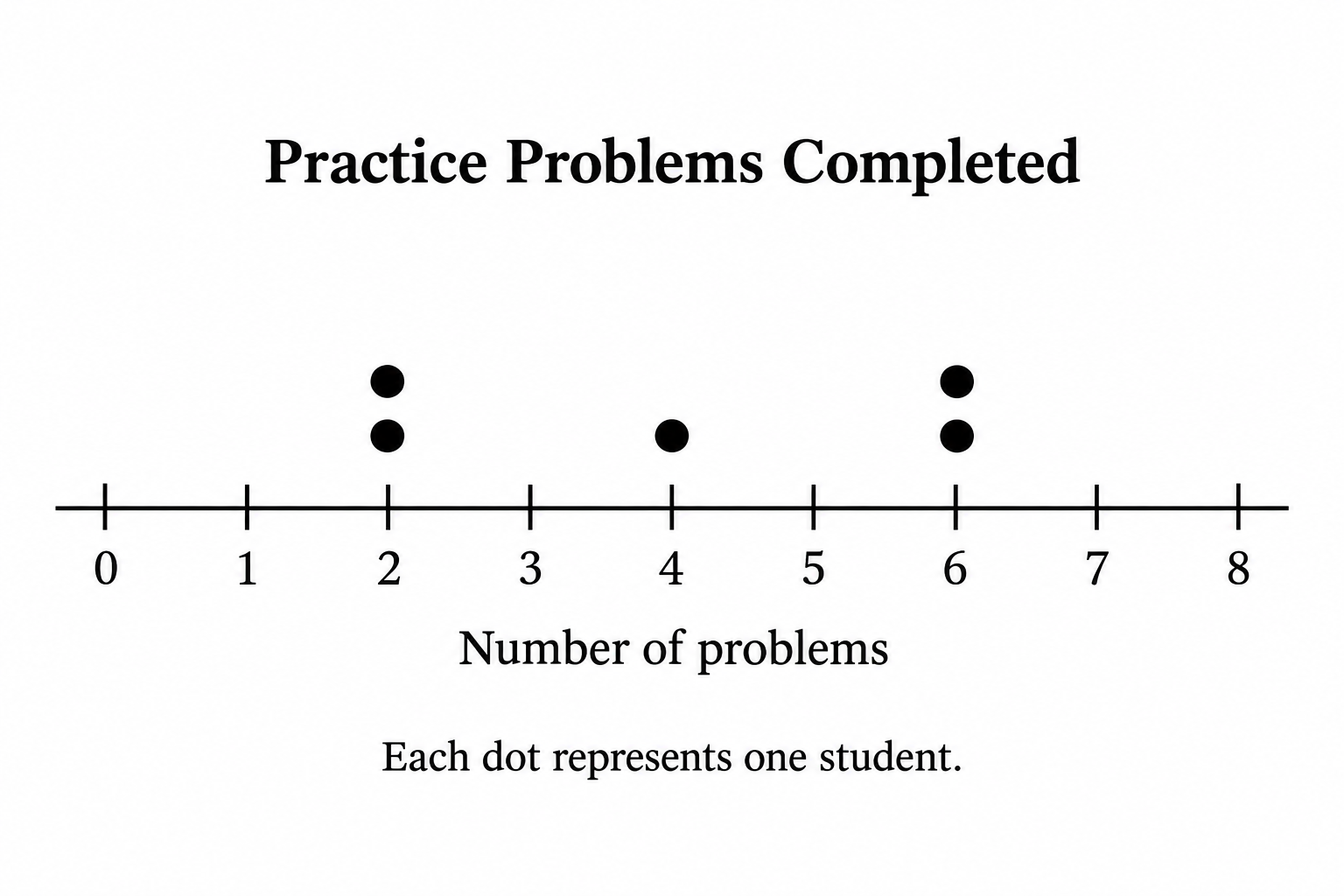
Diagram for question 9: The dot plot shows the number of practice problems completed by each of five students. The mean is 4…
  1. A) 4 problems
  2. B) 0 problems
  3. C) 1.6 problems
  4. D) 2 problems

Q10.

The table shows four daily delivery counts and their absolute deviations from the mean. A fifth day with 7 deliveries is added. Which statement correctly describes the new mean absolute deviation?
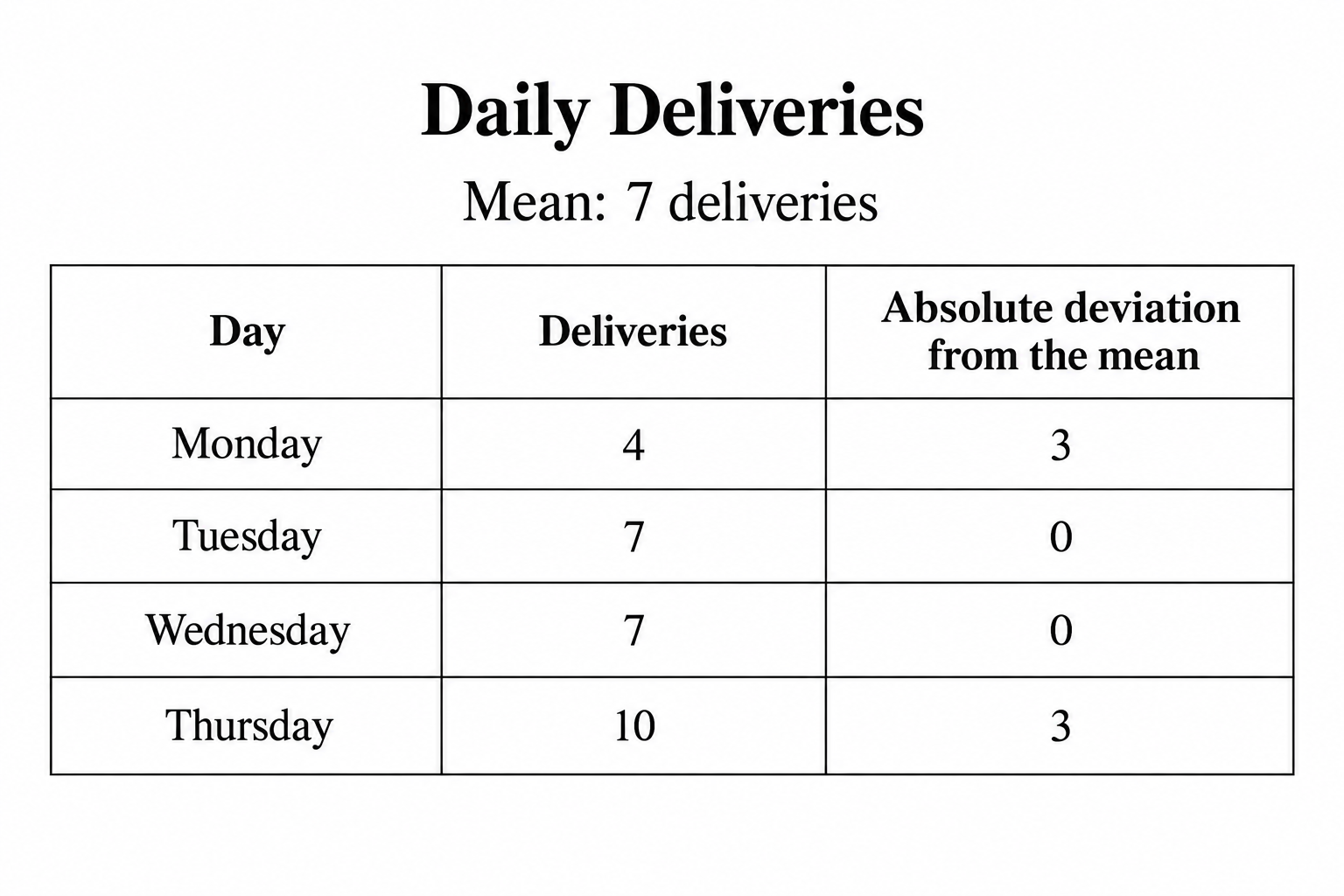
Diagram for question 10: The table shows four daily delivery counts and their absolute deviations from the mean. A fifth day with 7…
  1. A) It stays the same because the mean stays the same.
  2. B) It decreases because the total absolute deviation stays the same but is divided by more days.
  3. C) It increases because there are more days in the data set.
  4. D) It becomes zero because the new delivery count equals the mean.

What this assessment covers

Concepts Tested

  • Absolute Value

Question Mix

  • Medium questions included

Skills you build

  • Understand