

MATHEMATICS - RATIONAL NUMBERS

Rational Numbers Worksheet

  • 10 questions
  • Understand the hierarchy of natural numbers, integers and rational numbers.
  • Difficulty: Medium
  • Board: CAIE
  • Attempt online on the examination portal
Start the 10-question quiz Free, no sign-up needed. Your score shows instantly.

Here are the first 3 questions. Click “View all questions” to see the complete assessment.

Q1.

Which is the smallest of the following number sets that contains 18/3?

  1. A) Rational numbers but not integers
  2. B) None of the natural numbers, integers or rational numbers
  3. C) Natural numbers
  4. D) Integers but not natural numbers

Q2.

Three number sets are to be arranged so that every set is contained in the next set. Which order is correct?

  1. A) Natural numbers, then integers, then rational numbers
  2. B) Natural numbers, then rational numbers, then integers
  3. C) Integers, then natural numbers, then rational numbers
  4. D) Rational numbers, then integers, then natural numbers

Q3.

Which list contains only rational numbers that are not integers?

  1. A) −2.5, 3/4, 0.6
  2. B) −2, 3/4, 0.6
  3. C) −2.5, 3/4, 6
  4. D) −2.5, 8/4, 0.6

Q4.

A student says, “−7 is an integer, so it cannot also be rational.” Which explanation correctly identifies the student's mistake?

  1. A) Every integer is a natural number, so it is also rational.
  2. B) Every rational number must have a value between −1 and 1.
  3. C) Negative numbers cannot be integers.
  4. D) An integer can also be rational; for example, −7 = ( − 7)/(1).

Q5.

A number belongs to both the integers and the rational numbers, but does not belong to the natural numbers. Which number could it be?

  1. A) 9/2
  2. B) 9
  3. C) −9/2
  4. D) −9

Q6.

Two cards show 0.75 and 3/4. A student puts them in different number sets because one is written as a decimal and the other as a fraction. Which statement correctly describes the cards?

  1. A) Both cards show natural numbers because all their written digits are positive.
  2. B) Both cards show the same rational number, which is not an integer.
  3. C) Only the fraction card shows a rational number.
  4. D) Only the decimal card shows an integer.

Q7.

A number is rational but is not an integer. Which further conclusion must be true?

  1. A) It is less than 1.
  2. B) It is negative.
  3. C) It is not a natural number.
  4. D) It is positive.

Q8.

Five cards show 4,\ − 6,\ 7/2,\ 1.25,\ ( − 3)/(1). Each card is counted in every number set to which it belongs. How many cards show integers, and how many show rational numbers?

  1. A) 5 integers and 5 rational numbers
  2. B) 2 integers and 5 rational numbers
  3. C) 3 integers and 3 rational numbers
  4. D) 3 integers and 5 rational numbers

Q9.

The diagram shows three nested number sets. Which assignment of values to P, Q and R agrees with their positions?
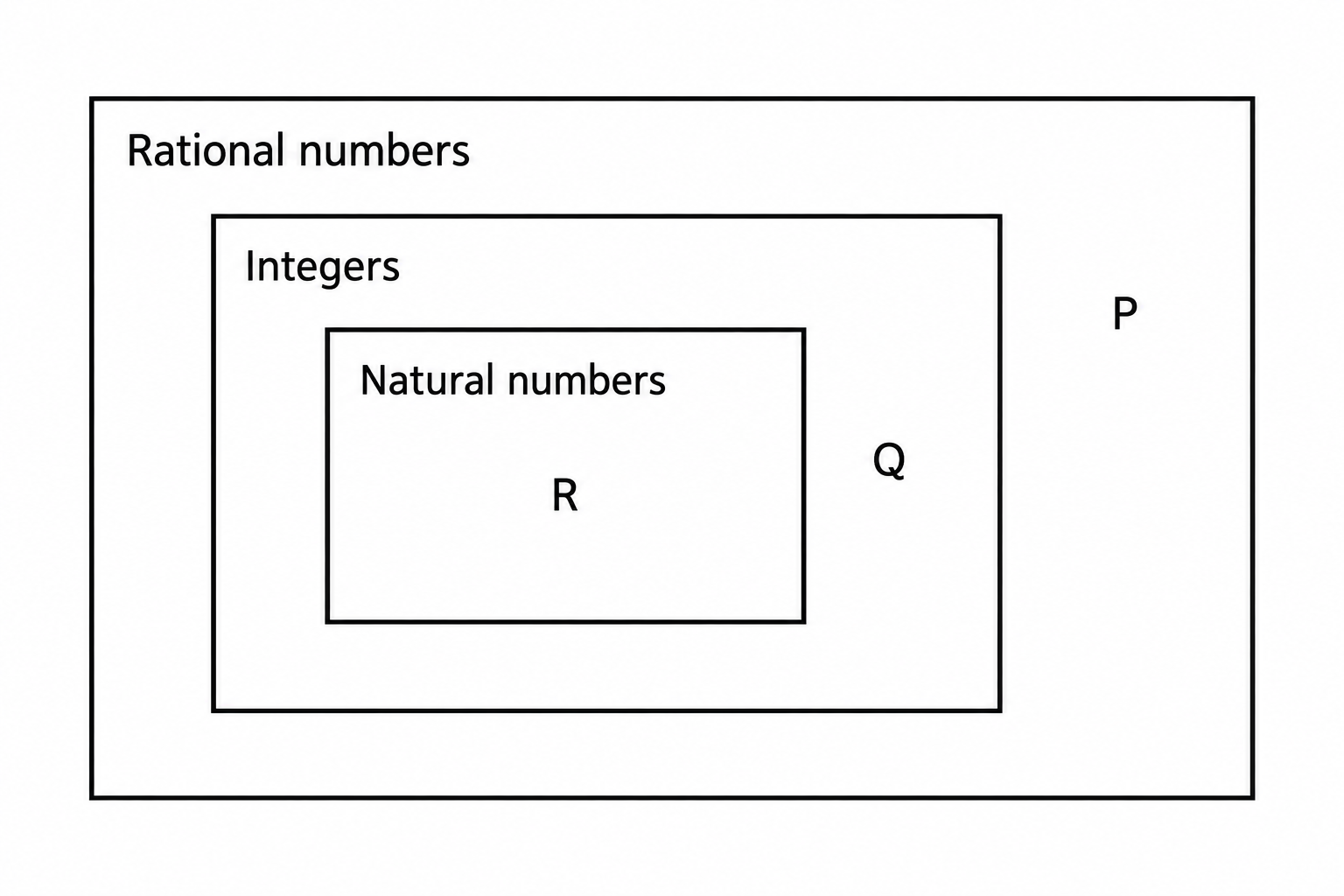
Diagram for question 9: The diagram shows three nested number sets. Which assignment of values to P, Q and R agrees with their…
  1. A) P = − 1.5, Q = − 4, R = 6
  2. B) P = − 4, Q = − 1.5, R = 6
  3. C) P = − 1.5, Q = 6, R = − 4
  4. D) P = 6, Q = − 4, R = − 1.5

Q10.

Which pair of labelled points on the number line represents one natural number and one rational number that is not an integer?
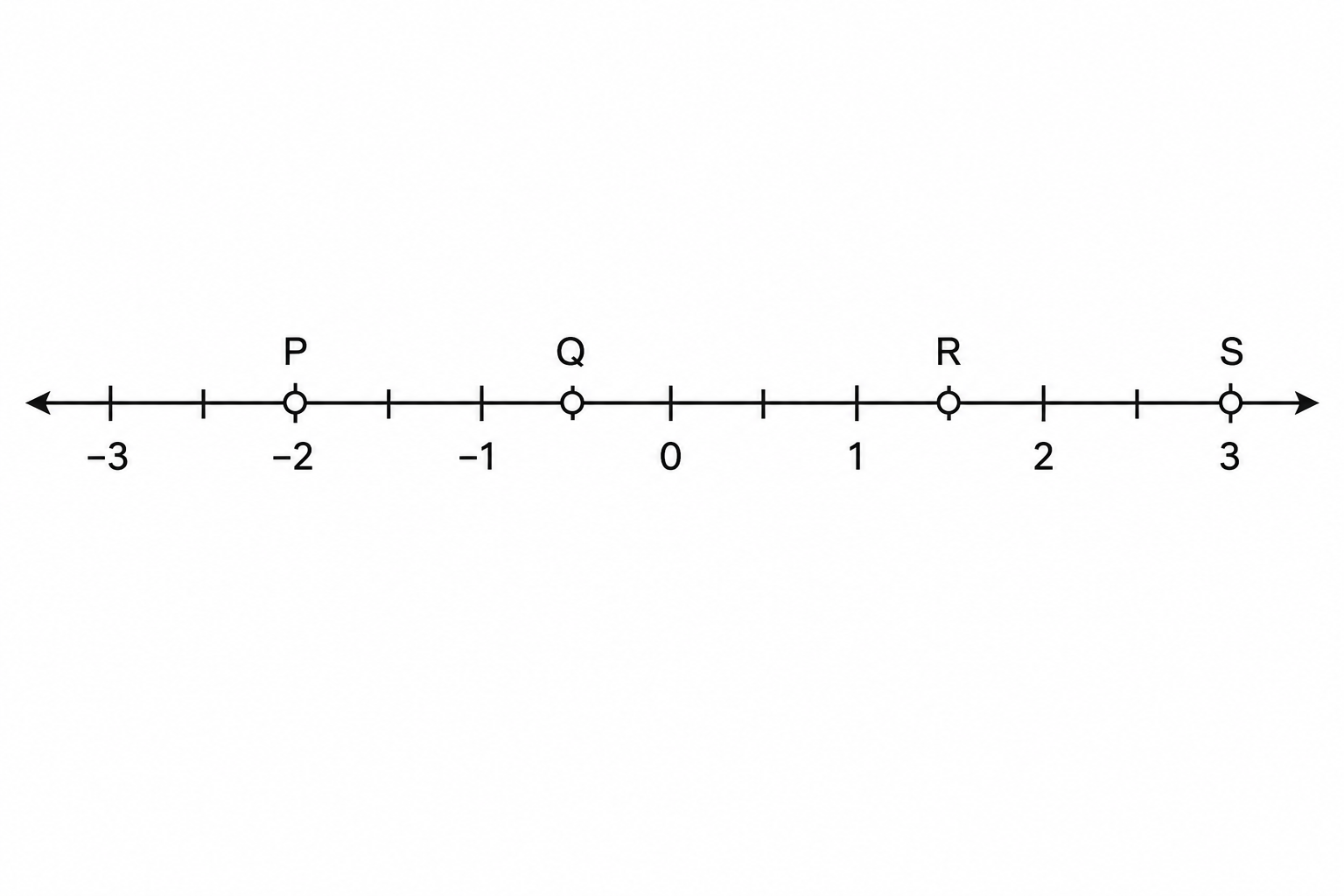
Diagram for question 10: Which pair of labelled points on the number line represents one natural number and one rational number that…
  1. A) R and S
  2. B) Q and R
  3. C) P and S
  4. D) P and Q

What this assessment covers

Concepts Tested

  • Rational Numbers
  • Understand the hierarchy of natural numbers, integers and rational numbers.

Question Mix

  • Medium questions included

Skills you build

  • Understand