

MATHEMATICS - PYTHAGOREAN THEOREM
Pythagorean Theorem Quiz
- 10 questions
- Know and use Pythagoras’ theorem.
- Difficulty: Hard
- Board: CAIE
- Attempt online on the examination portal
Start the 10-question quiz
Free, no sign-up needed. Your score shows instantly.
Here are the first 3 questions. Click “View all questions” to see the complete assessment.
Q1.
Q2.
A rectangular noticeboard has a diagonal of length 29 cm and a shorter side of length 20 cm. A strip of edging fits exactly around its perimeter, with no overlap. What length of edging is needed?
Q3.
An isosceles triangular panel has two equal sides of length 25 cm and a base of length 14 cm. What is the area of the panel?
Q4.
On a coordinate map, two shelters are at ( − 5,8) and (7, − 1). Each coordinate unit represents 0.6 km. What is the straight-line distance between the shelters?
Q5.
Two vertical poles stand on the same horizontal ground, with their bases 21 m apart. The poles are 31 m and 11 m tall. A cable must span the straight-line distance between their tops, with an additional 2 m allowed for fastening. What total length of cable is required?
Q6.
A rhombus has side length 17 cm. One diagonal has length 16 cm. The diagonals bisect each other at right angles. What is the area of the rhombus?
Q7.
The two perpendicular sides of a right-angled triangle are in the ratio 5:12. Its hypotenuse has length 52 cm. What is the perimeter of the triangle?
Q8.
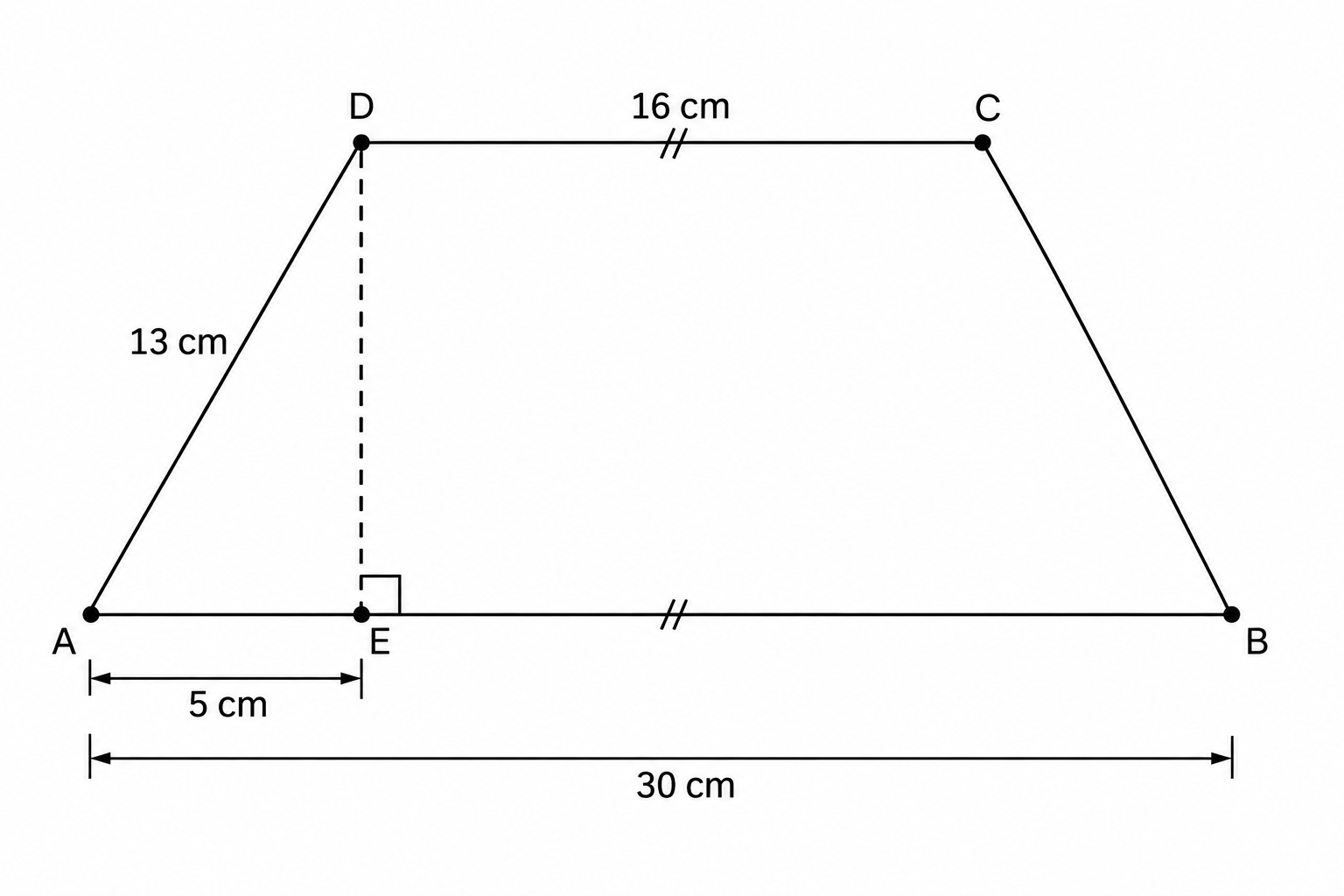
The diagram shows trapezium ABCD, with AB∥ DC. The perpendicular from D meets AB at E. What is the perimeter of the trapezium?
Q9.
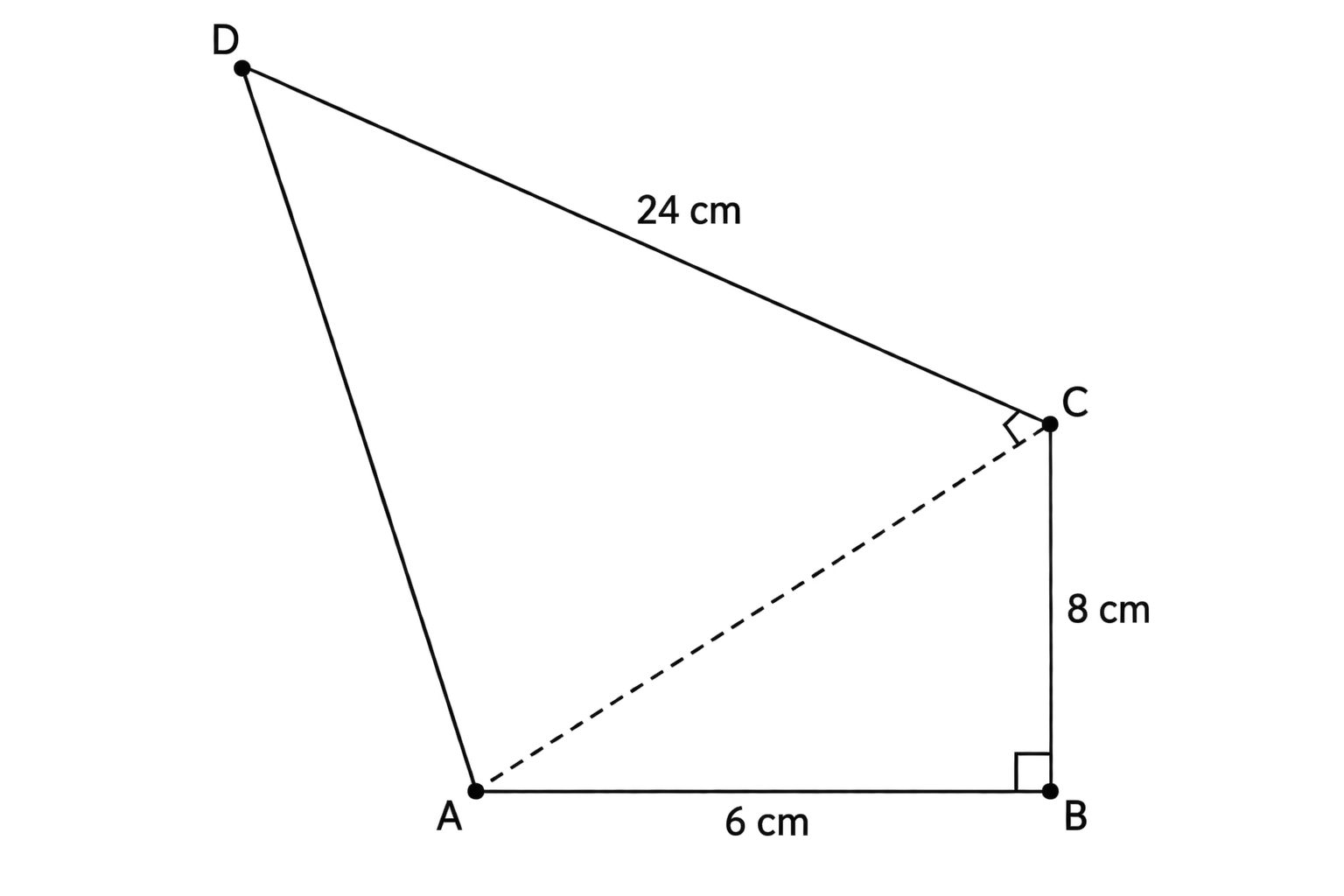
In the diagram, ∠ ABC = 90^(\)circ and ∠ ACD = 90^(\)circ. What is the perimeter of quadrilateral ABCD?
Q10.
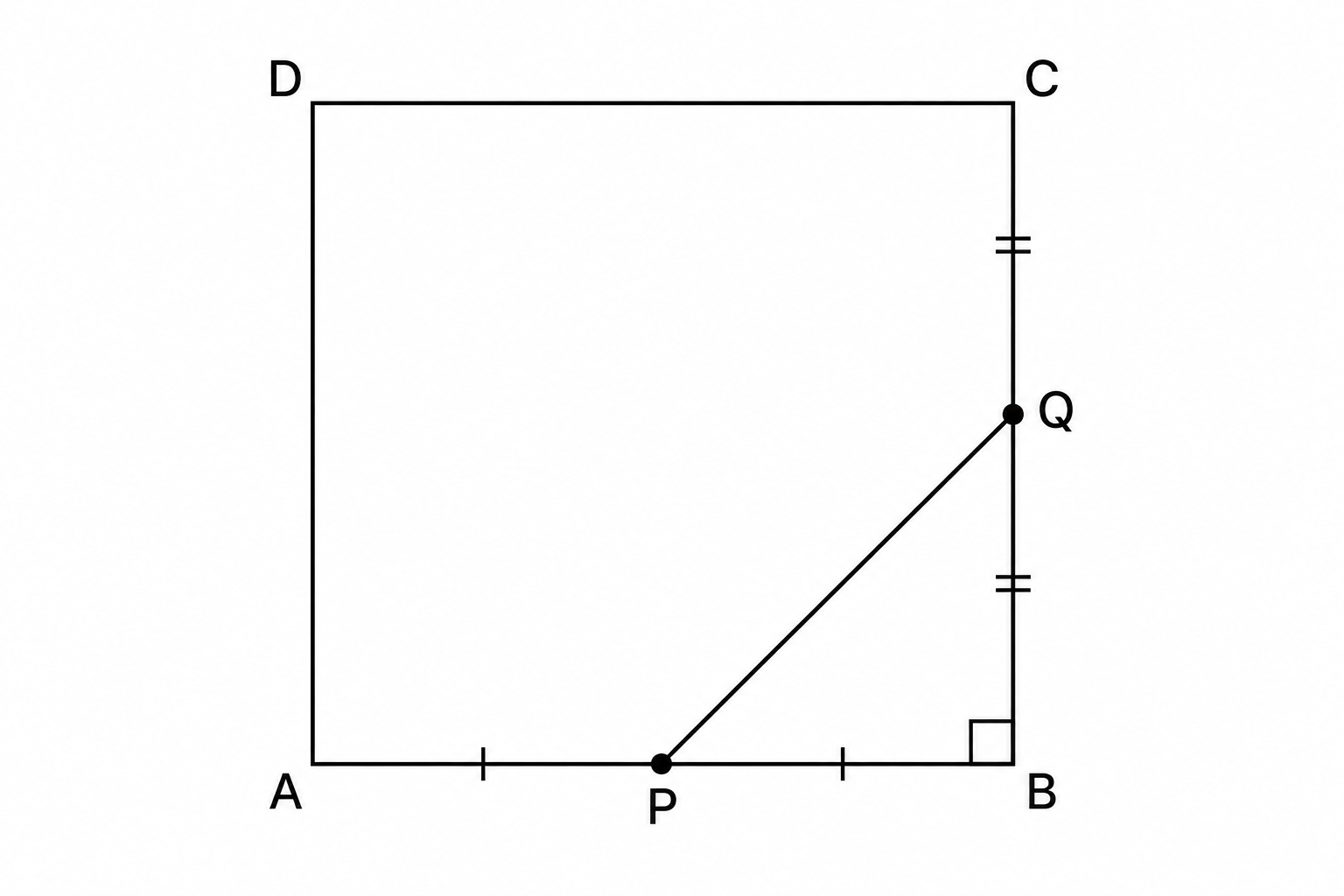
Square ABCD has area 288 cm². Points P and Q are the midpoints of AB and BC, respectively. What is the length of PQ?
What this assessment covers
Concepts Tested
- Pythagorean Theorem
- Know and use Pythagoras’ theorem.
Question Mix
- Hard questions included
Skills you build
- Apply
Related assessments
More practice
Other assessments in this subject
