Q1 Question
Points: 1
Choose the correct answer:
Which is the smallest of the following number sets that contains 18/3?
Showing question 1 of 10
Choose the correct answer:
Three number sets are to be arranged so that every set is contained in the next set. Which order is correct?
Choose the correct answer:
Which list contains only rational numbers that are not integers?
Choose the correct answer:
A student says, “−7 is an integer, so it cannot also be rational.” Which explanation correctly identifies the student's mistake?
Choose the correct answer:
A number belongs to both the integers and the rational numbers, but does not belong to the natural numbers. Which number could it be?
Choose the correct answer:
Two cards show 0.75 and 3/4. A student puts them in different number sets because one is written as a decimal and the other as a fraction. Which statement correctly describes the cards?
Choose the correct answer:
A number is rational but is not an integer. Which further conclusion must be true?
Choose the correct answer:
Five cards show 4,\ − 6,\ 7/2,\ 1.25,\ ( − 3)/(1). Each card is counted in every number set to which it belongs. How many cards show integers, and how many show rational numbers?
Choose the correct answer:
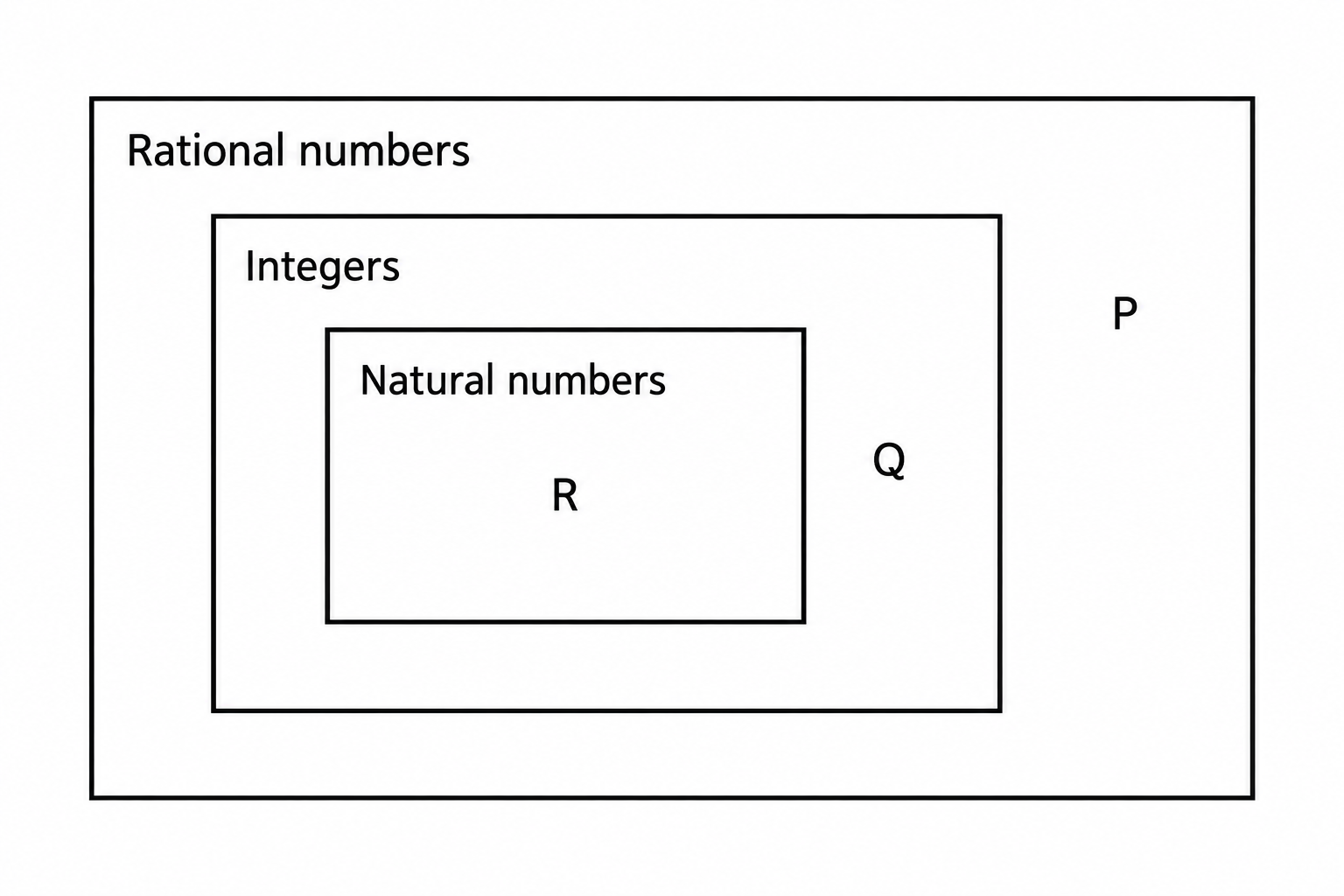
The diagram shows three nested number sets. Which assignment of values to P, Q and R agrees with their positions?
Choose the correct answer:
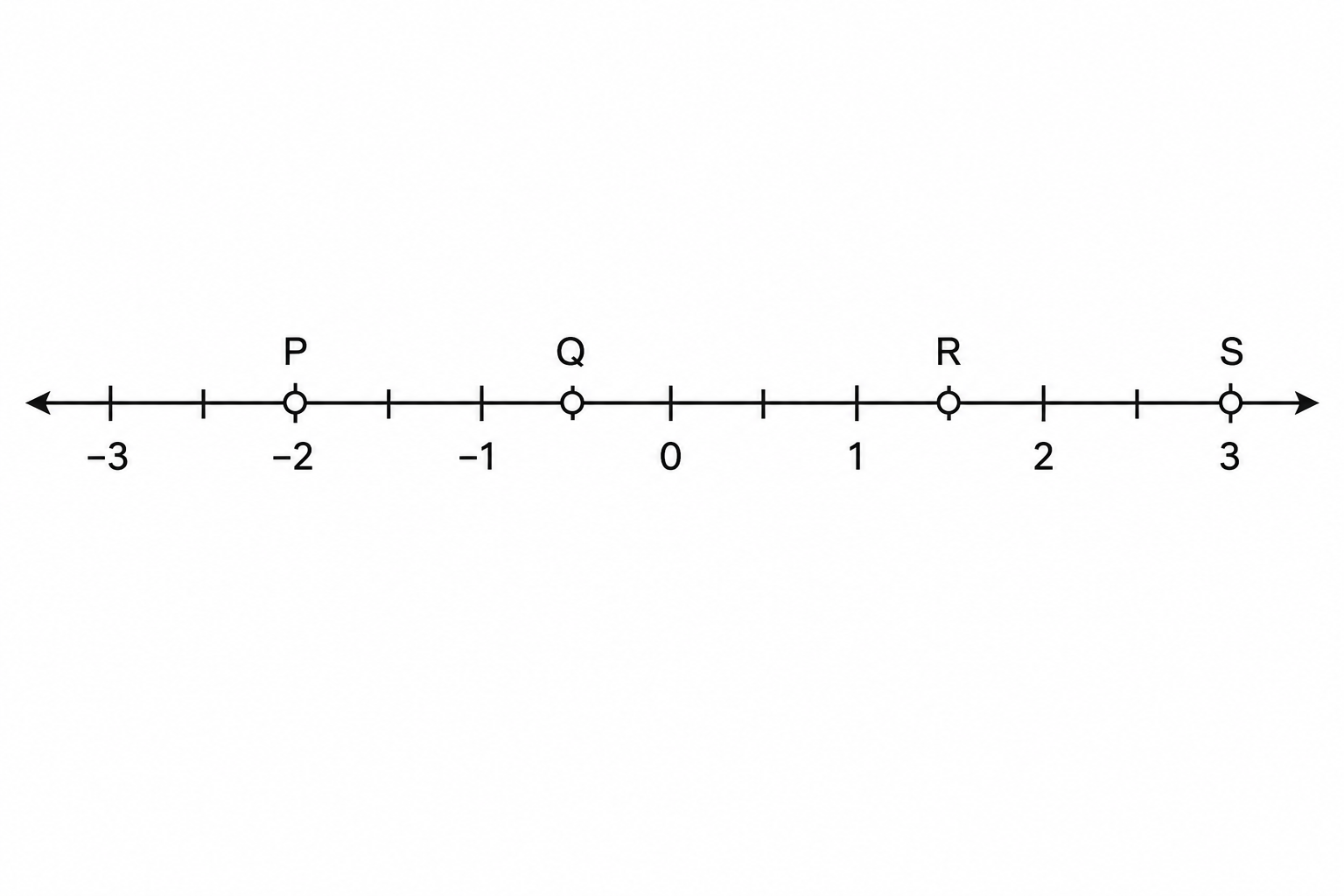
Which pair of labelled points on the number line represents one natural number and one rational number that is not an integer?