

MATHEMATICS - PROPORTION
Unit Rates Worksheet
- Focuses on calculating unit rates and proportional reasoning
- Includes real-world scenarios like shopping and travel
- Covers conversion between different units of measure
- Medium difficulty
Start the 10-question quiz
Free, no sign-up needed. Your score shows instantly.
Here are the first 3 questions. Click “View all questions” to see the complete assessment.
Q1.
Q2.
A van uses 7 L of fuel to travel 98 km. At the same rate, how far can it travel using 12 L?
Q3.
A drink is made using 3 scoops of powder for 450 mL of water. How many scoops are needed for 1.2 L of water at the same rate?
Q4.
A printing machine produces 126 labels in 7 minutes. How many labels will it produce in 25 minutes at the same rate?
Q5.
A tap fills a tank with 18 L of water in 2.5 minutes. At a constant rate, how much water does it supply in 7 minutes?
Q6.
Red and blue ribbons are used in the ratio 3:5. If 18 m of red ribbon is used, what length of blue ribbon is needed?
Q7.
Pack A contains 6 pens and costs pounds 4.80. Pack B contains 10 pens and costs pounds 7.50. Pack C contains 8 pens and costs pounds 6.24. Pack D contains 12 pens and costs pounds 9.36. Which pack has the lowest cost per pen?
Q8.
A cyclist travels 36 km in 1.5 hours at a constant speed. How long will it take the cyclist to travel 90 km at the same speed?
Q9.
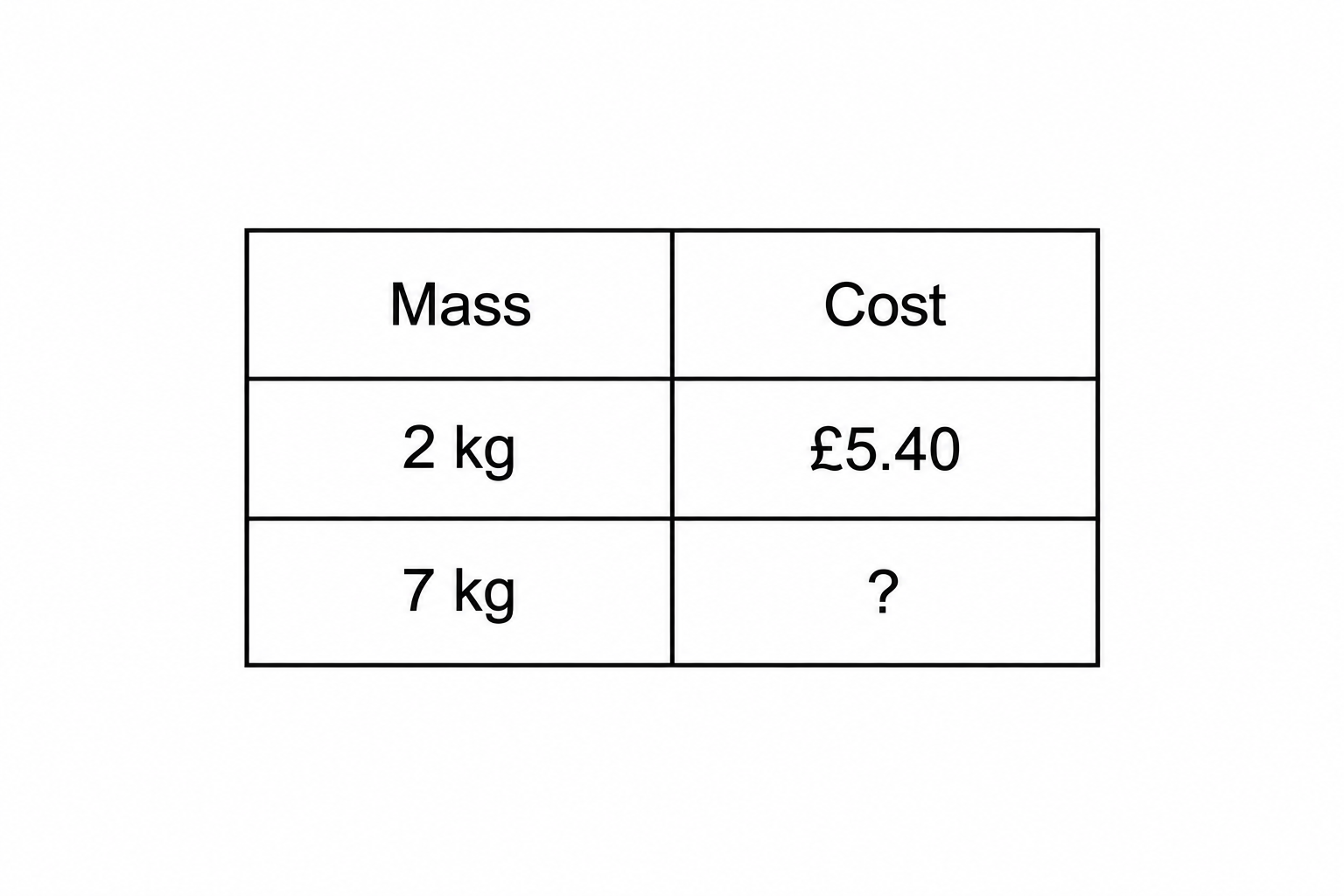
The table shows the cost of rice. The cost is directly proportional to the mass. What value should replace the question mark?
Q10.
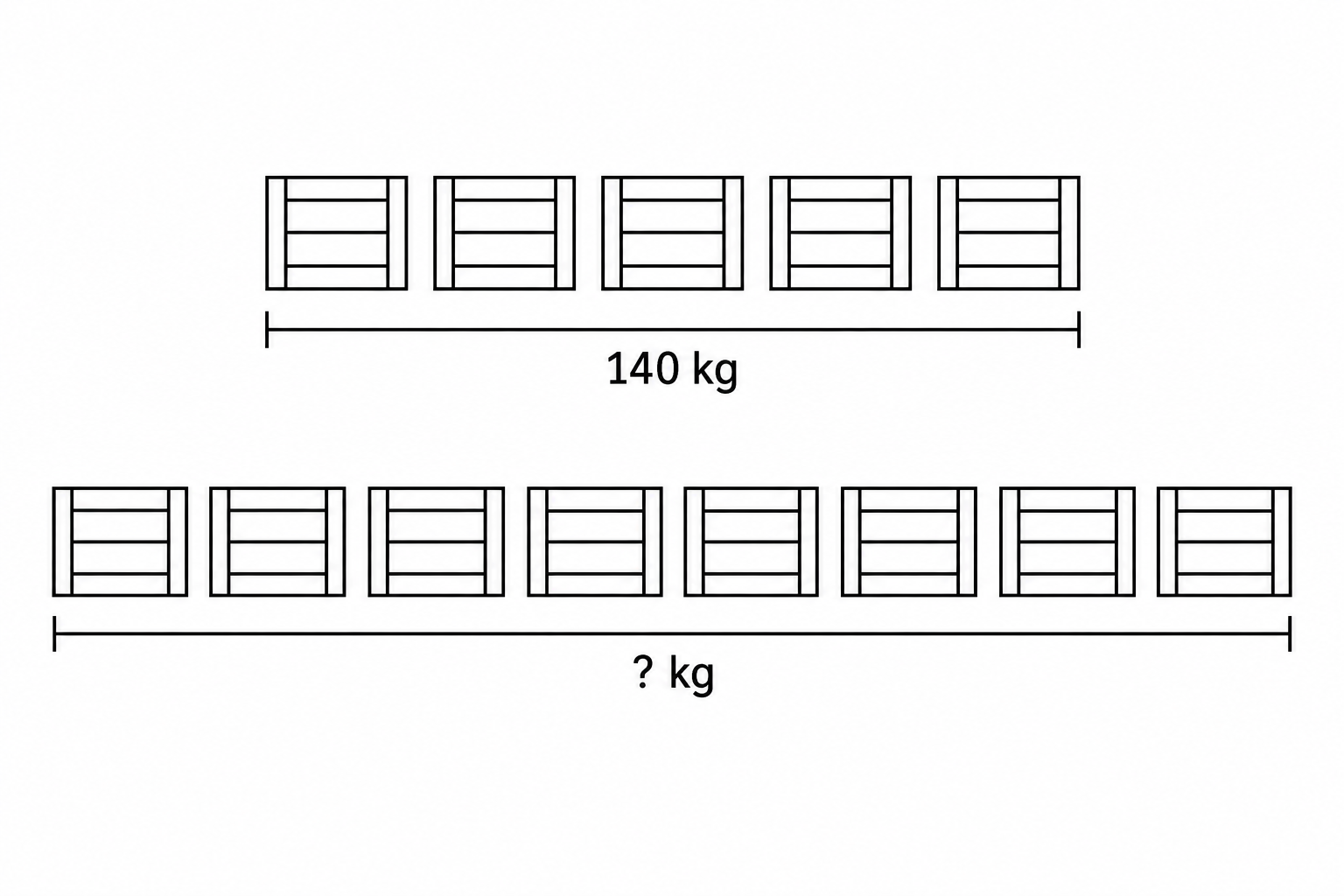
The diagram shows two groups of identical crates. The mass is directly proportional to the number of crates. What is the total mass of the lower group?
What this assessment covers
Concepts tested
- Unit rates and cost per item
- Direct proportionality in different contexts
- Ratio and proportion in practical situations
- Conversion of units in proportional problems
- Application of constant rates in various scenarios
Question Mix
- Medium questions included
Skills you build
- Calculate unit rates from given data
- Apply proportional reasoning to solve problems
- Convert between different units of measure
- Analyze and compare costs in practical situations
- Determine quantities using ratios and proportions
Related assessments
More practice
Other assessments in this topic
