

MATHEMATICS - PROPORTION
Constant of Proportionality Worksheet
- 10 questions
- Understand and use the unitary method to solve problems involving ratio and direct proportion in a range of contexts.
- Difficulty: Hard
- Board: CAIE
- Attempt online on the examination portal
Start the 10-question quiz
Free, no sign-up needed. Your score shows instantly.
Here are the first 3 questions. Click “View all questions” to see the complete assessment.
Q1.
Q2.
A printer prints 14 pages in 35 s. It works at a constant rate without pauses. How long will it take to print 6 copies of a booklet containing 18 pages?
Q3.
On a map, 3.6 cm represents 9 km. A planned walking route has two sections measuring 5.2 cm and 2.8 cm on the map. A diversion makes the actual walk 25% longer than the planned route. What is the actual walking distance?
Q4.
A school shares some money between its art, music and sports clubs in the ratio 4:7:9, respectively. The sports club receives £135 more than the art club. How much does the music club receive?
Q5.
Fabric costs £18 for 2.4 m, with cost directly proportional to length. A designer needs 5 strips, each 0.65 m long. She already has 0.35 m of suitable fabric, which she can join to the new fabric without waste. What is the cost of the additional fabric she needs?
Q6.
A van uses 7.5 L of fuel to travel 96 km. Fuel use is directly proportional to distance. The tank contains 22 L at the start of a 224 km journey. No fuel is added. How much fuel remains at the end?
Q7.
A recipe uses 0.45 kg of flour to make 18 identical biscuits. A baker must fill 7 boxes with 12 biscuits in each box and make 6 extra biscuits for tasting. Using the same recipe, what mass of flour is needed?
Q8.
A shop exchanges loyalty points for credit at a constant rate: 150 points give £6 of credit. Maya wants to pay entirely with points for an item costing £13.20 and delivery costing £4.80. She already has 125 points. How many more points does she need?
Q9.
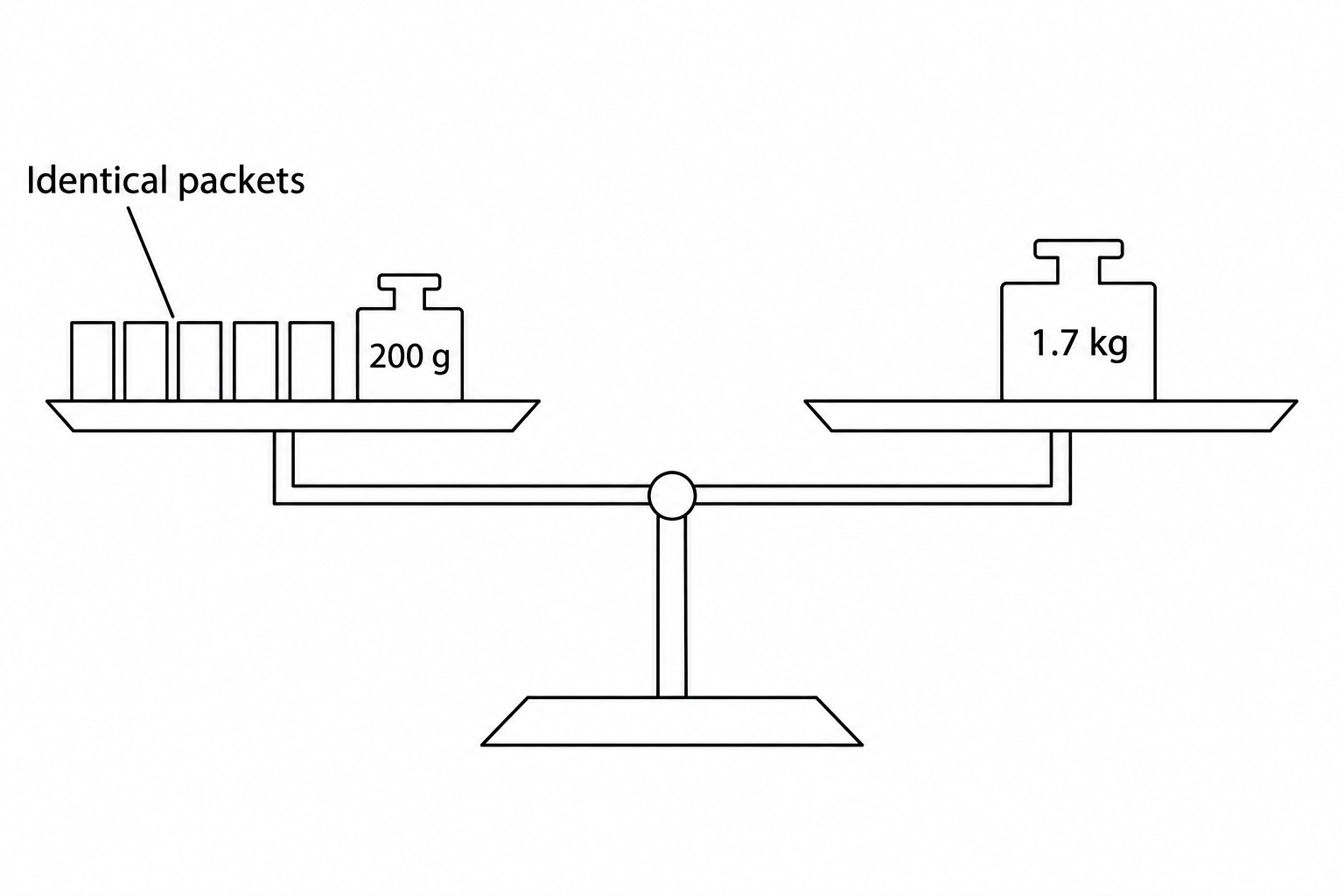
The balance shown is level. All the sealed packets have the same mass. What is the total mass of 8 of these packets, without any extra weights?
Q10.
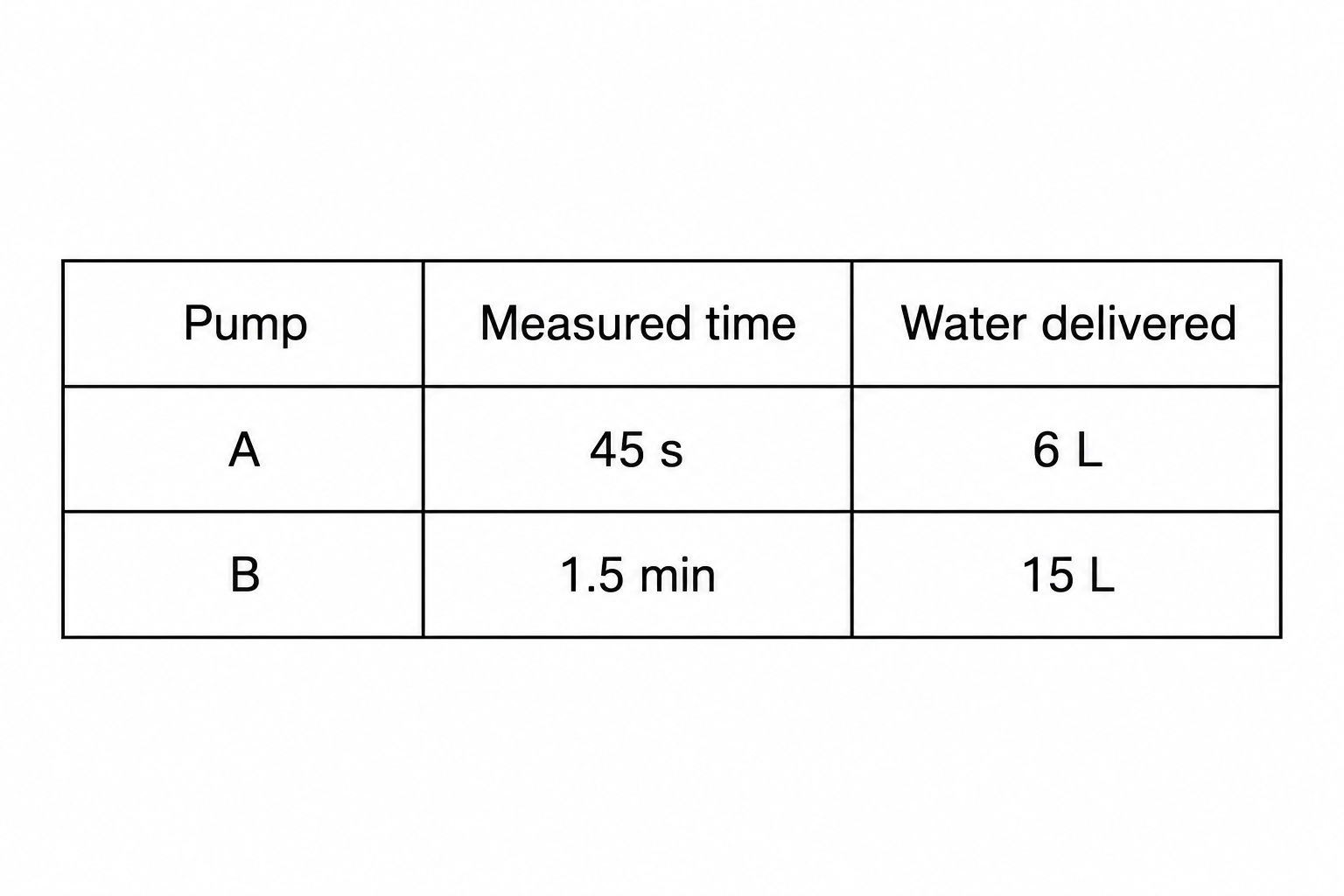
The table shows how much water each pump delivers in a measured time. Each pump works at its own constant rate. Both pumps are switched on together and deliver water into the same empty tank for 2 min 15 s. How much water is in the tank then?
What this assessment covers
Concepts Tested
- Proportion
- Understand and use the unitary method to solve problems involving ratio and direct proportion in a range of contexts.
Question Mix
- Hard questions included
Skills you build
- Apply
Related assessments
More practice
Other assessments in this topic
