

MATHEMATICS - PROPORTION
Proportions Word Problems Worksheet
- 10 questions
- Understand and use the unitary method to solve problems involving ratio and direct proportion in a range of contexts.
- Difficulty: Hard
- Board: CAIE
- Attempt online on the examination portal
Start the 10-question quiz
Free, no sign-up needed. Your score shows instantly.
Here are the first 3 questions. Click “View all questions” to see the complete assessment.
Q1.
Q2.
Ribbon costs $6.30 for 4.5 m and can be bought in any length at the same price per metre. A club has $15 to buy ribbon for 24 badges. Each badge needs 0.35 m of ribbon. How much money remains after buying exactly the ribbon needed?
Q3.
A printer prints 420 pages in 7 min at a constant rate. A new job requires 18 booklets, each containing 24 printed pages. Before printing starts, the printer takes 2.5 min to prepare. What is the total time for preparation and printing?
Q4.
At an activity centre, $18 buys 45 credits. Credits are sold at a constant rate. Lina spends $75 on credits. A single booking fee of 6 credits is deducted, and she then buys 4 activity tickets costing 38 credits each. How many credits remain?
Q5.
On a map, 3.6 cm represents 9 km. A walking route measures 5.4 cm on the map. A walker has already completed 4.5 km of this route. The walker takes 40 min to walk 3 km and continues at this constant speed without stopping. How long will the remaining route take?
Q6.
At an animal shelter, 8 rabbits eat 1.8 kg of food in 3 days. Every rabbit eats the same amount each day. The shelter needs food for 14 rabbits for 5 days, plus an unused reserve of 0.75 kg. What total mass of food is needed?
Q7.
A set of 12 identical tiles covers 0.48 m². A wall has an area of 3.6 m². A builder buys enough tiles to cover the wall, plus 10% of that number as spares. Tiles are sold only in packs of 11. What is the minimum number of packs the builder must buy?
Q8.
A theatre group has adults and children in the ratio 3:5. There are 45 children. At the theatre, 8 adult tickets cost $60. A child ticket costs 2/3 of an adult ticket. Ticket prices are constant. What is the total ticket cost for the whole group?
Q9.
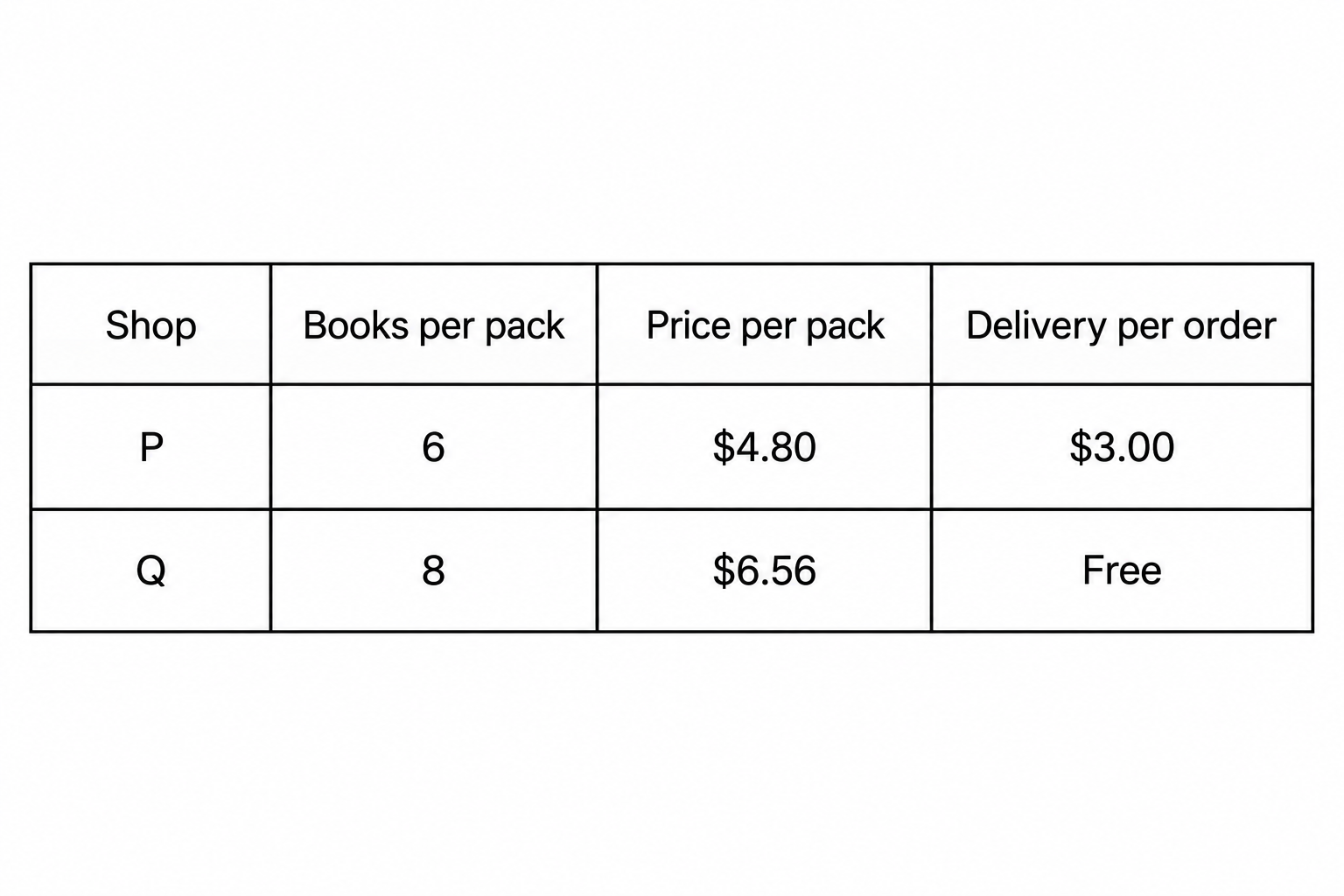
The table shows the prices of identical exercise books at two shops. A school orders exactly 120 books from one shop, buying whole packs. Each shop charges its delivery fee once per order. Including delivery, which shop is cheaper, and by how much?
Q10.
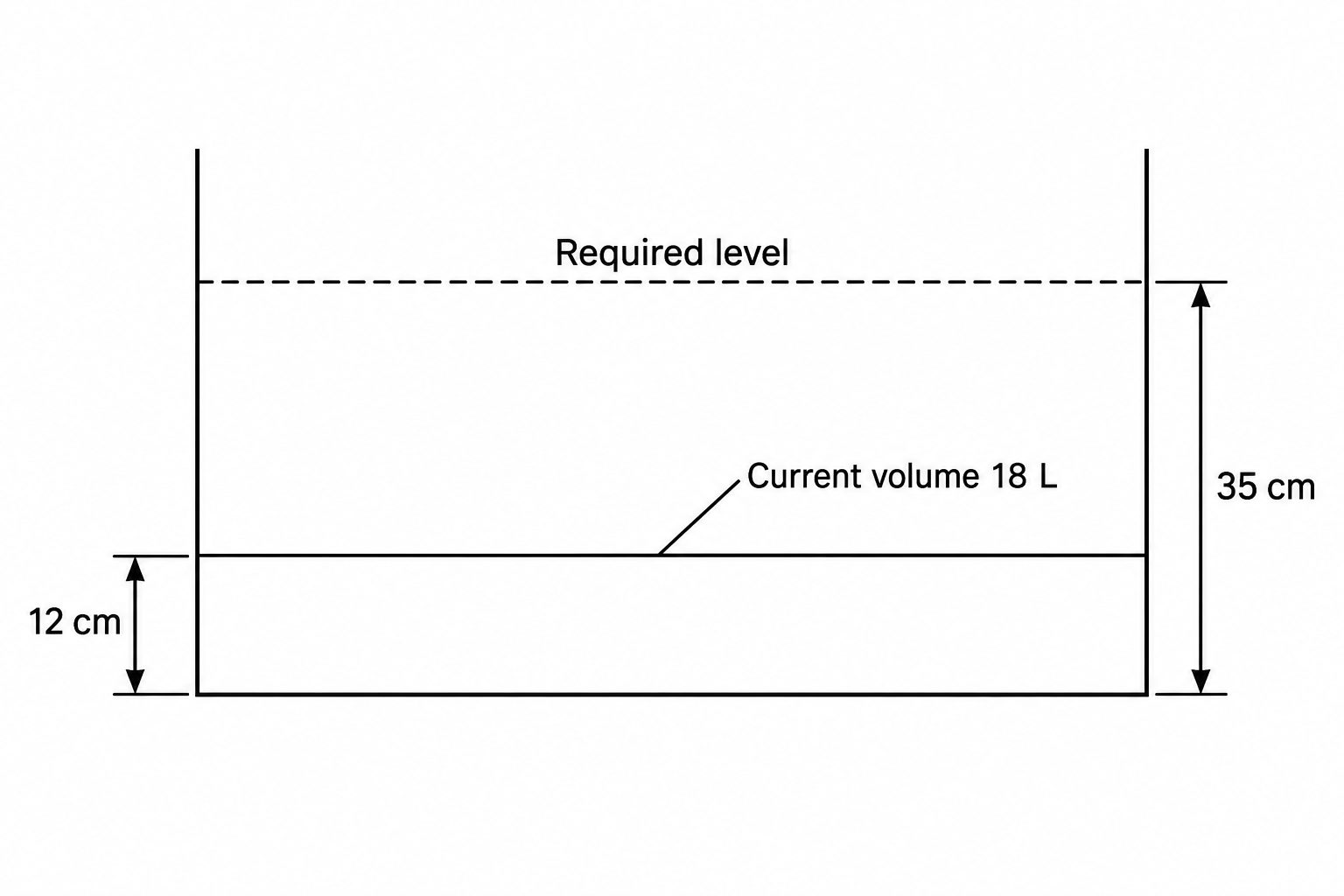
The tank has a uniform horizontal cross-sectional area. Its current water depth and volume are shown in the diagram, together with the required water depth. A pump adds 9 L of water every 2 min at a constant rate. No water leaves the tank. How long will the pump take to raise the water from its current level to the required level?
What this assessment covers
Concepts Tested
- Proportion
- Understand and use the unitary method to solve problems involving ratio and direct proportion in a range of contexts.
Question Mix
- Hard questions included
Skills you build
- Apply
Related assessments
More practice
Other assessments in this topic
