

MATHEMATICS - PROPORTION
Proportion Word Problems Worksheet
- 10 questions
- Understand and use the unitary method to solve problems involving ratio and direct proportion in a range of contexts.
- Difficulty: Hard
- Board: CAIE
- Attempt online on the examination portal
Start the 10-question quiz
Free, no sign-up needed. Your score shows instantly.
Here are the first 3 questions. Click “View all questions” to see the complete assessment.
Q1.
Q2.
Ribbon costs $8.10 for 3.6 m. Leena has $25.20 and first spends $3.60 on fasteners. She spends all her remaining money on ribbon at the same price per metre. What length of ribbon does she buy?
Q3.
A pump delivers 135 L of water in 4.5 minutes at a constant rate. A tank has capacity 1200 L and is initially 3/8 full. No water leaves the tank. How long must the pump run to make the tank 7/8 full?
Q4.
On a map, 3.6 cm represents 9 km. A planned walking route consists of two sections measuring 7.2 cm and 4.8 cm on the map. A closed path means that the walkers must travel an additional 3 km beyond the planned route. What total distance will they walk?
Q5.
The price of an adult ticket and the price of a child ticket are in the ratio 5:3. Two adult tickets and three child tickets cost $76 altogether. What is the total cost of three adult tickets and four child tickets?
Q6.
A currency office exchanges 45 dollars for 36 euros before charging a fee. It deducts a fixed fee of 3 euros from the euros exchanged in each transaction. How many dollars must Amir exchange in one transaction to receive exactly 117 euros after the fee?
Q7.
A length of fabric measuring 2.4 m before washing measures 2.1 m after washing. All lengths of this fabric shrink in the same proportion. A tailor needs at least 7.35 m of washed fabric. The shop sells unwashed fabric only in multiples of 0.5 m. What is the shortest length the tailor can buy?
Q8.
A vehicle uses 6.4 L of fuel to travel 80 km. Fuel use is directly proportional to distance travelled. Its tank currently contains 18 L. The driver must leave at least 3.6 L in the tank. What is the greatest distance the vehicle can travel without refuelling?
Q9.
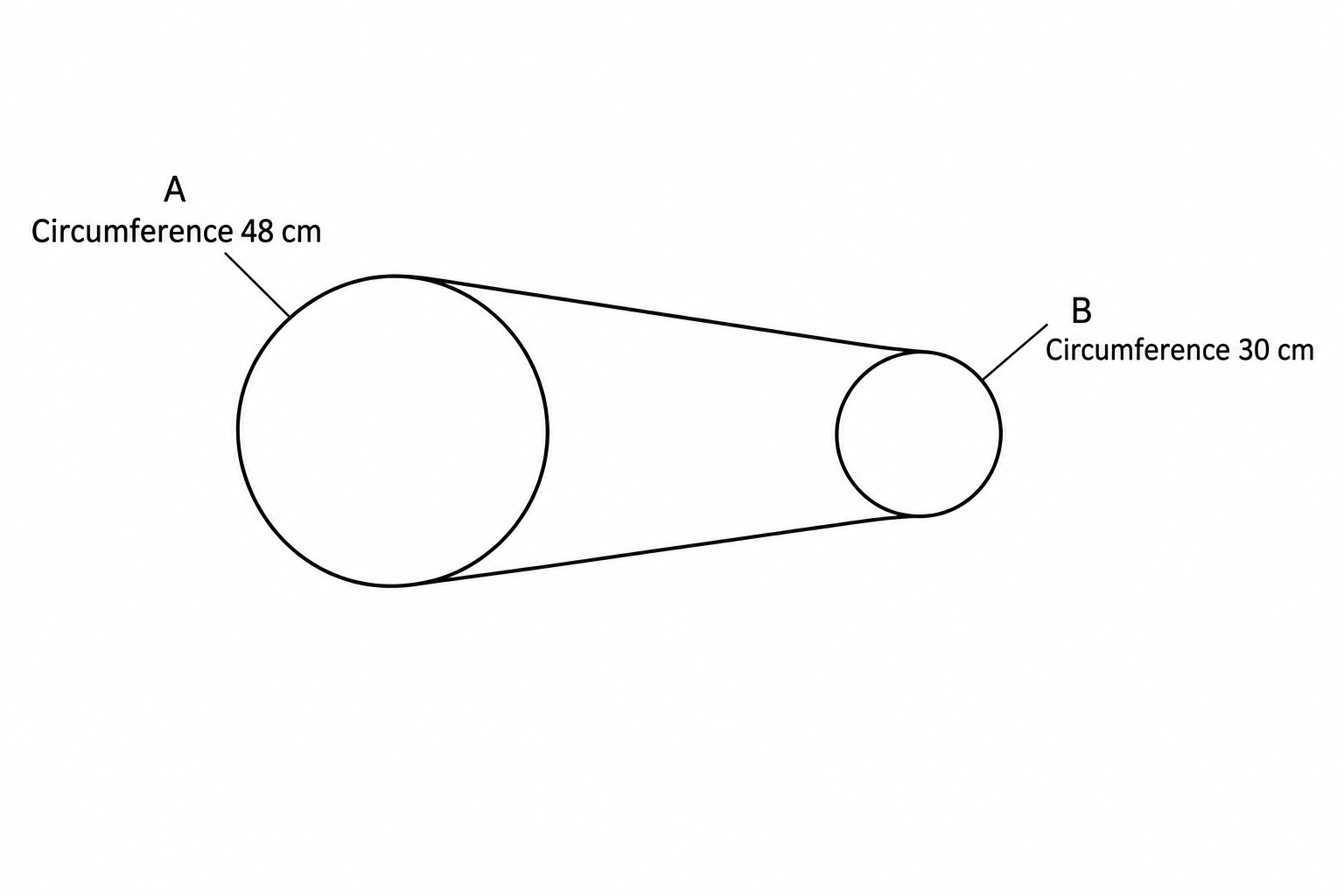
The diagram shows two wheels connected by a belt that does not slip. Wheel A makes 12.5 complete turns in 5 s at a constant rate. How many complete turns does wheel B make in 18 s?
Q10.
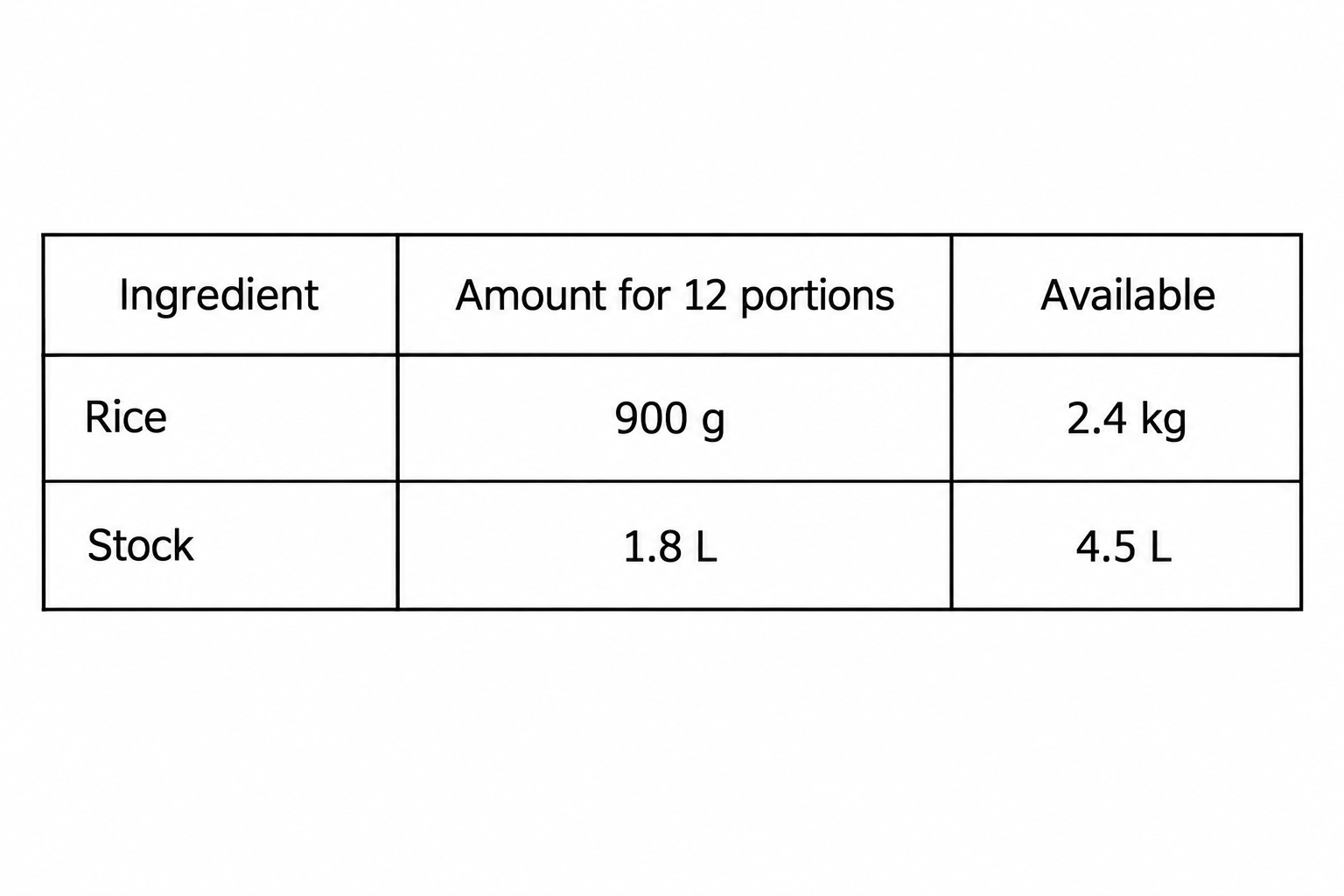
The table shows the ingredients needed for 12 identical portions of a rice dish and the supplies available. The amounts of both ingredients are directly proportional to the number of portions. Using only these supplies, what is the greatest number of whole portions that can be made?
What this assessment covers
Concepts Tested
- Proportion
- Understand and use the unitary method to solve problems involving ratio and direct proportion in a range of contexts.
Question Mix
- Hard questions included
Skills you build
- Apply
Related assessments
More practice
Other assessments in this topic
