

MATHEMATICS - LINEAR INEQUALITIES
Two Step Inequalities Worksheet
- Focuses on solving two-step inequalities in real-world contexts
- Includes scenarios involving costs, measurements, and limits
- Medium difficulty
- Multiple choice format to test understanding of inequality solutions
Start the 10-question quiz
Free, no sign-up needed. Your score shows instantly.
Here are the first 3 questions. Click “View all questions” to see the complete assessment.
Q1.
Q2.
Each notebook costs 3 dollars, and delivery costs 4 dollars. Amir can spend no more than 25 dollars. If n is the number of notebooks, which inequality and solution represent the situation?
Q3.
A tank initially contains 18 L. Water is drained at 2 L per minute. At least 8 L must remain. If m is the number of minutes, which inequality and solution are correct?
Q4.
Four less than three times n is at most 17. Which option correctly represents and solves this statement?
Q5.
A candle is initially 30 cm long and burns down by 2 cm each hour. It can be used while its length is at least 12 cm. If h is the number of hours, which statement is equivalent to this condition?
Q6.
At a competition, each team has 6 students, and there are also 10 helpers. Fewer than 52 people may enter the hall. If t is the number of teams, which option represents the restriction and identifies the greatest possible whole number of teams?
Q7.
The statement “seven added to negative four times x is no more than 19” is represented by −4x + 7 ≤ 19. A student concludes that x ≤ − 3. Which option correctly explains the error and gives the solution?
Q8.
A lift can carry no more than 500 kg. An operator of mass 68 kg uses the lift to move identical boxes, each of mass 36 kg. If b is the number of boxes, which inequality and maximum number of boxes are correct?
Q9.
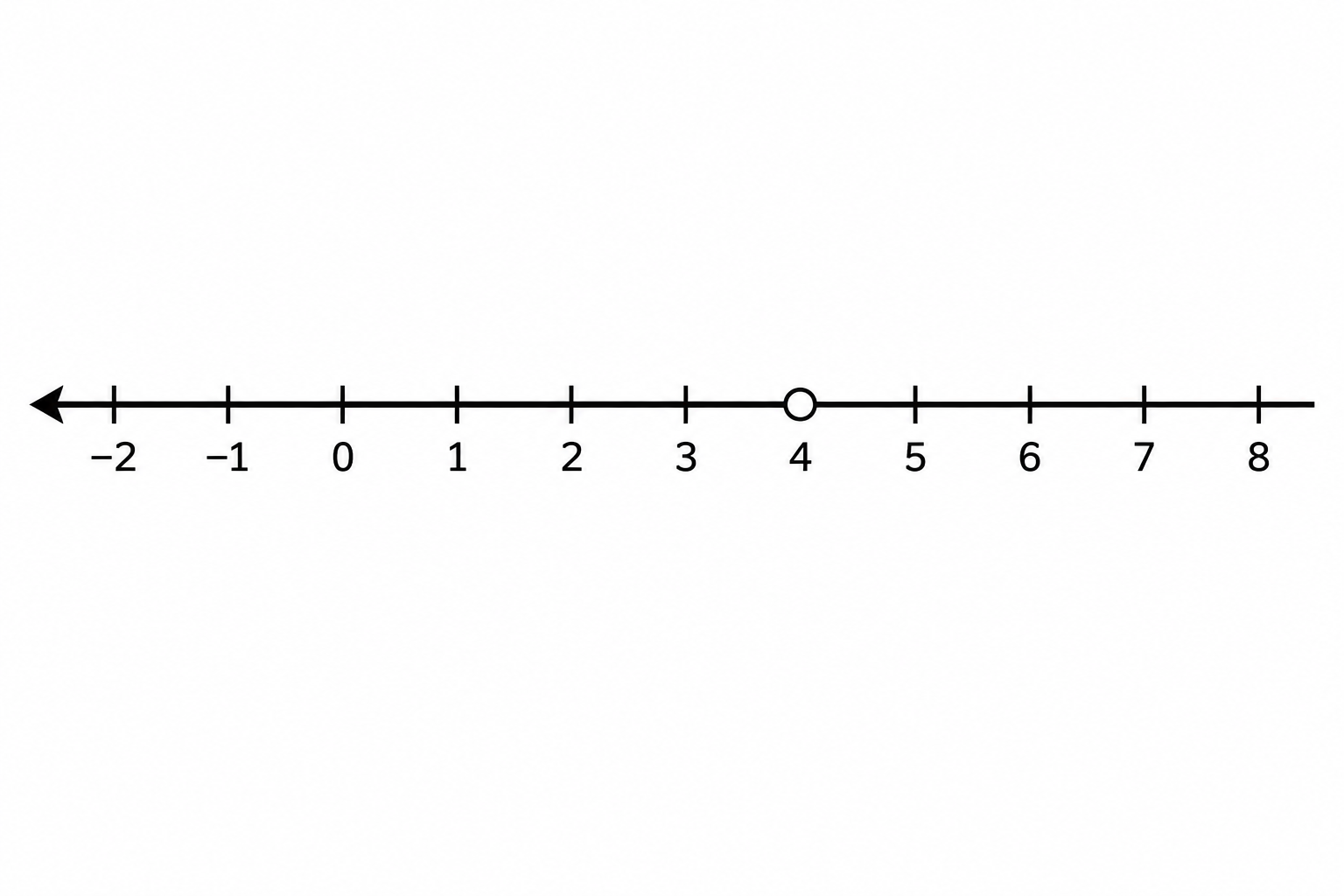
The number line shows the values of x that satisfy an inequality. Which two-step inequality has this solution?
Q10.
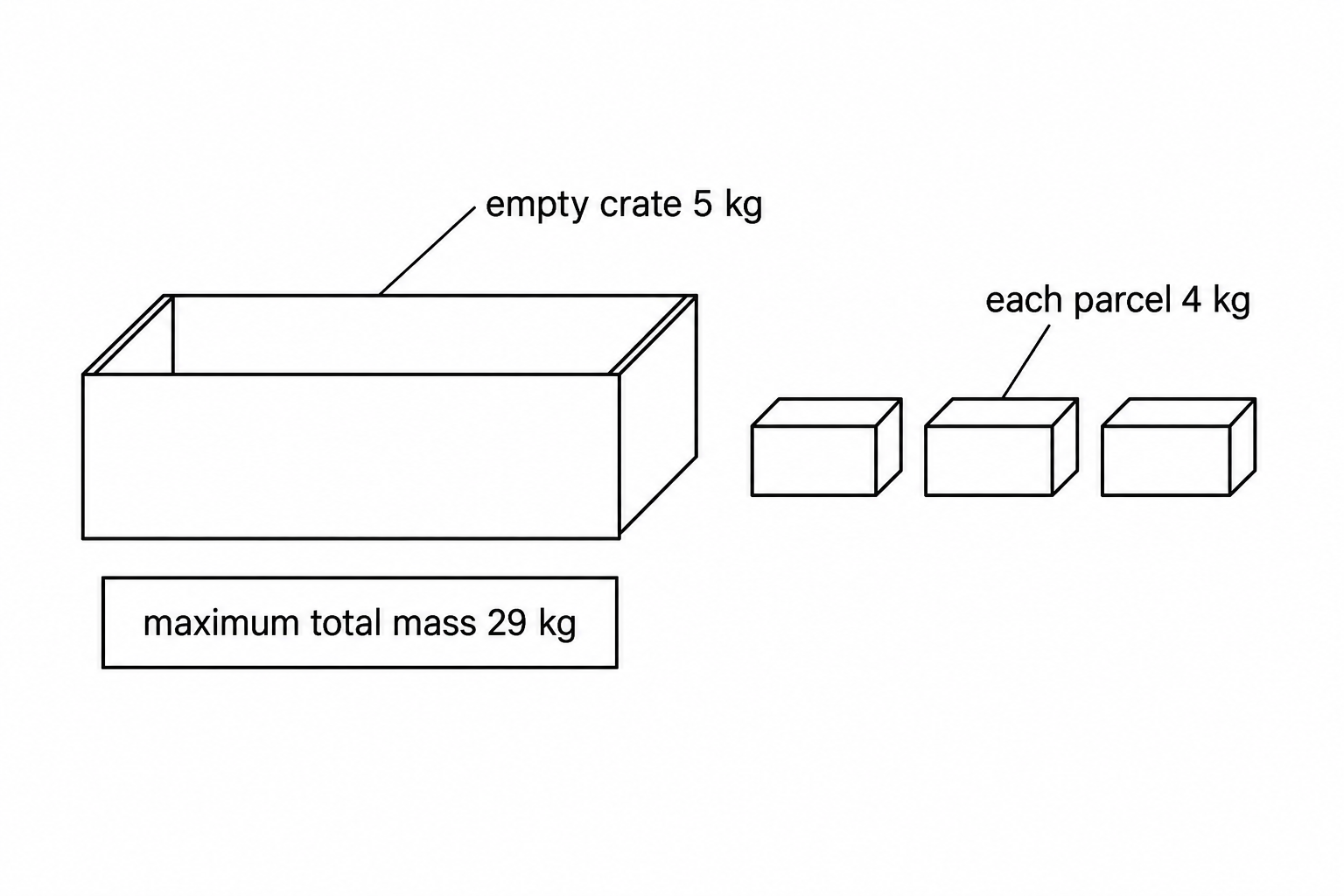
The diagram gives the mass information for loading a crate. Let p be the number of identical parcels placed in the crate. Which inequality represents the requirement, and what is the greatest possible value of p?
What this assessment covers
Concepts tested
- Two-step inequalities
- Inequality representation in word problems
- Solving inequalities with variables
- Interpreting real-world constraints as inequalities
- Understanding inequality solutions on a number line
Question Mix
- Medium questions included
Skills you build
- Translating word problems into mathematical inequalities
- Solving two-step inequalities involving addition and subtraction
- Applying multiplication and division in inequality solutions
- Interpreting and analyzing real-world situations using inequalities
- Identifying errors in inequality solutions and reasoning
Related assessments
More practice
Other assessments in this subject
