

MATHEMATICS - LINEAR INEQUALITIES
Multi Step Inequalities Worksheet
- Focus on solving multi-step inequalities in various contexts
- Includes real-world applications like budgeting and capacity limits
- Challenges students with complex expressions and constraints
Start the 10-question quiz
Free, no sign-up needed. Your score shows instantly.
Here are the first 3 questions. Click “View all questions” to see the complete assessment.
Q1.
Q2.
A tank initially contains 180 L. During each minute, 12 L of water leaves the tank. At least 72 L must remain. If t is the number of minutes, which inequality and solution represent this situation?
Q3.
A student has a budget of 96 credits. A delivery charge of 18 credits is added to the cost of notebooks priced at 6.5 credits each. What is the greatest whole number of notebooks the student can buy without exceeding the budget?
Q4.
A rectangle has length (3x + 2) cm and width (x − 1) cm. Its perimeter is greater than 44 cm. Which inequality gives all possible values of x?
Q5.
The sum of 3 consecutive positive odd integers is no more than 75. If n is the smallest integer, which inequality correctly represents the situation and gives its greatest possible value?
Q6.
For m minutes of use, Plan A costs 25 + 0.08m credits and Plan B costs 13 + 0.14m credits. For which values of m is Plan A no more expensive than Plan B? Assume m ≥ 0.
Q7.
A freezer calculates a warning score using 18 − 2/3(T + 6), where T is a sensor reading. The warning is activated when the score is no greater than 10. For which readings is the warning activated?
Q8.
A lift can carry at most 1200 kg. An operator of mass 78 kg travels with equipment of mass 90 kg and identical crates of mass 32 kg each. What is the greatest number of crates that can be carried?
Q9.
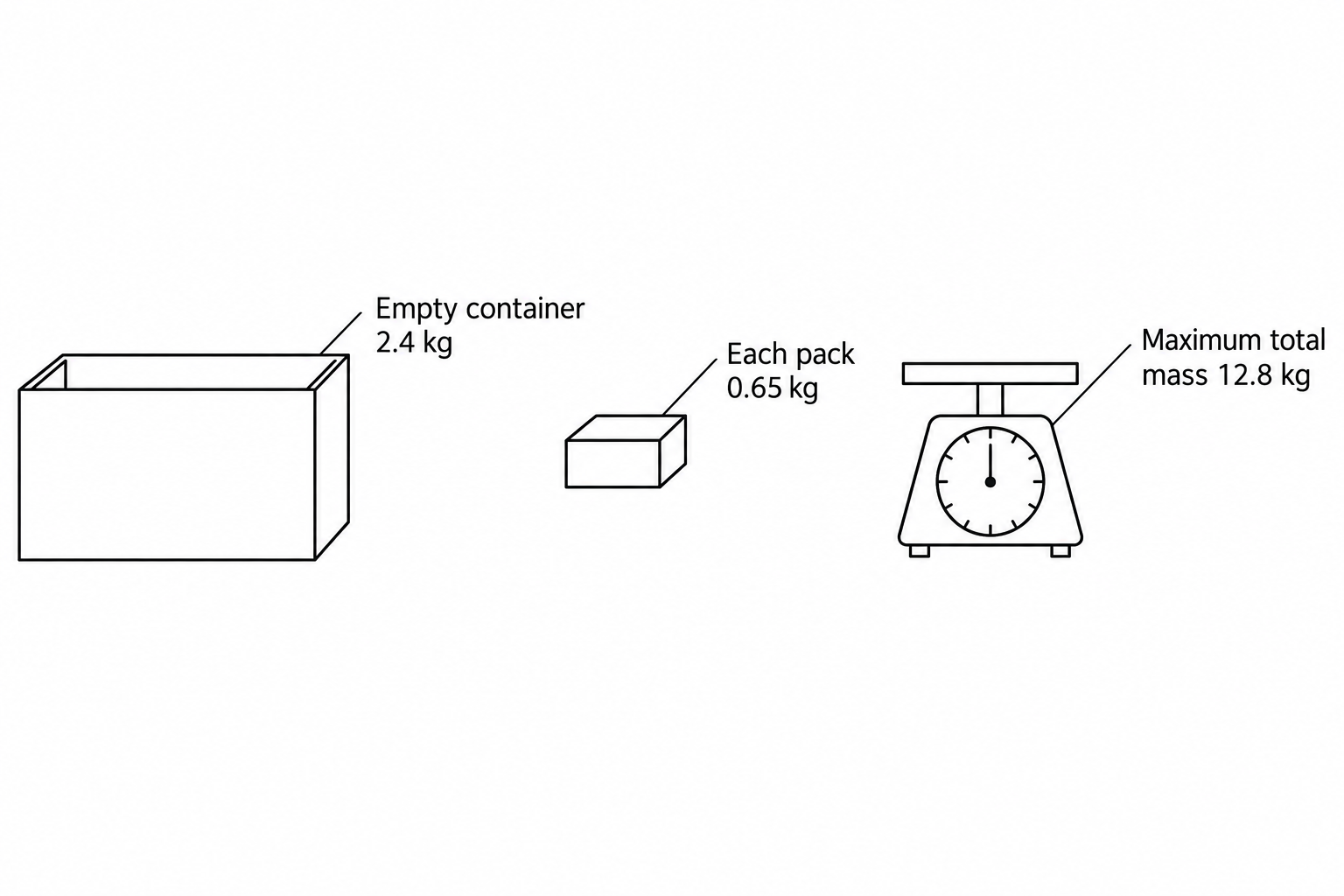
The diagram shows the masses of an empty shipping container and one pack, together with the maximum permitted total mass. What is the greatest whole number of packs that can be placed in the container?
Q10.
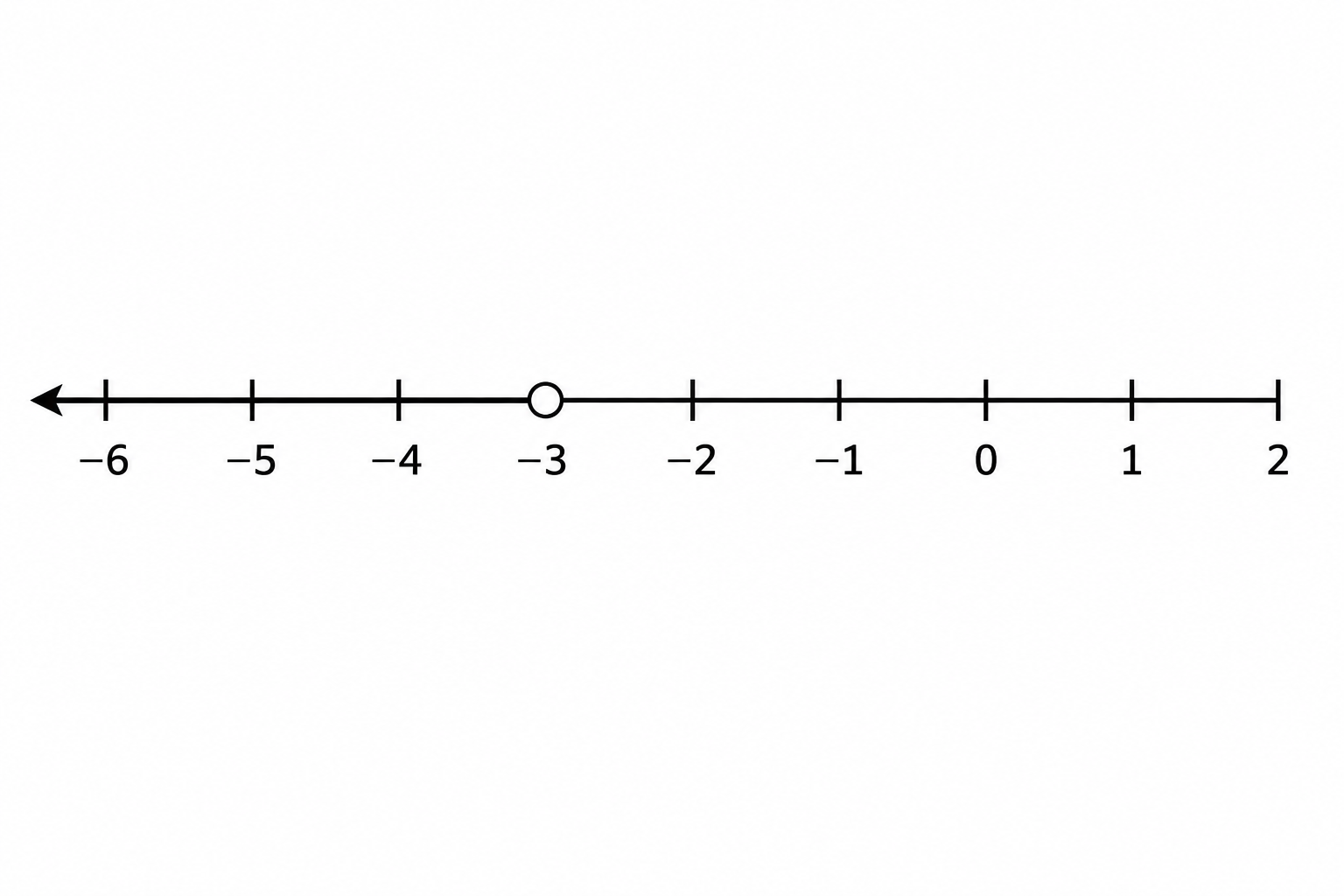
The number line shows the solution of an inequality. Which inequality has the solution shown?
What this assessment covers
Concepts tested
- Multi-step inequalities
- Budget constraints in mathematical problems
- Perimeter and area inequalities
- Real-world application of inequalities
- Understanding and interpreting number lines
Question Mix
- Hard questions included
Skills you build
- Solving complex inequalities
- Applying inequalities to real-life scenarios
- Interpreting mathematical expressions
- Analyzing constraints and limits
- Comparing costs and making decisions
Related assessments
More practice
Other assessments in this subject
