MATHEMATICS - ANGLES

Complementary Angles Worksheet

  • 10 questions
  • Difficulty: Medium
  • Board: US
  • Attempt online on the examination portal
Start the 10-question quiz Free, no sign-up needed. Your score shows instantly.

Here are the first 3 questions. Click “View all questions” to see the complete assessment.

Q1.

An angle measures 27^(\)circ. Which calculation gives the measure of its complementary angle?

  1. A) 180^(\)circ − 90^(\)circ = 90^(\)circ
  2. B) 90^(\)circ + 27^(\)circ = 117^(\)circ
  3. C) 180^(\)circ − 27^(\)circ = 153^(\)circ
  4. D) 90^(\)circ − 27^(\)circ = 63^(\)circ

Q2.

Two angles on separate sheets of paper measure 38^(\)circ and 52^(\)circ. A student says they cannot be complementary because they do not share a vertex. Which response is correct?

  1. A) The student is incorrect because any two acute angles are complementary.
  2. B) The student is incorrect because their measures add to 90^(\)circ, regardless of their locations.
  3. C) The student is correct because complementary angles must have equal measures.
  4. D) The student is correct because complementary angles must share a vertex.

Q3.

Two angles are complementary. The smaller angle is increased by 9^(\)circ. What must happen to the other angle so that the angles remain complementary?

  1. A) It must decrease by 9^(\)circ.
  2. B) It must remain unchanged.
  3. C) It must decrease by 18^(\)circ.
  4. D) It must increase by 9^(\)circ.

Q4.

A student sorts angle pairs by their relationships. Which pair belongs in the complementary category rather than the supplementary category?

  1. A) 90^(\)circ and 90^(\)circ
  2. B) 24^(\)circ and 156^(\)circ
  3. C) 66^(\)circ and 114^(\)circ
  4. D) 24^(\)circ and 66^(\)circ

Q5.

One angle is complementary to an angle measuring 34^(\)circ. Another angle is supplementary to that same angle. How does the supplementary angle compare with the complementary angle?

  1. A) It is 90^(\)circ greater.
  2. B) It has the same measure.
  3. C) It is 56^(\)circ greater.
  4. D) It is 34^(\)circ greater.

Q6.

Two positive angle measures are complementary and unequal. Which statement must be true?

  1. A) Both angles measure more than 45^(\)circ.
  2. B) The larger angle measures more than 90^(\)circ.
  3. C) Both angles measure less than 45^(\)circ.
  4. D) The smaller angle measures less than 45^(\)circ, and the larger measures more than 45^(\)circ.

Q7.

Each of two angles is complementary to an angle measuring 57^(\)circ. What can you conclude about the two angles?

  1. A) They are supplementary to each other.
  2. B) They are equal, and each measures 57^(\)circ.
  3. C) They are complementary to each other.
  4. D) They are equal, and each measures 33^(\)circ.

Q8.

The diagram shows a right angle divided into two angles. Which statement correctly explains the measure of the angle labeled a?
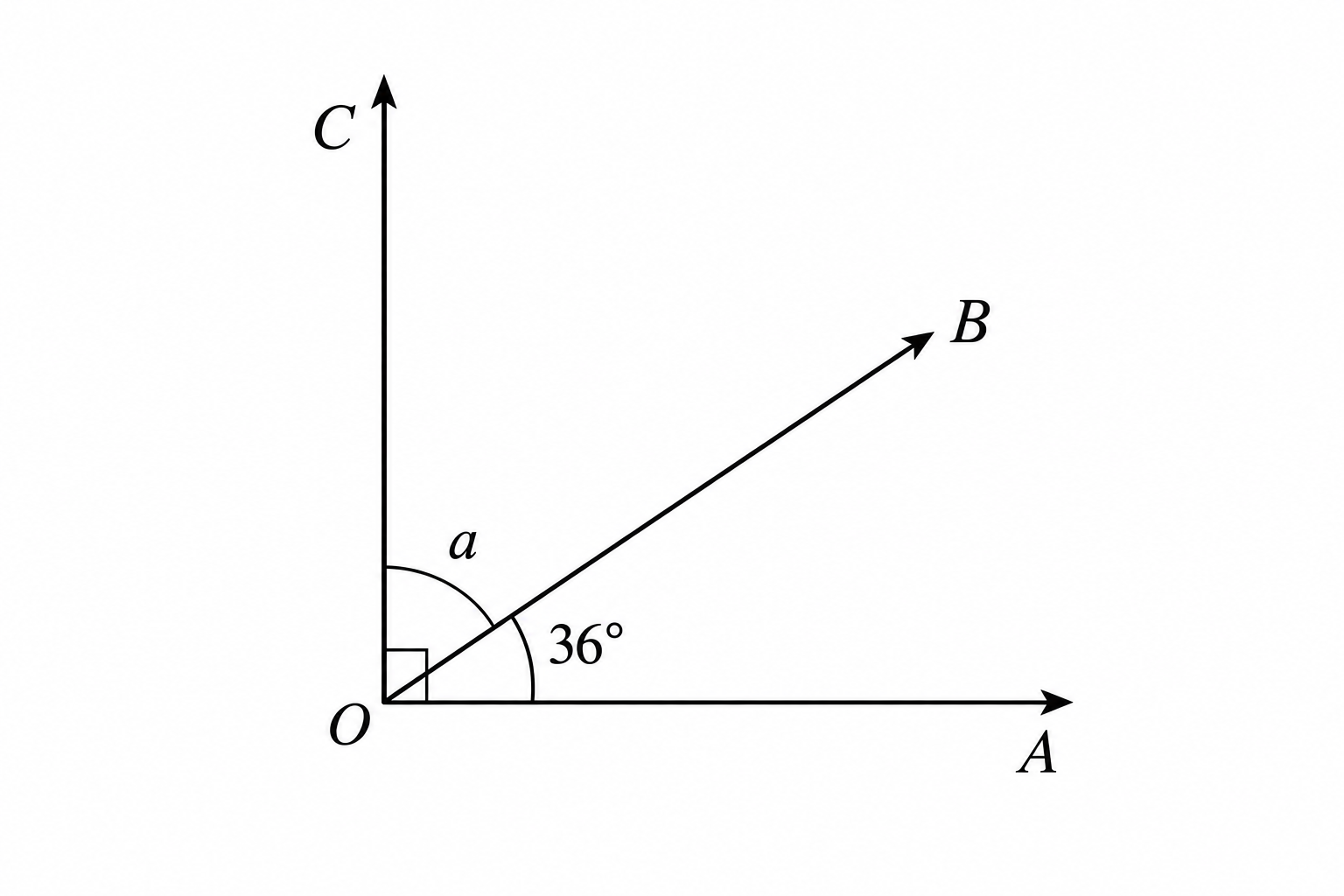
Diagram for question 8: The diagram shows a right angle divided into two angles. Which statement correctly explains the measure of…
  1. A) It measures 144^(\)circ because the two angles are supplementary.
  2. B) It measures 36^(\)circ because a ray always divides a right angle equally.
  3. C) It measures 126^(\)circ because its measure is the right angle plus the labeled angle.
  4. D) It measures 54^(\)circ because the two angles are complementary.

Q9.

Use the right-angle mark and the straight line in the diagram. Which pair of angles is complementary?
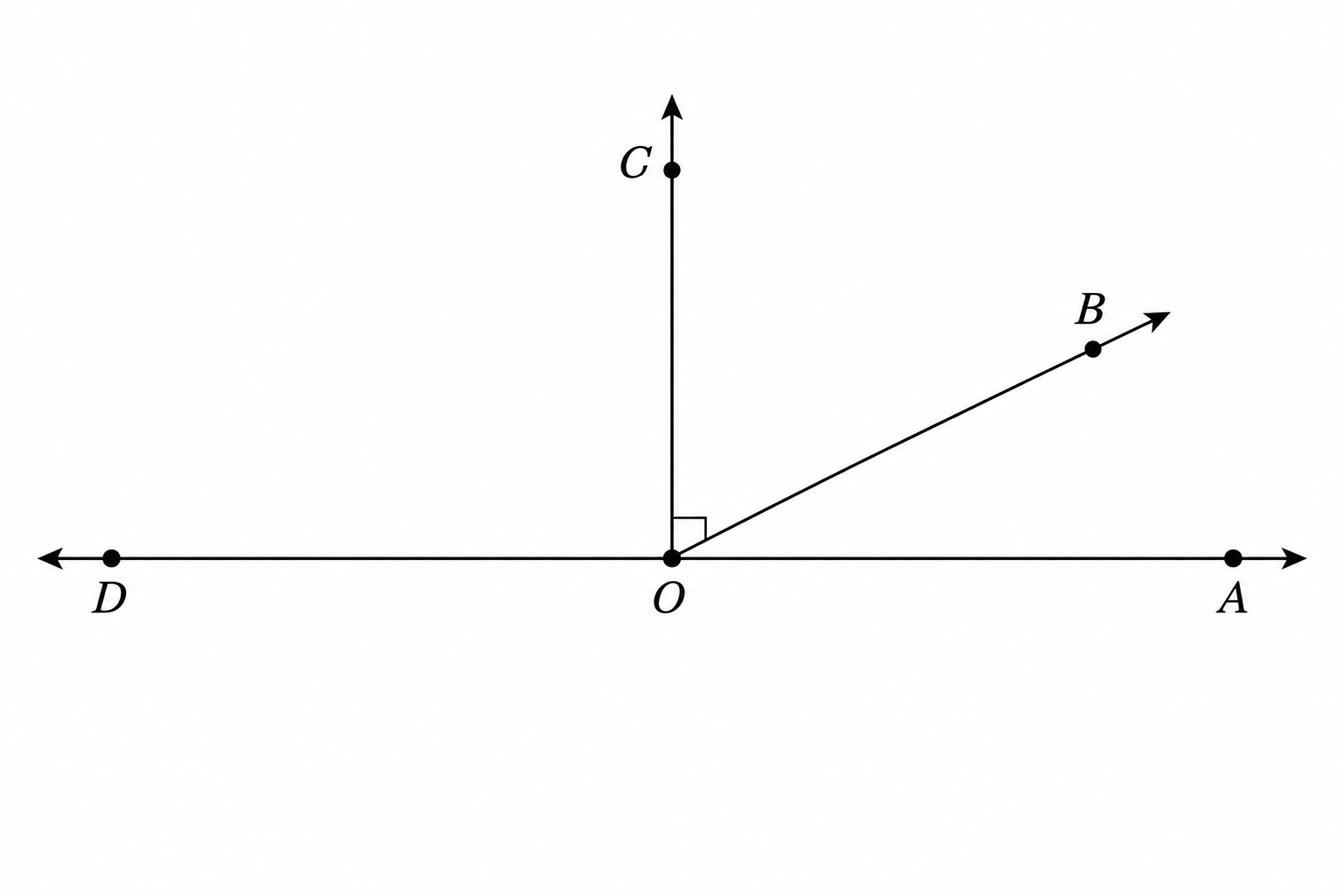
Diagram for question 9: Use the right-angle mark and the straight line in the diagram. Which pair of angles is complementary?
  1. A) ∠ BOC and ∠ BOD
  2. B) ∠ AOB and ∠ BOC
  3. C) ∠ AOB and ∠ BOD
  4. D) ∠ AOC and ∠ COD

Q10.

The matching angle arcs show that the two angles in the diagram are equal. A student labels one angle 40^(\)circ and the other 50^(\)circ. Which statement best explains whether these labels satisfy all the markings?
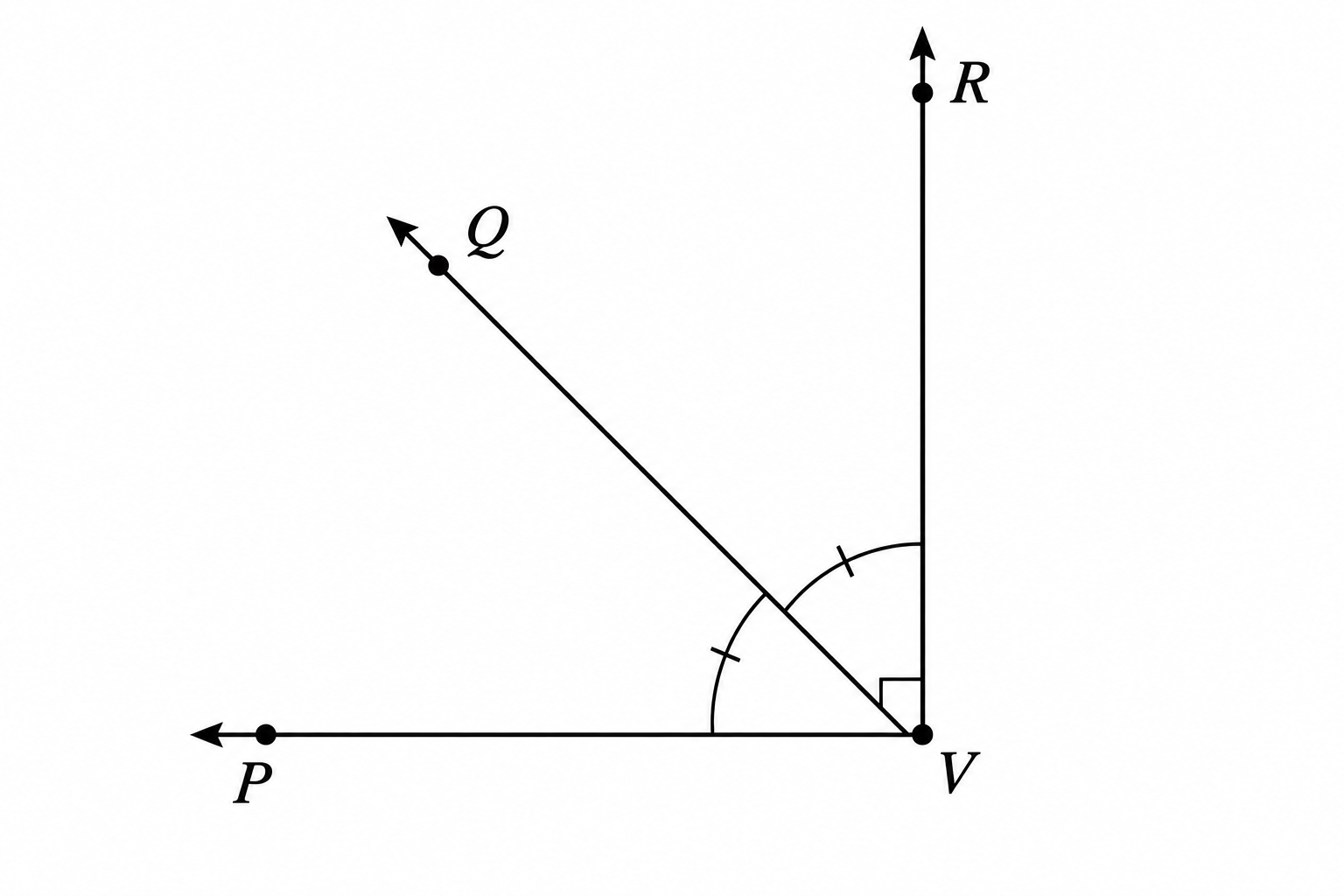
Diagram for question 10: The matching angle arcs show that the two angles in the diagram are equal. A student labels one angle…
  1. A) No, because the angles must be equal as well as complementary, so each must measure 45^(\)circ.
  2. B) Yes, because the two measures add to 90^(\)circ.
  3. C) No, because equal angles must each measure 90^(\)circ.
  4. D) Yes, because both labeled angles are acute.

What this assessment covers

Concepts Tested

  • Angles

Question Mix

  • Medium questions included

Skills you build

  • Understand