

MATHEMATICS - ANGLES
Angle Relationships Worksheet
- Focuses on angle relationships involving parallel lines and transversals
- Challenges students with algebraic expressions for angle measures
- Includes problems on corresponding, alternate, and same-side interior angles
Start the 10-question quiz
Free, no sign-up needed. Your score shows instantly.
Here are the first 3 questions. Click “View all questions” to see the complete assessment.
Q1.
Q2.
Two parallel lines are cut by a transversal. Same-side interior angles D and E measure (4y + 9)^(\)circ and (7y − 5)^(\)circ. Angle F is vertically opposite D. What is the measure of F?
Q3.
Straight lines AB and CD intersect at O. The adjacent angles ∠ AOC and ∠ COB measure (2z + 17)^(\)circ and (5z + 2)^(\)circ. What is the measure of ∠ BOD?
Q4.
Two lines are cut by a transversal. A pair of corresponding angles measure (6k − 7)^(\)circ and (4k + 25)^(\)circ. For which value of k does the equality of these angles show that the two lines are parallel?
Q5.
Parallel lines r and s are cut by a transversal. Angle A measures 127^(\)circ. Angle B corresponds to A, angle C is vertically opposite B, and angle D is adjacent to C on a straight line. What is the measure of D?
Q6.
Two same-side interior angles formed by a transversal across parallel lines measure (2x + 15)^(\)circ and (4x − 3)^(\)circ. Angle P corresponds to the smaller angle, and angle Q corresponds to the larger angle. What is Q − P?
Q7.
Two horizontal parallel lines are crossed by a transversal. At the upper intersection, the angles are numbered clockwise from the upper-left region as 1,2,3,4. At the lower intersection, they are numbered in the same way as 5,6,7,8. Which pair consists of alternate exterior angles?
Q8.
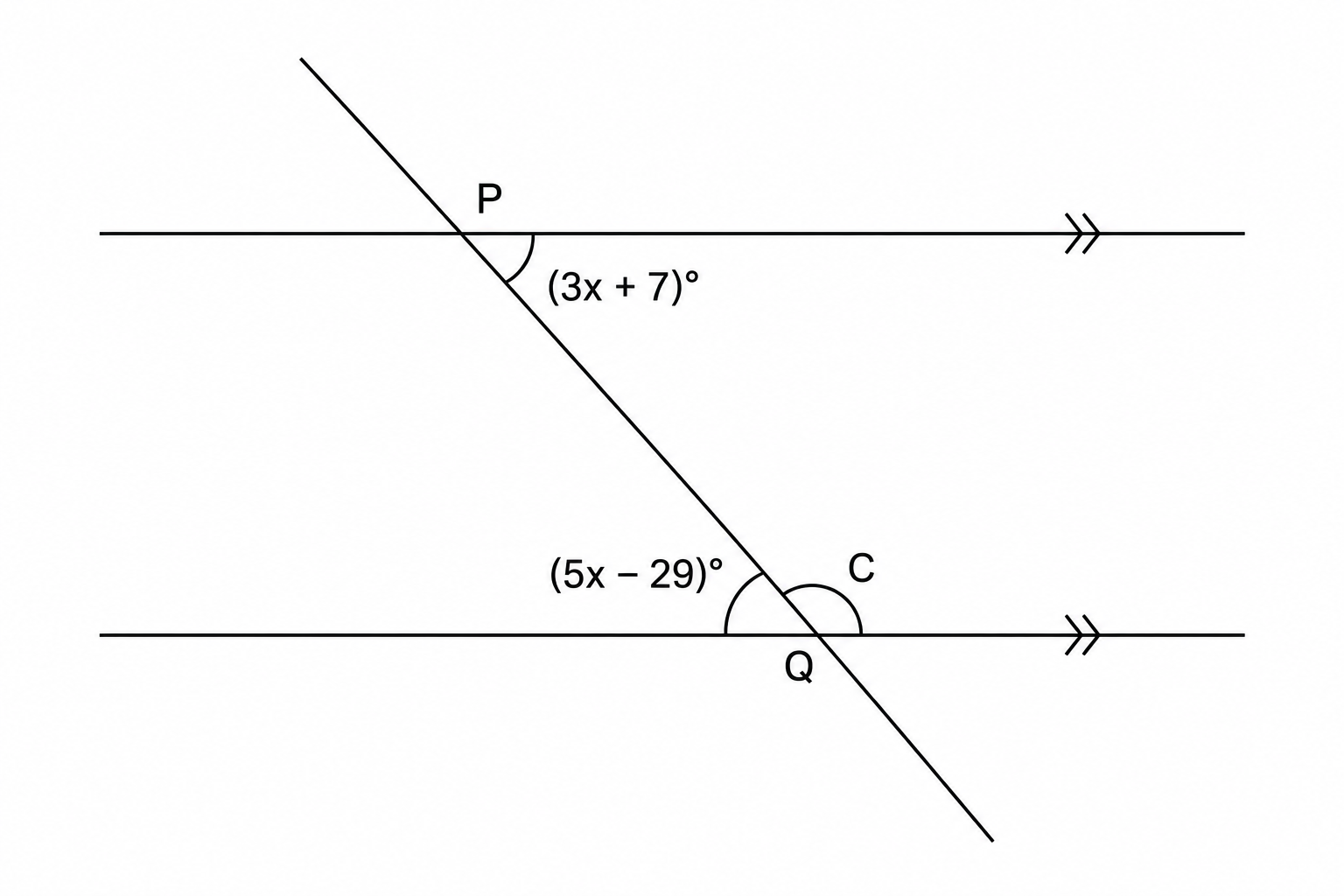
The diagram shows two parallel lines cut by a transversal. Use the labelled alternate interior angles to find the measure of ∠ C.
Q9.
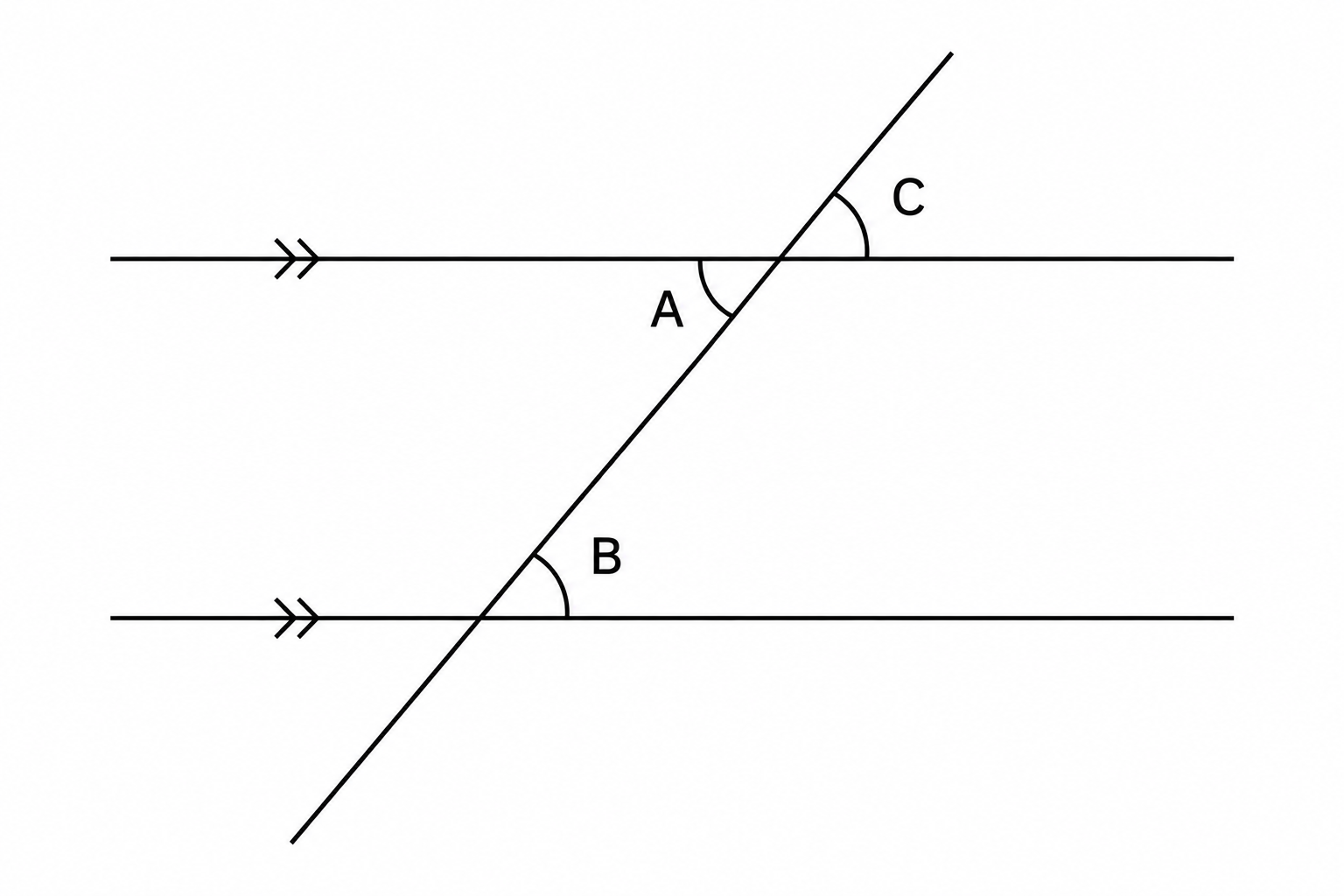
The diagram shows parallel lines and a transversal. Which sequence of angle relationships correctly explains why C = B?
Q10.
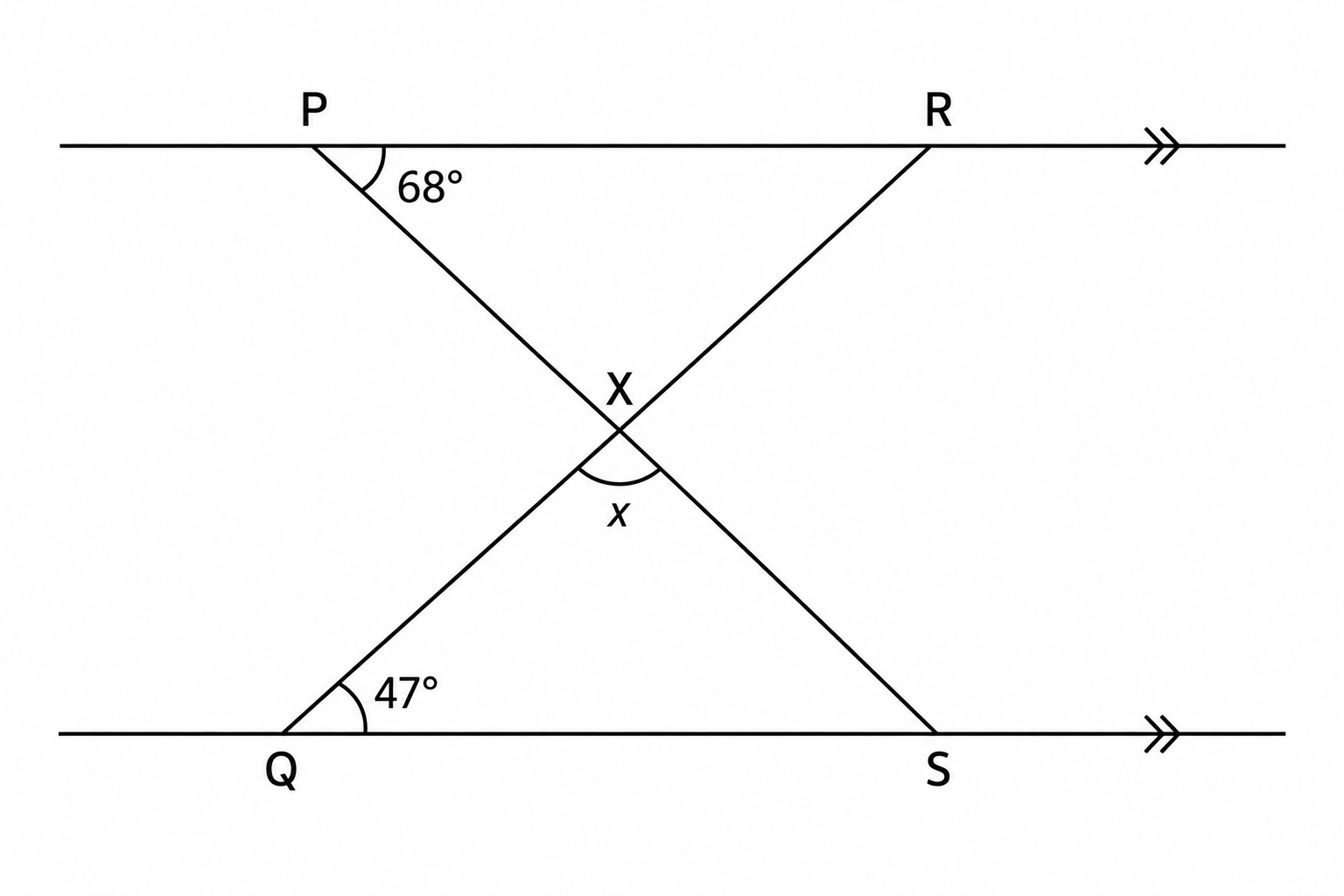
The two horizontal lines in the diagram are parallel, and the two transversals intersect at X. What is the measure of the angle marked x?
What this assessment covers
Concepts tested
- Corresponding angles and their properties
- Alternate interior and exterior angles
- Same-side interior angles
- Vertical angles and their relationships
- Using algebra to solve for unknown angle measures
Question Mix
- Hard questions included
Skills you build
- Identify and apply angle relationships in parallel line diagrams
- Solve algebraic equations to find angle measures
- Analyze geometric diagrams to determine angle types
- Use logical reasoning to justify angle relationships
- Interpret complex geometric configurations with transversals
Related assessments
More practice
Other assessments in this subject
