Choose the correct answer:
Parallel lines p and q are cut by a transversal. Corresponding angles A and B have measures (3x + 14)^(\)circ and (5x − 22)^(\)circ, respectively. Angle C is adjacent to B on a straight line. What is the measure of C?
Choose the correct answer:
Parallel lines p and q are cut by a transversal. Corresponding angles A and B have measures (3x + 14)^(\)circ and (5x − 22)^(\)circ, respectively. Angle C is adjacent to B on a straight line. What is the measure of C?
Choose the correct answer:
Two parallel lines are cut by a transversal. Same-side interior angles D and E measure (4y + 9)^(\)circ and (7y − 5)^(\)circ. Angle F is vertically opposite D. What is the measure of F?
Choose the correct answer:
Straight lines AB and CD intersect at O. The adjacent angles ∠ AOC and ∠ COB measure (2z + 17)^(\)circ and (5z + 2)^(\)circ. What is the measure of ∠ BOD?
Choose the correct answer:
Two lines are cut by a transversal. A pair of corresponding angles measure (6k − 7)^(\)circ and (4k + 25)^(\)circ. For which value of k does the equality of these angles show that the two lines are parallel?
Choose the correct answer:
Parallel lines r and s are cut by a transversal. Angle A measures 127^(\)circ. Angle B corresponds to A, angle C is vertically opposite B, and angle D is adjacent to C on a straight line. What is the measure of D?
Choose the correct answer:
Two same-side interior angles formed by a transversal across parallel lines measure (2x + 15)^(\)circ and (4x − 3)^(\)circ. Angle P corresponds to the smaller angle, and angle Q corresponds to the larger angle. What is Q − P?
Choose the correct answer:
Two horizontal parallel lines are crossed by a transversal. At the upper intersection, the angles are numbered clockwise from the upper-left region as 1,2,3,4. At the lower intersection, they are numbered in the same way as 5,6,7,8. Which pair consists of alternate exterior angles?
Choose the correct answer:
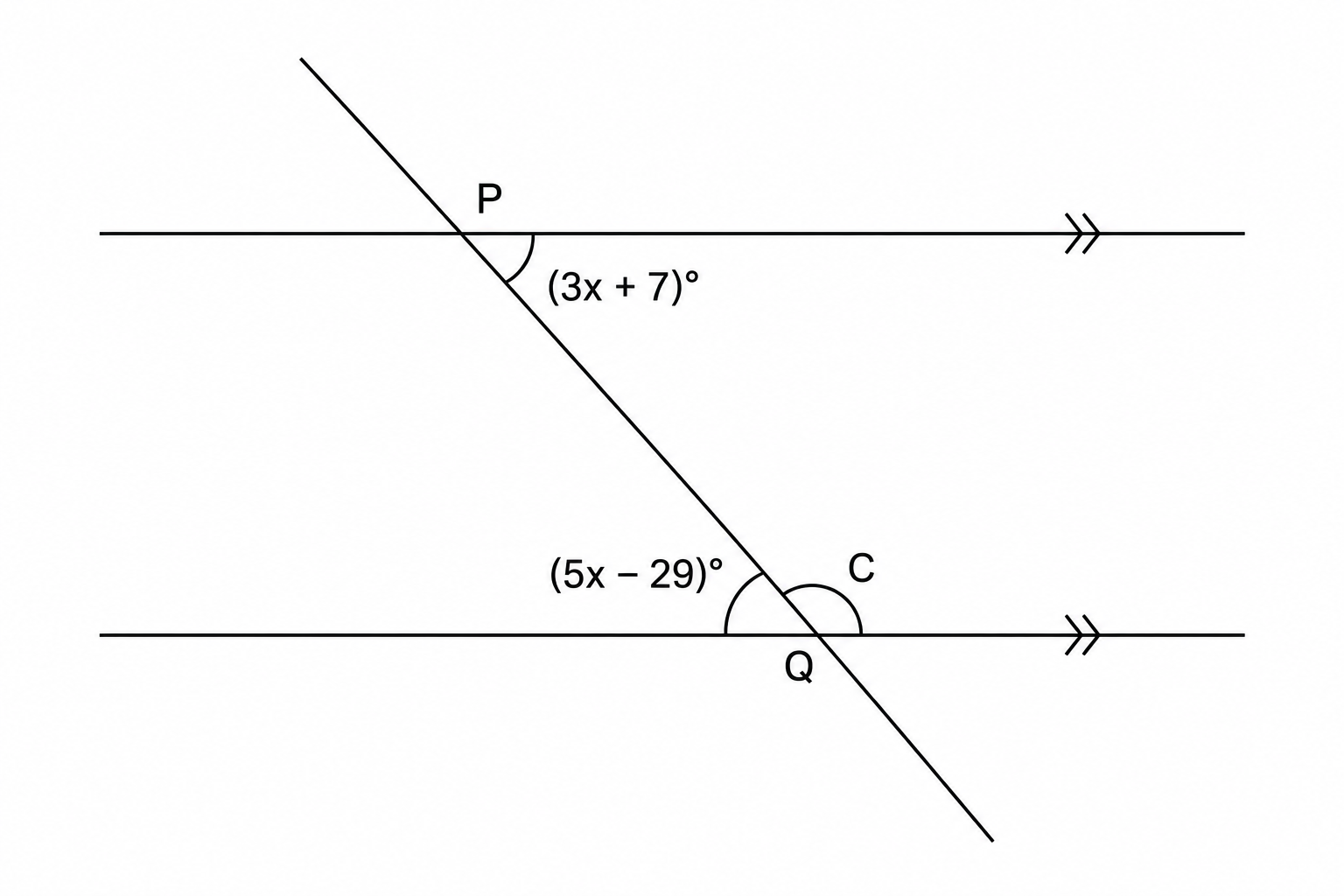
The diagram shows two parallel lines cut by a transversal. Use the labelled alternate interior angles to find the measure of ∠ C.
Choose the correct answer:
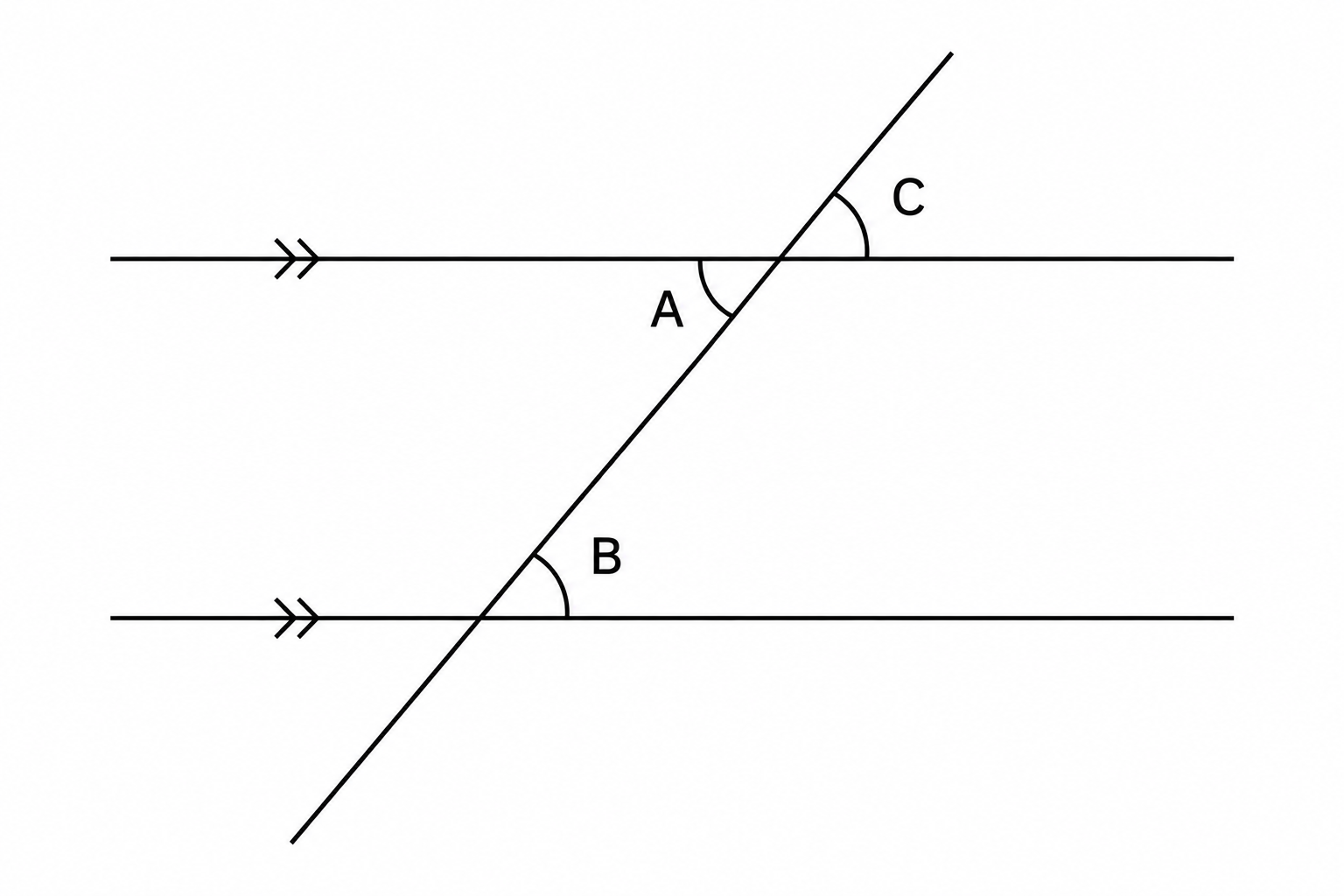
The diagram shows parallel lines and a transversal. Which sequence of angle relationships correctly explains why C = B?
Choose the correct answer:
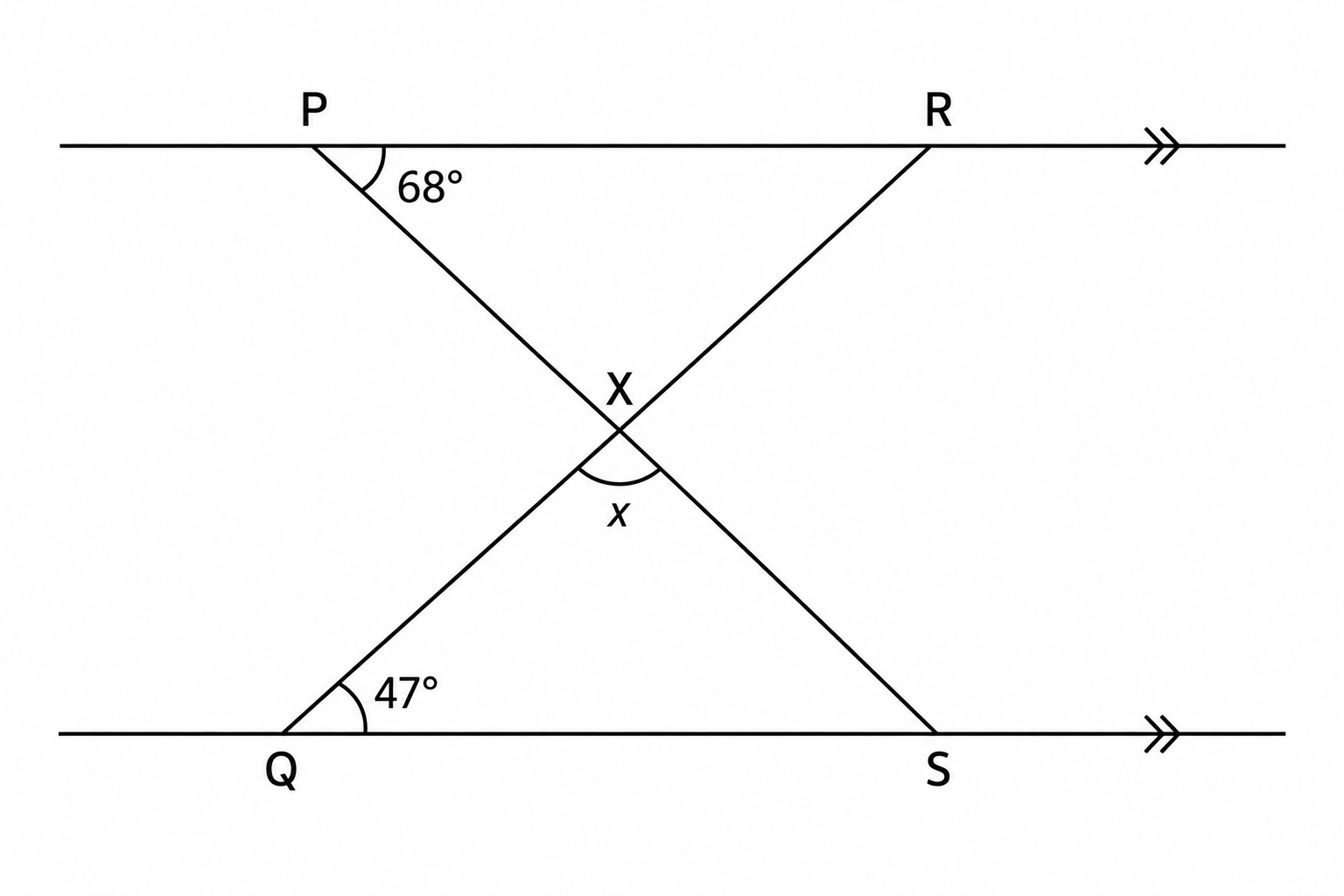
The two horizontal lines in the diagram are parallel, and the two transversals intersect at X. What is the measure of the angle marked x?