EARTH & ENVIRONMENTAL SCIENCE - CLIMATE CHANGE

Carbon Footprint Quiz

  • 10 questions
  • Difficulty: Medium
  • Board: USCC
  • Attempt online on the examination portal

Here are the first 3 questions. Click “View all questions” to see the complete assessment.

Q1.

Two towns use the same amount of energy per person, but one town has twice as many residents. If both towns obtain energy from the same sources, why will the larger town probably have a greater total carbon footprint?

  1. A) The number of residents does not affect the total amount of energy used.
  2. B) More residents will require more total energy, causing more greenhouse gas emissions.
  3. C) A larger population will cause fossil fuels to release less carbon dioxide.
  4. D) Each resident in the larger town will automatically use twice as much energy.

Q2.

A city's population stays nearly constant, but its total carbon footprint increases over several years. Which change best explains this pattern?

  1. A) The city captures methane from its landfill for energy.
  2. B) Residents buy more goods and use more energy per person.
  3. C) Residents plant more native trees in public parks.
  4. D) More residents walk to nearby schools and stores.

Q3.

A student lives close enough to school to travel by bicycle safely. How would choosing a bicycle instead of riding alone in a gasoline-powered car most directly reduce the student's carbon footprint?

  1. A) It would increase the amount of carbon stored in road surfaces.
  2. B) It would reduce the amount of fuel burned for the trip.
  3. C) It would prevent all greenhouse gas emissions from bicycle production.
  4. D) It would cause the car to use renewable fuel while parked.

Q4.

A school cafeteria sends large amounts of uneaten food to a landfill. Which explanation best connects this practice to the school's carbon footprint?

  1. A) Producing and transporting wasted food uses energy, and food can release methane as it breaks down in a landfill.
  2. B) Uneaten food has a carbon footprint only when it is stored in metal containers.
  3. C) Transporting food waste cancels the emissions created while the food was produced.
  4. D) Food waste removes all carbon dioxide from the atmosphere as soon as it reaches a landfill.

Q5.

Four households use the same amount of electricity. Which household is likely to have the smallest carbon footprint from electricity use?

  1. A) The household whose electricity comes mainly from wind turbines
  2. B) The household whose electricity comes mainly from a diesel generator
  3. C) The household whose electricity comes mainly from a natural-gas power plant
  4. D) The household whose electricity comes mainly from a coal-fired power plant

Q6.

A growing community wants to meet the needs of more residents without greatly increasing its carbon footprint. Which plan best addresses both population growth and per-person consumption?

  1. A) Expand public transportation and construct energy-efficient housing.
  2. B) Build more roads for single-occupant cars and larger homes that require more heating.
  3. C) Send more reusable materials to landfills outside the community.
  4. D) Increase electricity production only by burning coal.

Q7.

A company claims that replacing disposable water bottles with refillable bottles will reduce carbon emissions. Which evidence would best support this claim?

  1. A) The disposable and refillable bottles can hold the same volume of water.
  2. B) The refillable bottles are available in more colors than the disposable bottles.
  3. C) Each refillable bottle costs more to purchase at the beginning of the year.
  4. D) Over a year, producing and washing the refillable bottles uses less fossil-fuel energy than producing and transporting all the disposable bottles they replace.

Q8.

Why can high consumption of newly manufactured products increase a person's carbon footprint even if the products do not burn fuel while being used?

  1. A) Products affect the carbon cycle only after they are placed in a landfill.
  2. B) Manufacturing removes greenhouse gases because factories require raw materials.
  3. C) Extracting raw materials, operating factories, and transporting products can release greenhouse gases.
  4. D) Every manufactured product continuously releases the same amount of carbon dioxide.

Q9.

Study the graph comparing two communities. Which statement best explains the difference in their total annual carbon emissions?
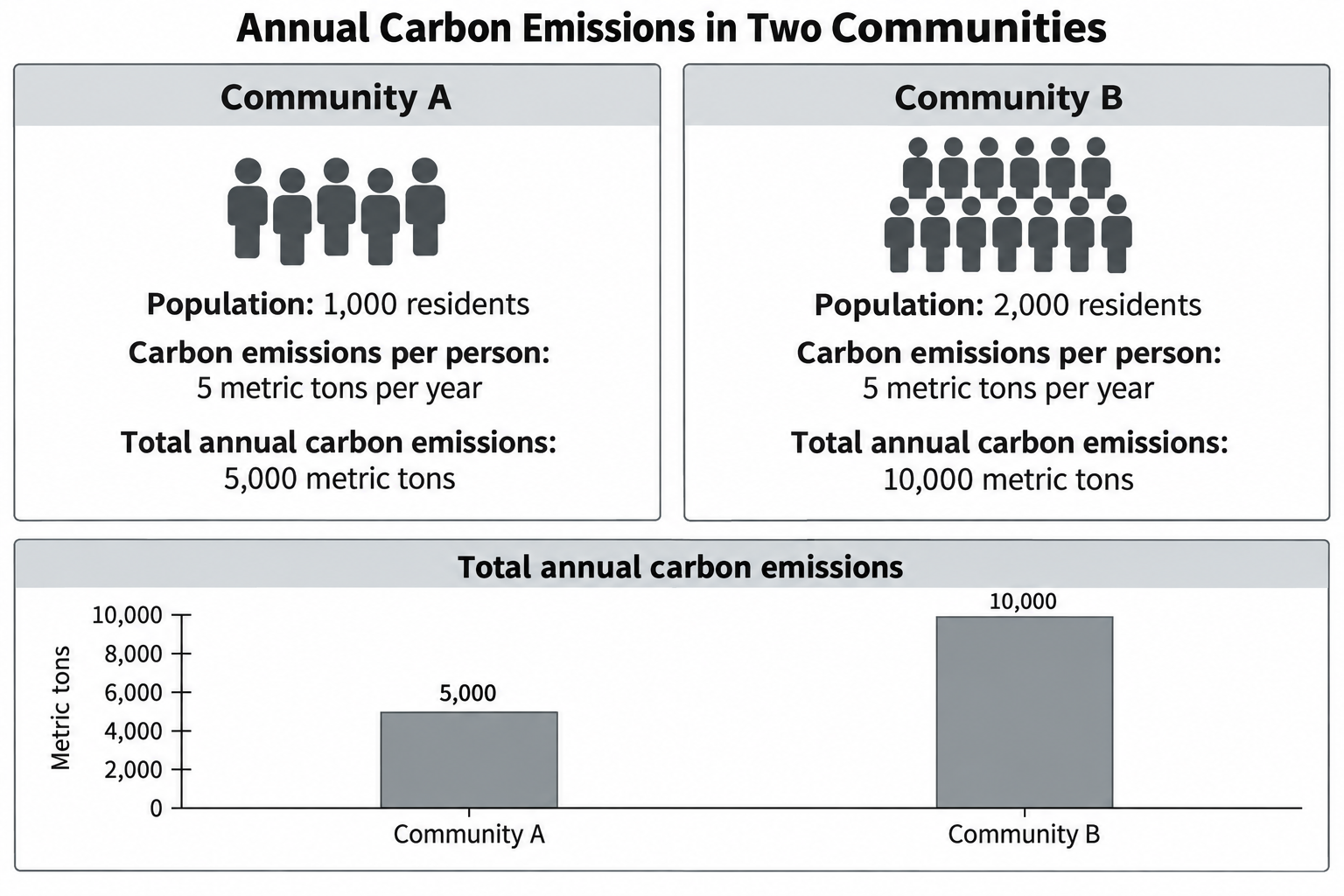
Diagram for question 9: Study the graph comparing two communities. Which statement best explains the difference in their total…
  1. A) Community B has greater total emissions because each resident produces twice the emissions of a resident in Community A.
  2. B) Community B has greater total emissions because it has more residents, even though emissions per person are the same.
  3. C) Community A has greater total emissions because a smaller population always consumes more per person.
  4. D) Both communities have equal total emissions because their emissions per person are equal.

Q10.

The diagram shows changes a neighborhood made during one year. Which change most directly explains the largest reduction shown in the neighborhood's carbon emissions?
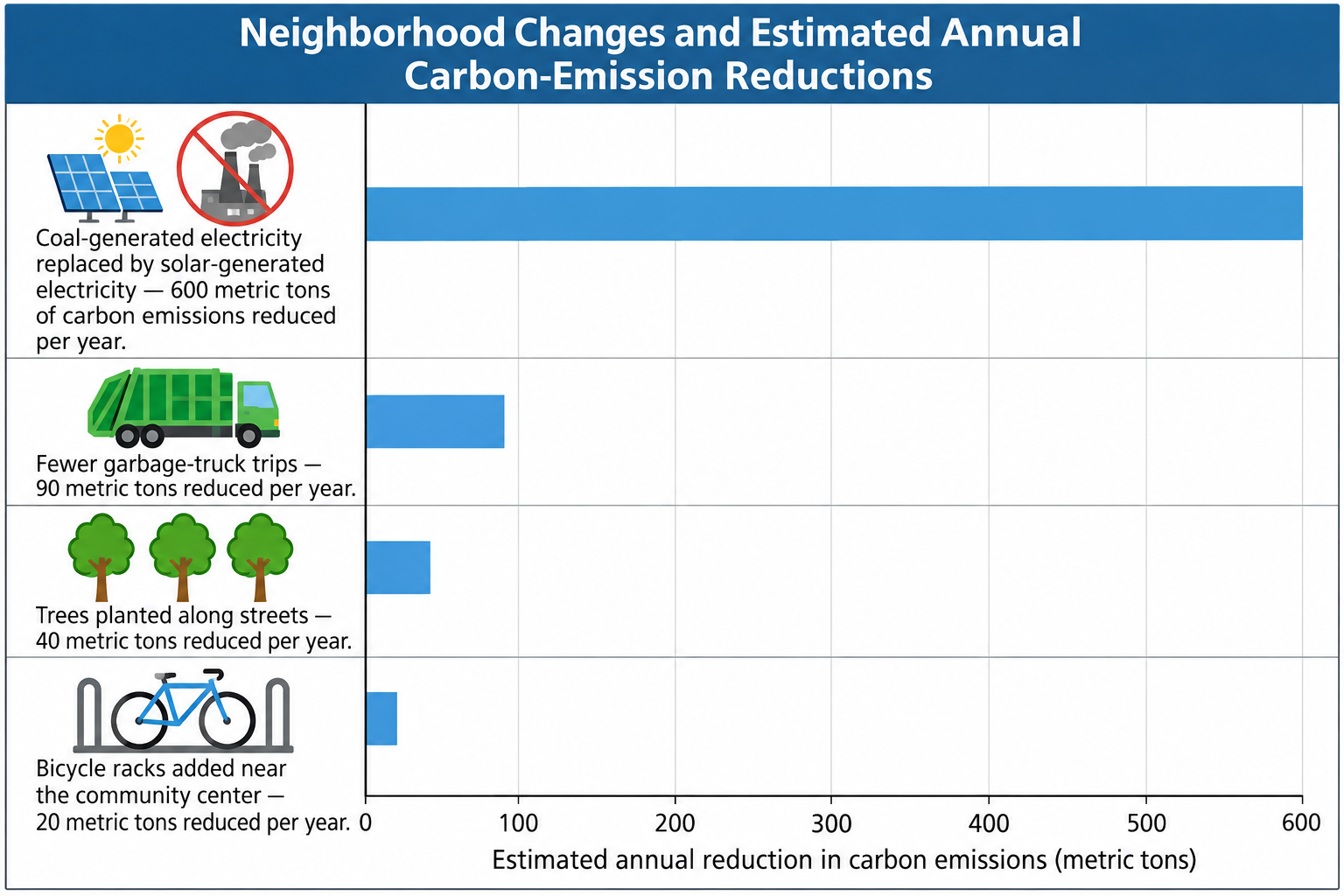
Diagram for question 10: The diagram shows changes a neighborhood made during one year. Which change most directly explains the…
  1. A) Replacing coal-generated electricity with solar-generated electricity
  2. B) Reducing the number of garbage-truck trips
  3. C) Adding bicycle racks near the community center
  4. D) Planting trees along neighborhood streets

What this assessment covers

Concepts Tested

  • Climate Change

Question Mix

  • Medium questions included

Skills you build

  • Understand