

CHEMISTRY - STOICHIOMETRY
Stoichiometry Practice Problems
- Covers stoichiometry calculations involving gas volumes at room temperature and pressure.
- Includes problems on percentage yield and purity in chemical reactions.
- Focuses on reactions involving common gases like hydrogen, oxygen, and carbon dioxide.
Start the 10-question quiz
Free, no sign-up needed. Your score shows instantly.
Here are the first 3 questions. Click “View all questions” to see the complete assessment.
Q1.
Q2.
A 25.0 g sample of limestone is heated strongly. The calcium carbonate in it decomposes according to CaCO₃ → CaO + CO₂. The reaction produces 3.36 dm³ of carbon dioxide at room temperature and pressure. What percentage by mass of the limestone is calcium carbonate? Use Mr(CaCO₃) = 100 and molar gas volume = 24 dm³/mol.
Q3.
At room temperature and pressure, 9.60 dm³ of nitrogen is mixed with 24.0 dm³ of hydrogen. They react according to N₂ + 3H₂ → 2NH₃. If the percentage yield of ammonia is 75.0%, what volume of ammonia is obtained at the same conditions? Use molar gas volume = 24 dm³/mol.
Q4.
A 12.0 dm³ mixture of methane and ethane requires exactly 27.0 dm³ of oxygen for complete combustion. All gas volumes are measured at room temperature and pressure. The equations are CH₄ + 2O₂ → CO₂ + 2H₂O and 2C₂H₆ + 7O₂ → 4CO₂ + 6H₂O. How many moles of methane were present? Use molar gas volume = 24 dm³/mol.
Q5.
A 50.0 cm³ portion of 2.40 mol/dm³ hydrochloric acid reacts completely with excess zinc according to Zn + 2HCl → ZnCl₂ + H₂. What volume of hydrogen is produced at room temperature and pressure? Use molar gas volume = 24 dm³/mol.
Q6.
Potassium chlorate decomposes when heated according to 2KClO₃ → 2KCl + 3O₂. A sample produces 3.60 dm³ of oxygen at room temperature and pressure, representing an 80.0% yield. What was the mass of potassium chlorate in the original sample? Use Ar: K = 39.0, Cl = 35.5, O = 16.0 and molar gas volume = 24 dm³/mol.
Q7.
An airbag contains 13.0 g of a mixture that is 90.0% sodium azide by mass. Sodium azide decomposes according to 2NaN₃ → 2Na + 3N₂. If 80.0% of the theoretical nitrogen is collected, what volume is obtained at room temperature and pressure? Use Mr(NaN₃) = 65.0 and molar gas volume = 24 dm³/mol.
Q8.
A 600 cm³ sample of a pure gas has a mass of 1.10 g at room temperature and pressure. Which gas could it be? Use molar gas volume = 24 dm³/mol and Ar: H = 1, C = 12, N = 14, O = 16, S = 32.
Q9.
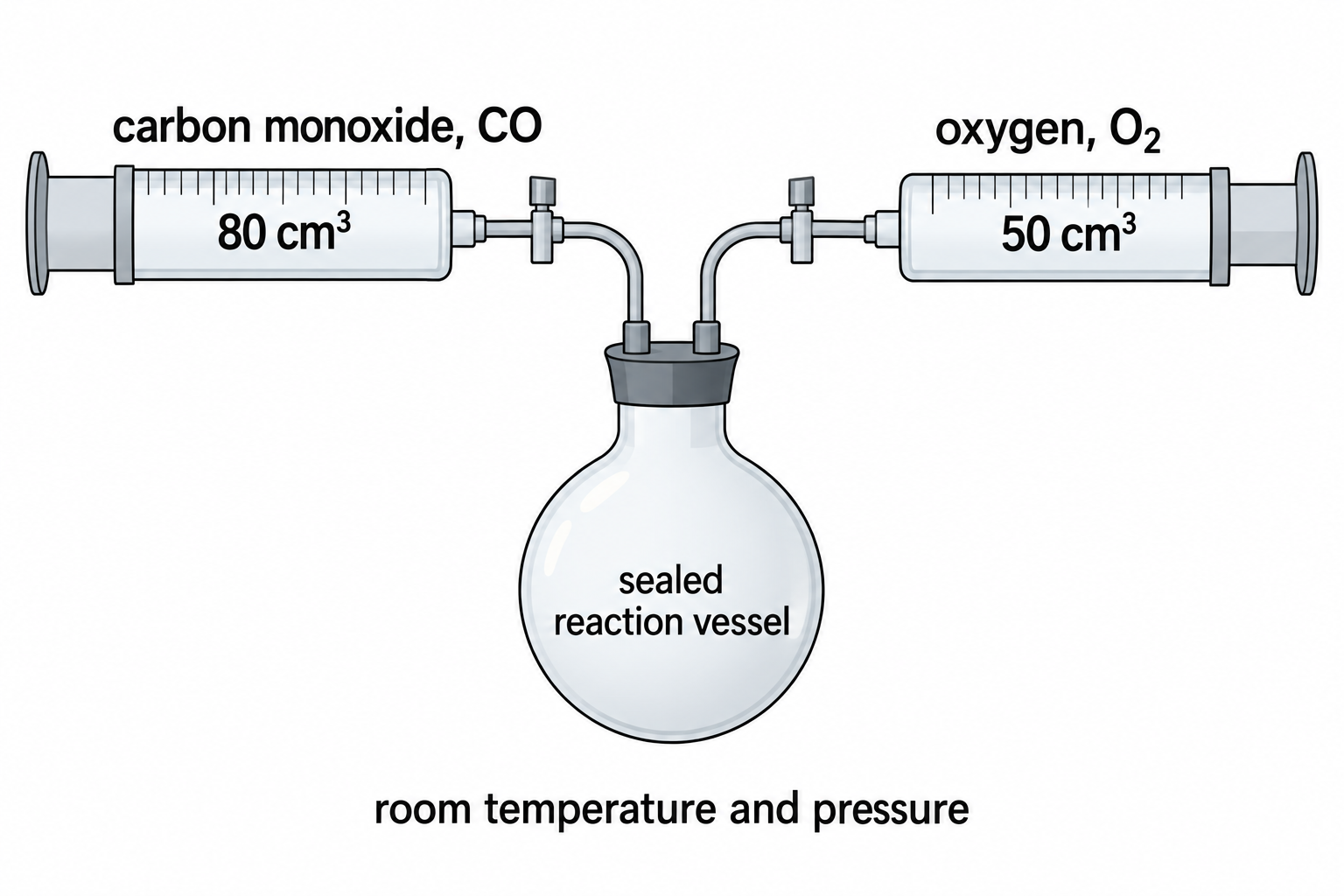
The figure shows the volumes of carbon monoxide and oxygen placed in a closed vessel at room temperature and pressure. The gases react completely according to 2CO + O₂ → 2CO₂ and then return to the same conditions. What is the total amount of gas remaining in the vessel? Use molar gas volume = 24 dm³/mol.
Q10.
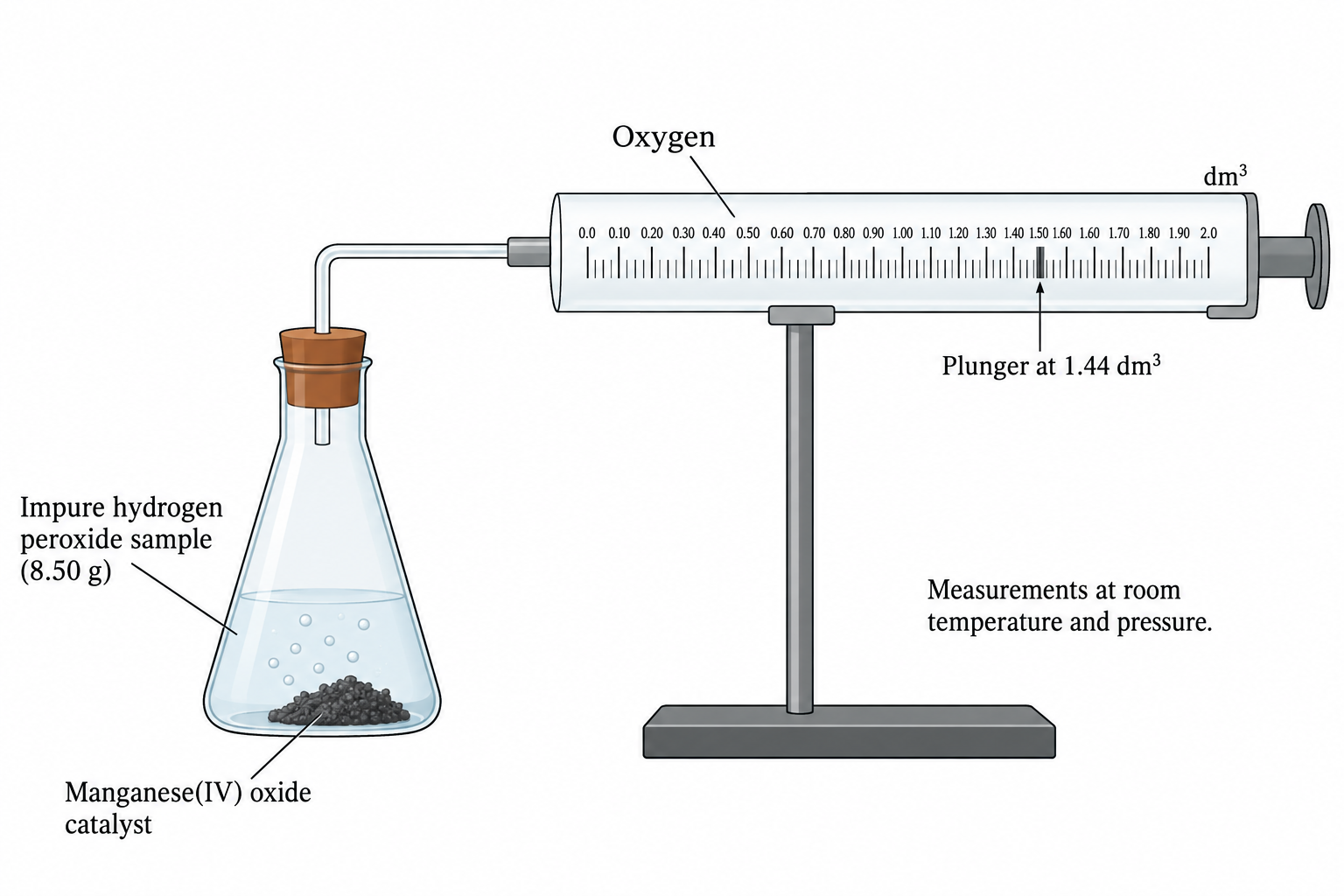
The apparatus in the figure is used to decompose the hydrogen peroxide in an impure sample according to 2H₂O₂ → 2H₂O + O₂. Assuming the reaction is complete, what is the percentage by mass of hydrogen peroxide in the sample? Use Mr(H₂O₂) = 34.0 and molar gas volume = 24 dm³/mol.
What this assessment covers
Concepts tested
- Stoichiometry and chemical equations
- Gas laws and molar volume calculations
- Percentage yield in chemical reactions
- Purity and composition of chemical samples
- Identification of gases based on mass and volume
Question Mix
- Hard questions included
Skills you build
- Calculate gas volumes from chemical reactions
- Determine percentage yield and purity of substances
- Apply stoichiometric principles to real-world problems
- Identify unknown gases using molar mass calculations
- Interpret chemical equations to solve quantitative problems
Related assessments
More practice
Other assessments in this subject
