

CHEMISTRY - HESS'S LAW
Hess Law Practice Problems
- 10 questions
- Difficulty: Hard
- Board: CAIE
- Attempt online on the examination portal
Start the 10-question quiz
Free, no sign-up needed. Your score shows instantly.
Here are the first 3 questions. Click “View all questions” to see the complete assessment.
Q1.
Q2.
The following enthalpy changes refer to the equations as written: Fe₂O₃(s) + CO(g) → 2FeO(s) + CO₂(g), ΔH = −18 kJ; FeO(s) + CO(g) → Fe(s) + CO₂(g), ΔH = −11 kJ; CO(g) + ½O₂(g) → CO₂(g), ΔH = −283 kJ. What is the enthalpy change for 2Fe(s) + ³⁄₂O₂(g) → Fe₂O₃(s)?
Q3.
When 0.120 mol of MgO(s) reacts completely with excess dilute hydrochloric acid, 18.12 kJ of heat is released. For Mg(s) + 2HCl(aq) → MgCl₂(aq) + H₂(g), ΔH = −462 kJ mol⁻¹. For H₂(g) + ½O₂(g) → H₂O(l), ΔH = −286 kJ mol⁻¹. Assume all data refer to matching conditions and that dilution effects are negligible. What is the enthalpy change for Mg(s) + ½O₂(g) → MgO(s)?
Q4.
Dissolving 1.60 g of anhydrous CuSO₄(s) in water releases 0.664 kJ. Dissolving 5.00 g of CuSO₄·5H₂O(s) in water absorbs 0.234 kJ. The molar masses are 160 g mol⁻¹ and 250 g mol⁻¹, respectively. The experiments are corrected to the same temperature and a common dilute aqueous final state; further dilution has negligible enthalpy change. What is ΔH for CuSO₄(s) + 5H₂O(l) → CuSO₄·5H₂O(s)?
Q5.
A mixture containing 0.100 mol of CH₃OH(l) and 0.0500 mol of C₂H₅OH(l) undergoes complete combustion, releasing 140.95 kJ. The standard enthalpy of combustion of CH₃OH(l) is −726 kJ mol⁻¹. The standard enthalpies of formation of CO₂(g) and H₂O(l) are −394 kJ mol⁻¹ and −286 kJ mol⁻¹, respectively. All combustion products are in these states. What standard enthalpy of formation of C₂H₅OH(l) follows from these data?
Q6.
The standard enthalpies of combustion of cyclohexene, C₆H₁₀(l), cyclohexane, C₆H₁₂(l), and H₂(g) are −3752, −3924, and −286 kJ mol⁻¹, respectively. All produce liquid water. The enthalpy of hydrogenation of benzene to cyclohexane is −208 kJ mol⁻¹. A hypothetical C₆H₆(l) molecule with three independent, localised carbon–carbon double bonds is assumed to have a hydrogenation enthalpy equal to three times that of cyclohexene. What is the enthalpy change for converting one mole of this hypothetical molecule into benzene?
Q7.
For this calculation, use the following data: C(s, graphite) → C(g), ΔH = +717 kJ mol⁻¹; H₂(g) → 2H(g), ΔH = +436 kJ mol⁻¹; and 2C(s, graphite) + H₂(g) → C₂H₂(g), ΔH = +227 kJ mol⁻¹. The C–H bond enthalpy in C₂H₂ is taken as 413 kJ mol⁻¹. What C≡C bond enthalpy is consistent with this Hess cycle?
Q8.
The following molar enthalpy changes apply at the same temperature: NH₄Cl(s) → NH₄Cl(aq), +15 kJ mol⁻¹; NH₃(g) → NH₃(aq), −34 kJ mol⁻¹; HCl(g) → HCl(aq), −75 kJ mol⁻¹; NH₃(aq) + HCl(aq) → NH₄Cl(aq), −52 kJ mol⁻¹. All aqueous states are compatible, and dilution effects are negligible. What is ΔH for NH₄Cl(s) → NH₃(g) + HCl(g)?
Q9.
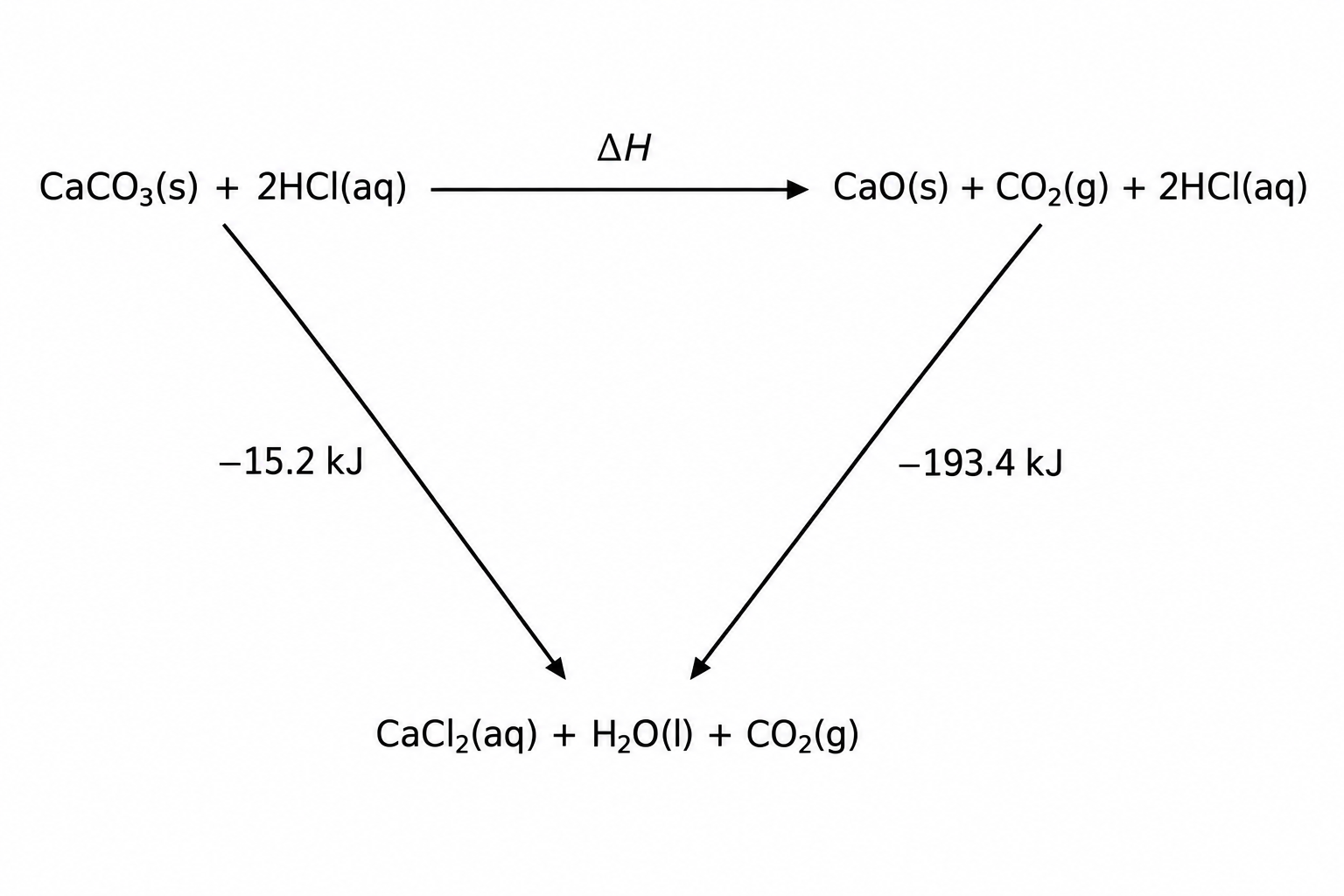
The diagram shows enthalpy changes for two reactions with excess dilute hydrochloric acid. Values refer to the amounts shown, under matching conditions. Using the cycle, what enthalpy change is required to decompose 25.0 g of CaCO₃(s) completely into CaO(s) and CO₂(g)? Use a molar mass of 100 g mol⁻¹ for CaCO₃.
Q10.
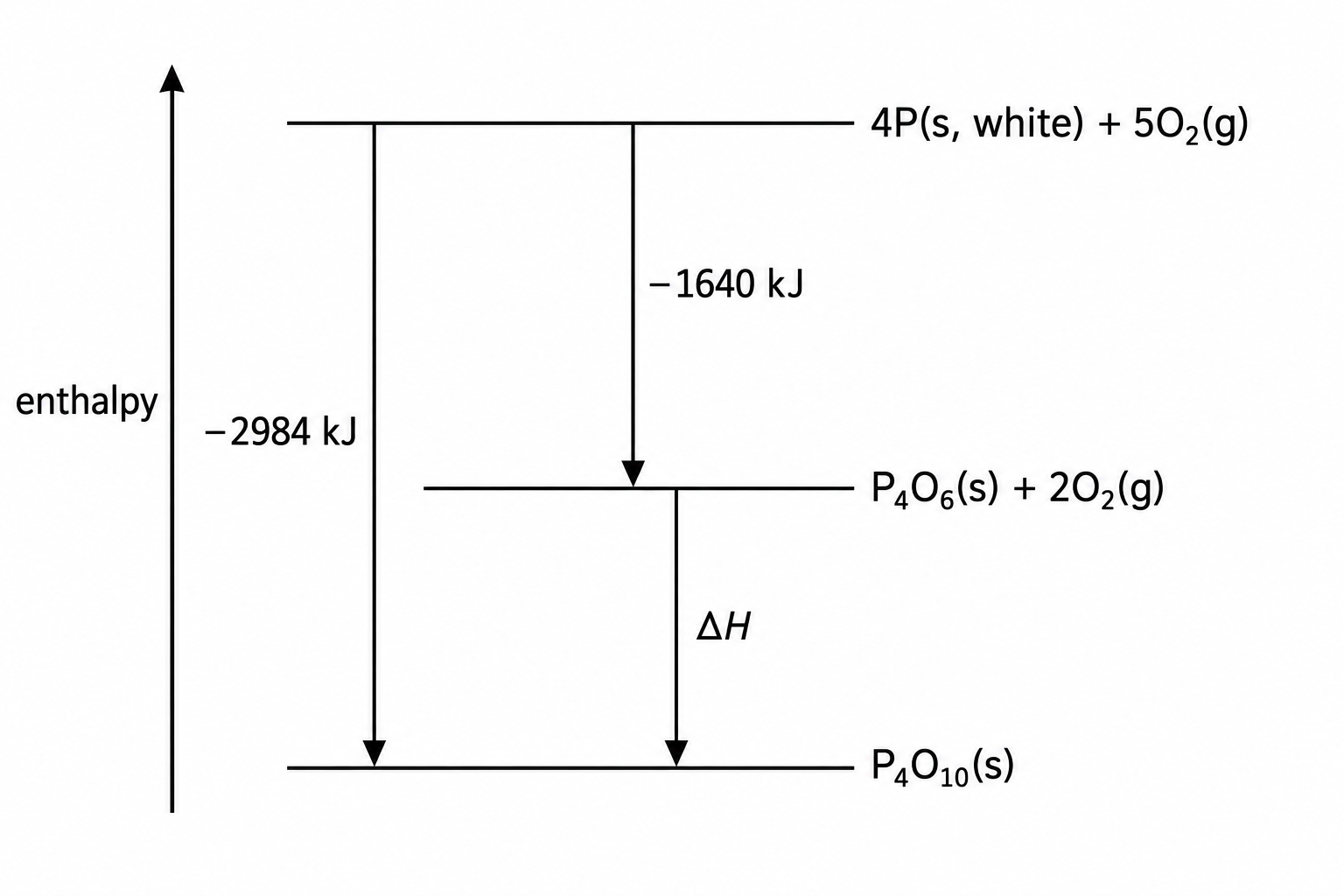
The energy-level diagram gives enthalpy changes for the amounts shown. A mixture of 0.100 mol of P₄O₆(s) and 0.120 mol of O₂(g) reacts to form P₄O₁₀(s), with no other reaction occurring. Using the diagram, what is the enthalpy change when the limiting reactant is completely consumed?
What this assessment covers
Concepts Tested
- Hess's Law
Question Mix
- Hard questions included
Skills you build
- Apply
Related assessments
More practice
Other assessments in this subject
