

CHEMISTRY - NET IONIC EQUATIONS
Net Ionic Equations Worksheet Answers
- 10 questions
- Difficulty: Hard
- Board: CAIE
- Attempt online on the examination portal
Start the 10-question quiz
Free, no sign-up needed. Your score shows instantly.
Here are the first 3 questions. Click “View all questions” to see the complete assessment.
Q1.
Q2.
Equal amounts, in moles, of aqueous ethanoic acid and aqueous ammonia are mixed. Both reactants are weak electrolytes, and proton transfer strongly favours the products. Which net ionic equation correctly represents their reaction without treating either weak electrolyte as completely ionised?
Q3.
Equal volumes of 0.0500 mol dm⁻³ barium hydroxide solution and 0.0500 mol dm⁻³ copper(II) sulfate solution are mixed. Barium sulfate and copper(II) hydroxide both precipitate essentially completely. Which net ionic equation accounts for all the reacting species?
Q4.
Chlorine is passed into cold, dilute aqueous sodium hydroxide. One chlorine atom in each chlorine molecule is reduced to oxidation state −1, while the other is oxidised to oxidation state +1. Which net ionic equation represents the reaction under these conditions?
Q5.
Potassium dichromate(VI) solution acidified with dilute sulfuric acid is added to excess potassium iodide solution. Dichromate(VI) ions form chromium(III) ions, and iodide ions form iodine. Which net ionic equation gives the smallest whole-number coefficients?
Q6.
Aqueous bromine reacts with aqueous sodium sulfite. Sulfite ions are oxidised to sulfate ions, and bromine is reduced to bromide ions. No alkali is added. Which net ionic equation correctly shows the reaction and its effect on acidity?
Q7.
Aluminium metal reacts with excess aqueous sodium hydroxide to produce hydrogen gas and tetrahydroxoaluminate ions, [Al(OH)₄]⁻. Which balanced net ionic equation represents the reaction?
Q8.
Excess aqueous ammonia is added to aqueous copper(II) sulfate. After any initial precipitate has dissolved, the copper-containing species has changed from [Cu(H₂O)₆]²⁺ to [Cu(NH₃)₄(H₂O)₂]²⁺. Which net ionic equation represents the overall ligand substitution between these initial and final complex ions?
Q9.
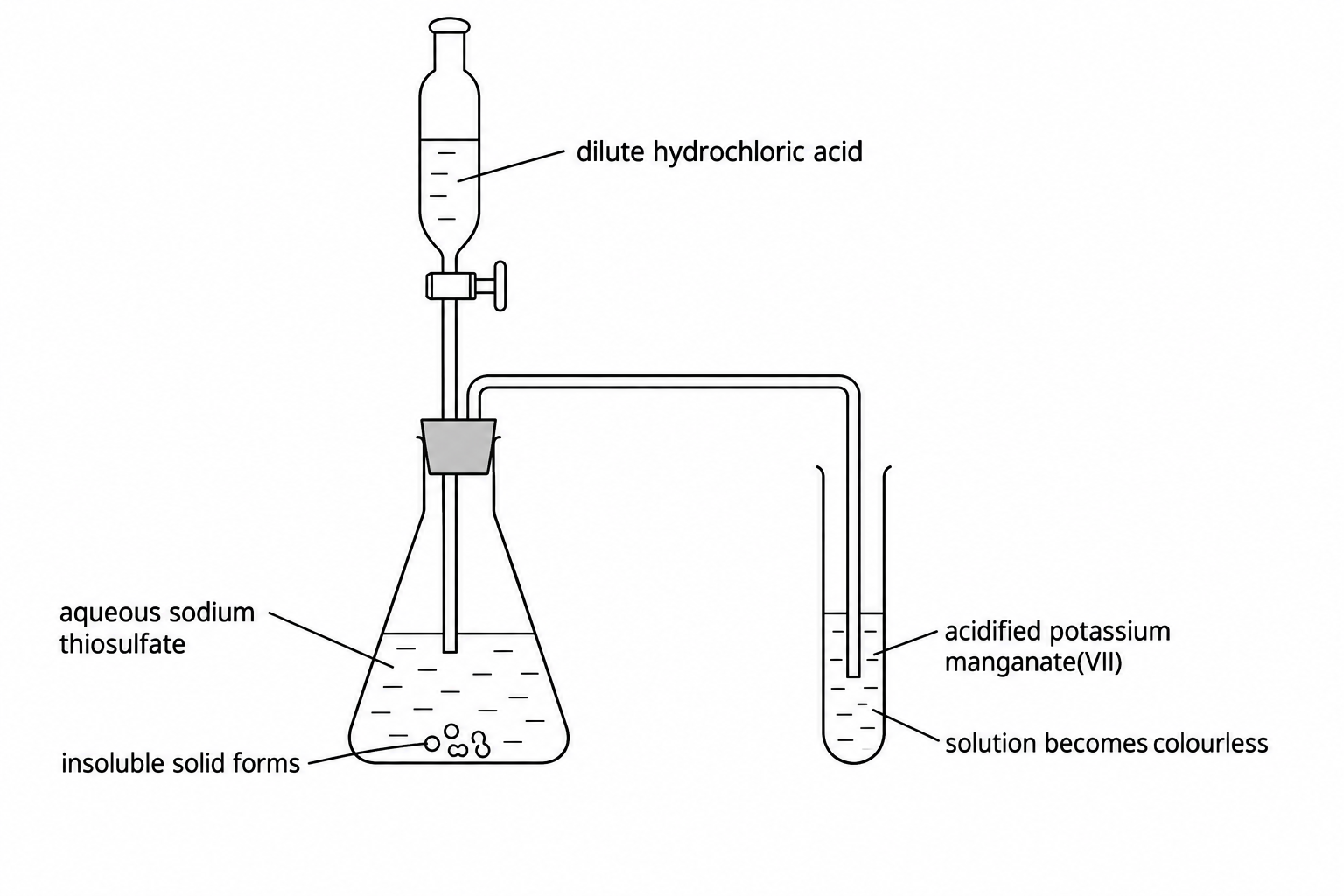
The apparatus shows dilute hydrochloric acid being added to aqueous sodium thiosulfate. An insoluble solid forms in the flask, and the gas produced decolourises acidified potassium manganate(VII). Which net ionic equation accounts for both observations?
Q10.
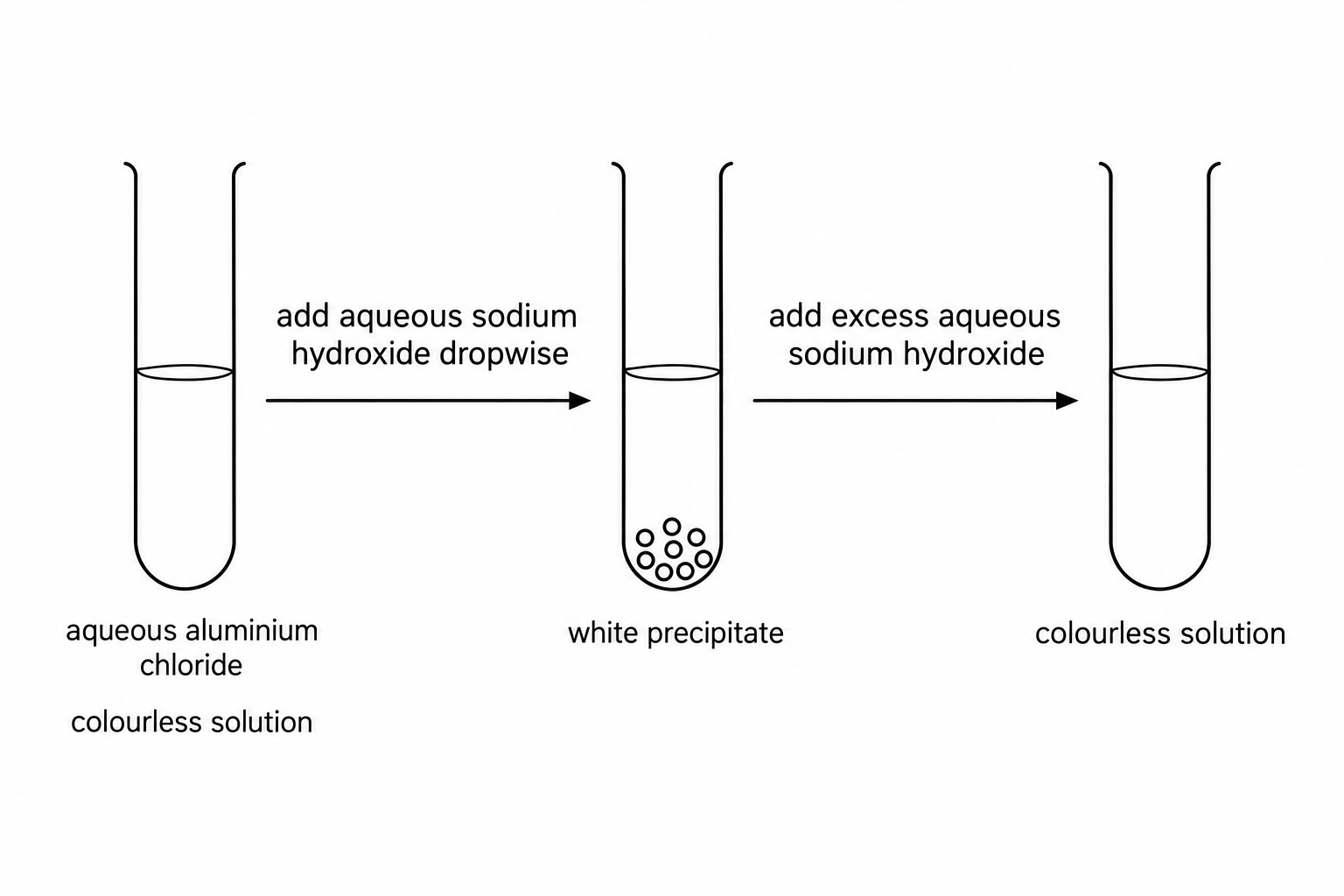
The diagram shows successive additions of aqueous sodium hydroxide to aqueous aluminium chloride. In the final solution, aluminium is present as [Al(OH)₄]⁻. Which net ionic equation represents only the change from the middle stage to the final stage?
What this assessment covers
Concepts Tested
- Net Ionic Equations
Question Mix
- Hard questions included
Skills you build
- Apply
Related assessments
More practice
Other assessments in this subject
