

CHEMISTRY - ACIDS AND BASES
Acids and Bases Worksheet
- 10 questions
- Difficulty: Hard
- Board: CAIE
- Attempt online on the examination portal
Start the 10-question quiz
Free, no sign-up needed. Your score shows instantly.
Here are the first 3 questions. Click “View all questions” to see the complete assessment.
Q1.
Q2.
Four separate portions of hydrochloric acid each contain 0.10 mol of HCl. Each portion reacts completely with exactly 0.050 mol of one of the substances listed. Which substance produces the greatest amount of water in its reaction with the acid? Consider only water formed by the reaction, not water already present in the solution.
Q3.
A 10.6 g mixture contains only calcium carbonate and calcium oxide. It reacts completely with hydrochloric acid, releasing 0.050 mol of carbon dioxide. What is the minimum amount of HCl needed to react with the entire mixture? Use relative formula masses: CaCO₃ = 100 and CaO = 56.
Q4.
A student must prepare pure hydrated copper(II) sulfate crystals from dilute sulfuric acid. The reaction must not release any gas, and the solution used for crystallisation must contain no excess acid. Which procedure meets all these requirements?
Q5.
A conservator wants to remove an oxide coating from an object using dilute hydrochloric acid. The acid must dissolve the coating without reacting with the material underneath, even if a little excess acid is used. No gas should be produced. Which object is suitable for this treatment?
Q6.
A student mixes 50.0 cm³ of 1.00 mol dm⁻³ hydrochloric acid with 20.0 cm³ of 1.00 mol dm⁻³ sodium hydroxide. After neutralisation is complete, excess magnesium is added. What volume of hydrogen is produced at room temperature and pressure? The molar gas volume is 24 000 cm³ mol⁻¹.
Q7.
A metal carbonate has the formula M₂CO₃. A 13.8 g sample reacts completely with excess dilute hydrochloric acid and produces 2.40 dm³ of carbon dioxide at room temperature and pressure. Which metal is M? The molar gas volume is 24.0 dm³ mol⁻¹. Use relative atomic masses: Li = 7, Na = 23, K = 39, Rb = 85, C = 12 and O = 16.
Q8.
Separate portions of dilute sulfuric acid react completely with iron(III) oxide and sodium carbonate. In each experiment, a normal sulfate salt is formed and no acid remains. Which pair of equations correctly represents both reactions?
Q9.
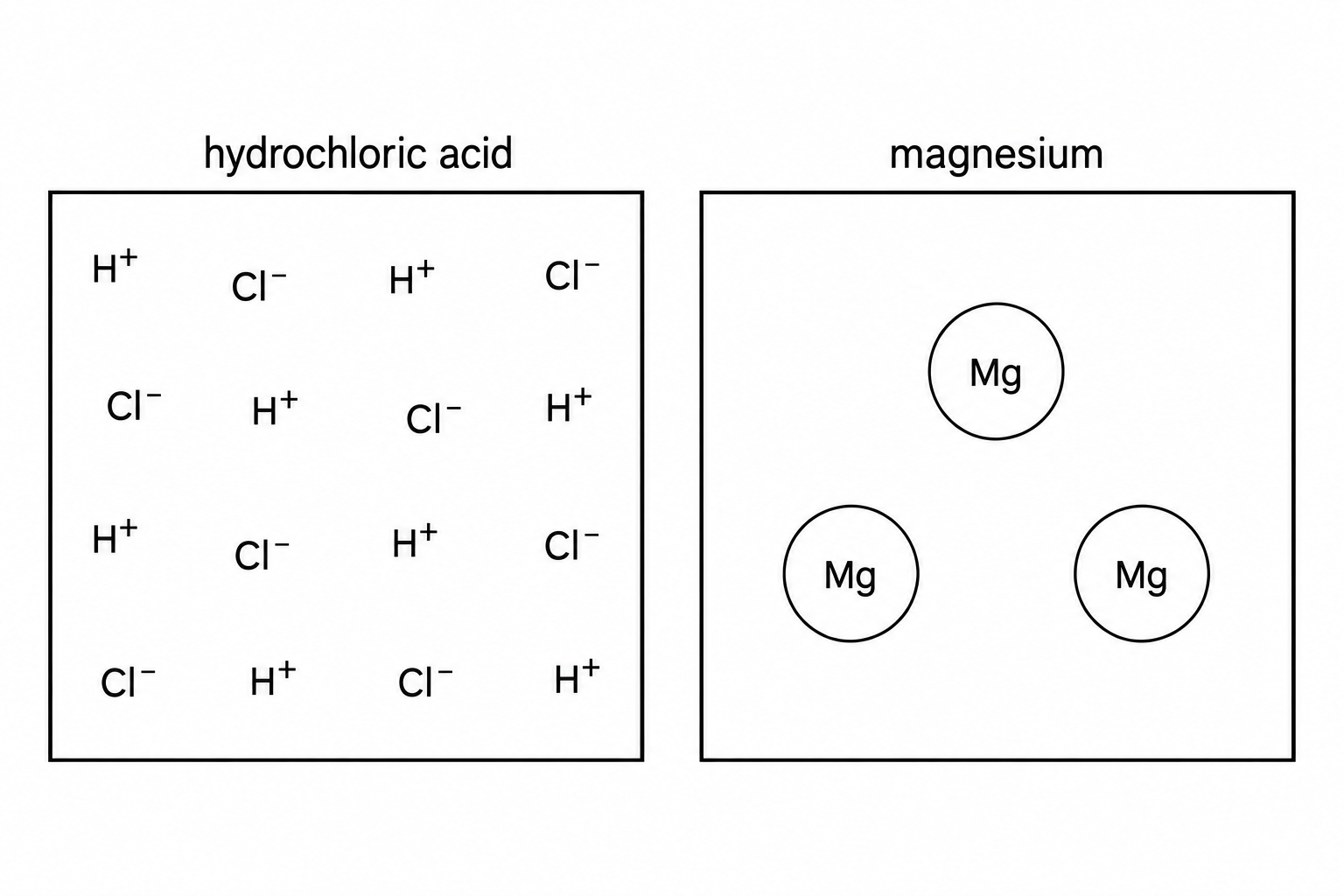
The diagram represents all the reacting particles in a very small sample of hydrochloric acid and a separate sample of magnesium before mixing. Water molecules are not shown. The samples are mixed and the reaction finishes. Which inventory correctly describes the particles then present, including the gas produced?
Q10.
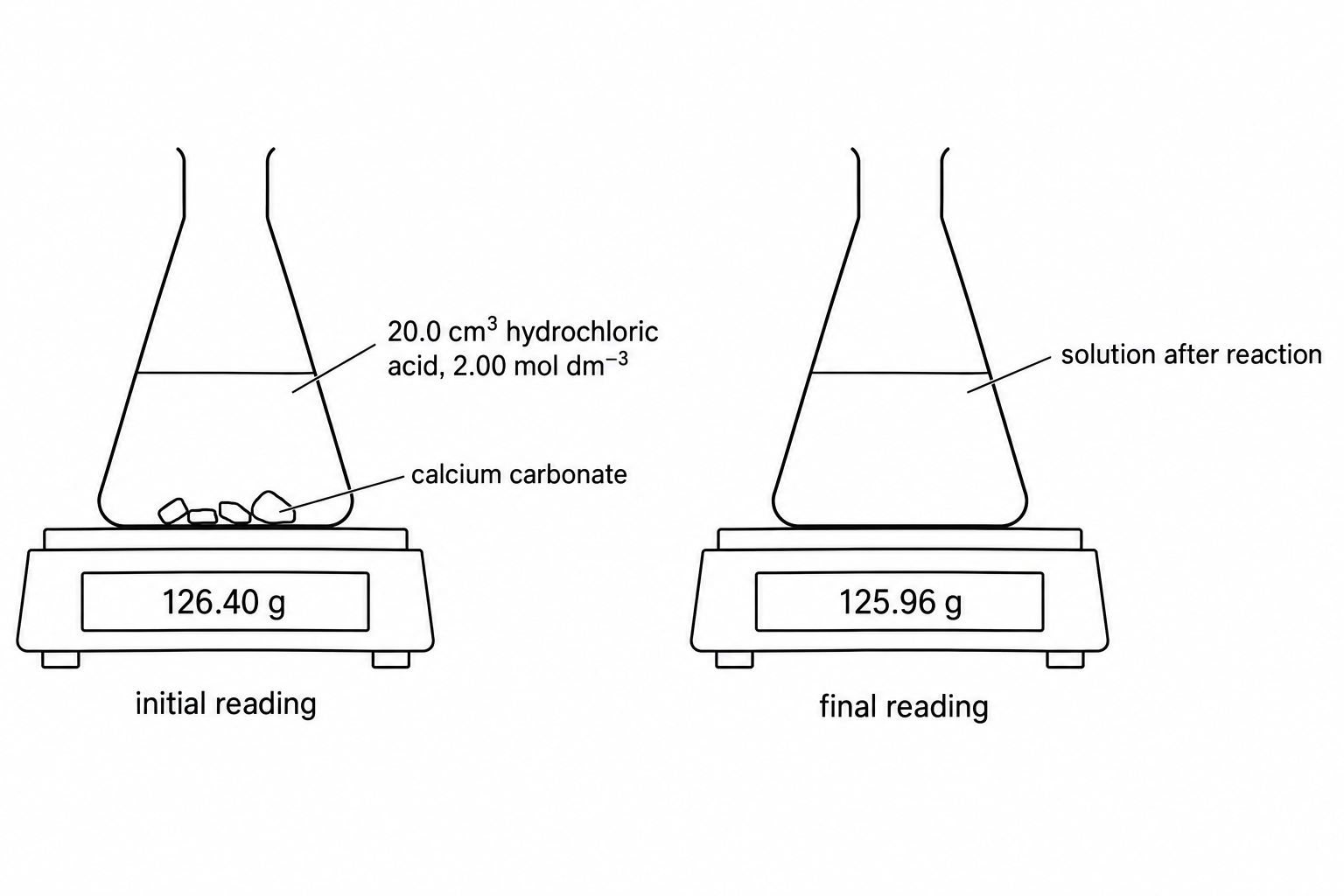
The diagram shows an experiment in which calcium carbonate reacts with hydrochloric acid in an open flask. Initially, the flask contains 20.0 cm³ of 2.00 mol dm⁻³ hydrochloric acid. The calcium carbonate is added, and the first balance reading is taken before a measurable amount of gas escapes. At the final reading, all the calcium carbonate has reacted. Only carbon dioxide escapes; evaporation and splashing are negligible. What volume of 1.00 mol dm⁻³ sodium hydroxide is needed to neutralise the acid remaining in the flask? Use relative atomic masses: C = 12 and O = 16.
What this assessment covers
Concepts Tested
- Acids and Bases
Question Mix
- Hard questions included
Skills you build
- Apply
Related assessments
More practice
Other assessments in this subject
