

CHEMISTRY - SOLUTION CONCENTRATION
Molarity Practice Problems
- Covers calculations involving dilution and concentration of solutions.
- Includes problems on titration and reaction stoichiometry.
- Focuses on real-world applications of molarity in chemical reactions.
- Designed for advanced high school chemistry students.
Start the 10-question quiz
Free, no sign-up needed. Your score shows instantly.
Here are the first 3 questions. Click “View all questions” to see the complete assessment.
Q1.
Q2.
A 25.0 cm³ sample of 0.120 mol dm⁻³ sodium carbonate reacts completely with 30.0 cm³ of hydrochloric acid. The equation is Na₂CO₃ + 2HCl → 2NaCl + H₂O + CO₂. What is the molarity of the hydrochloric acid?
Q3.
An aqueous sulfuric acid solution is 24.5% H₂SO₄ by mass and has a density of 1.18 g cm⁻³. The relative formula mass of H₂SO₄ is 98.0. What is the molarity of this solution?
Q4.
A student mixes 150 cm³ of 0.400 mol dm⁻³ potassium nitrate with 250 cm³ of 0.160 mol dm⁻³ potassium nitrate. Assume that the volumes are additive. What is the molarity of potassium nitrate in the mixture?
Q5.
A 500 cm³ sample of 0.300 mol dm⁻³ copper(II) sulfate is heated so that only water evaporates. Heating stops when the solution has a molarity of 0.750 mol dm⁻³. What volume of water has evaporated?
Q6.
A student dilutes 10.0 cm³ of 1.50 mol dm⁻³ sodium chloride to 100 cm³. The student then takes 20.0 cm³ of this diluted solution and dilutes it to 250 cm³. What is the molarity of the final solution?
Q7.
A student dissolves 7.15 g of Na₂CO₃·10H₂O in water and makes the solution up to 250 cm³. The relative formula mass of Na₂CO₃·10H₂O is 286. What is the molarity of Na₂CO₃ in the solution?
Q8.
A student mixes 100 cm³ of 0.600 mol dm⁻³ calcium chloride with 150 cm³ of 0.500 mol dm⁻³ sodium carbonate. Calcium carbonate precipitates according to CaCl₂ + Na₂CO₃ → CaCO₃ + 2NaCl. Assume that the total solution volume remains 250 cm³. What is the molarity of the excess sodium carbonate after the reaction?
Q9.
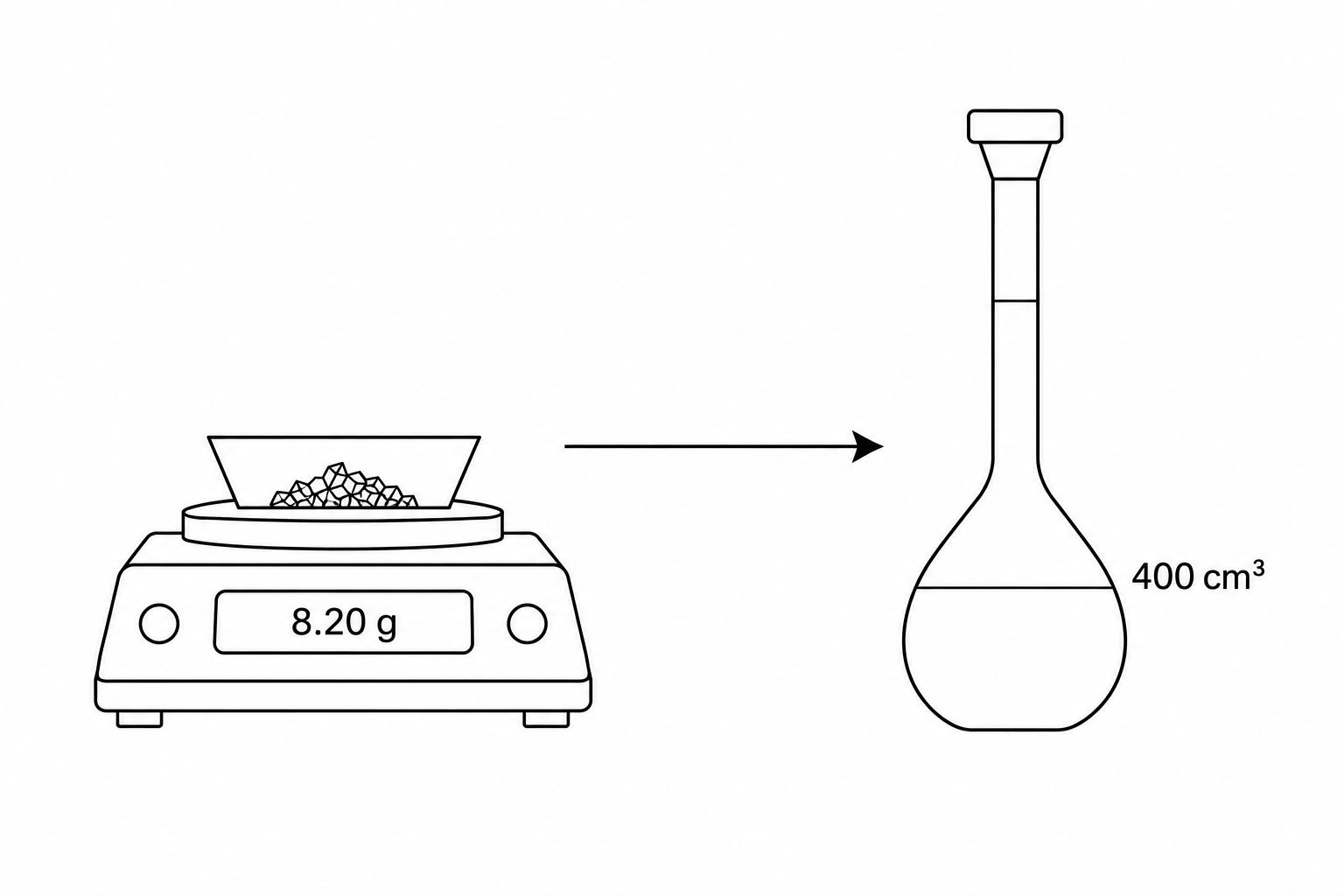
The figure shows measurements used to prepare a solution from an impure sample of potassium nitrate. The sample is 87.5% KNO₃ by mass, and the relative formula mass of KNO₃ is 101. What is the molarity of KNO₃ in the prepared solution?
Q10.
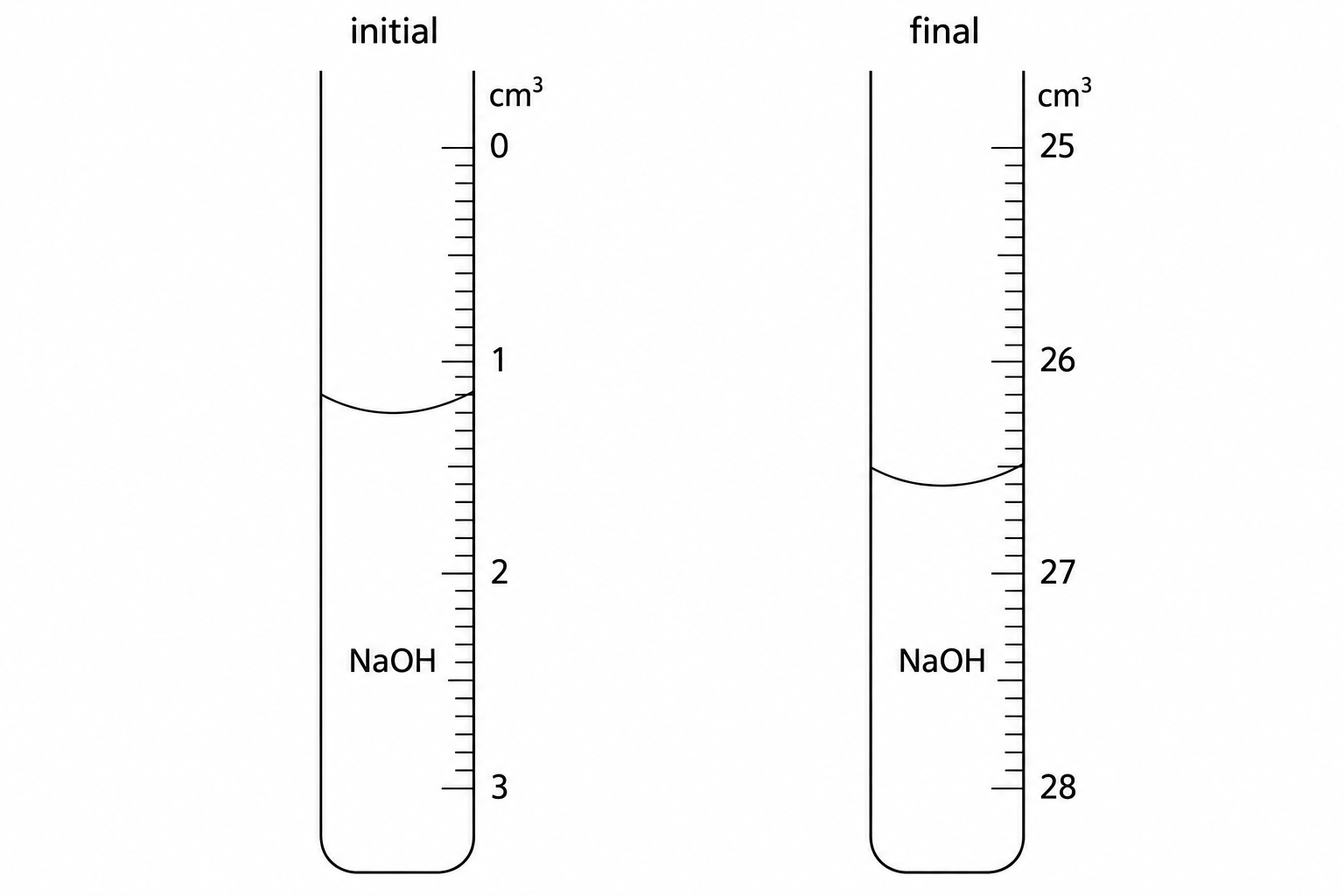
A 25.00 cm³ sample of sulfuric acid is titrated with 0.150 mol dm⁻³ sodium hydroxide. The figure shows the initial and final burette readings. The equation is H₂SO₄ + 2NaOH → Na₂SO₄ + 2H₂O. What is the molarity of the sulfuric acid?
What this assessment covers
Concepts tested
- Dilution of solutions and concentration changes
- Stoichiometry in chemical reactions
- Calculating molarity from mass and volume data
- Understanding solution density and its role in molarity
- Using titration data to determine solution concentration
Question Mix
- Hard questions included
Skills you build
- Calculate molarity in various chemical scenarios
- Apply stoichiometry to solve reaction problems
- Interpret data from chemical experiments
- Perform dilution calculations accurately
- Analyze and solve complex chemistry problems
Related assessments
More practice
Other assessments in this subject
